Diana Fitzgerald
Writer
Mar 20, 2026 ArticleAirflow around rockets as they travel from Earth into space can have a dramatic impact on a mission, which is why NASA used advanced simulations to provide the best possible launch conditions for the Artemis II test flight around the Moon.
To better understand the Artemis Space Launch System (SLS) rocket’s flight environment, engineers turned to a NASA-developed tool called the Launch, Ascent, and Vehicle Aerodynamics (LAVA) framework. The software addresses computational fluid dynamics, the flow behavior of gases and liquids.
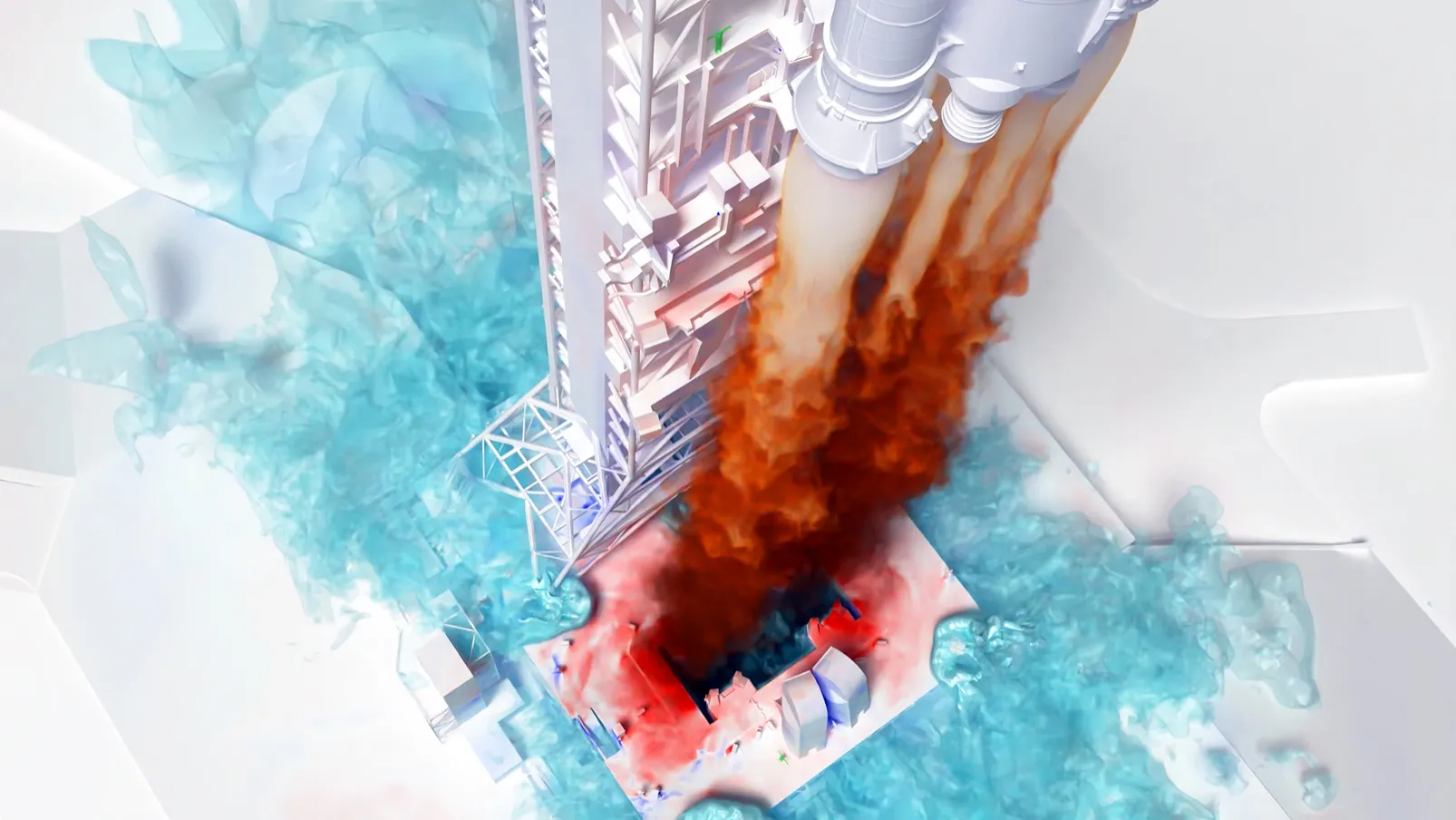
Using data from the 2022 Artemis I launch, researchers at NASA’s Ames Research Center in California’s Silicon Valley used LAVA to simulate complex interactions between the rocket plume and a system that pumps water to suppress sound during launch. The system protects the rocket and other equipment from potentially damaging sound waves.
Comparing simulations with and without the sound suppression system activated revealed that the water effectively reduces pressure waves from sound, but exhaust gases from the rocket could also redirect water, causing significant pressure increases in certain areas of the launchpad.
The LAVA simulations improved NASA’s understanding of the plume interaction with the Artemis mobile launcher platform. Using this knowledge, aerospace engineers at NASA’s Kennedy Space Center in Florida refined the design plume pressures and adapted the launch platform to endure those pressures for Artemis II, NASA’s first mission with crew aboard the SLS and Orion spacecraft.
NASA will release LAVA in the coming weeks to the aerospace community and accelerate innovation by enabling U.S. companies and researchers to run complex simulations and optimize designs for aircraft and rockets. NASA has hosted a seminar on using LAVA with more about the tool’s capabilities.
The work on LAVA is supported through NASA’s 4 min read As four astronauts travel around the Moon on NASA’s Artemis II mission, they will venture beyond Earth’s…NASA’s X-59 Prepares for Second Flight
Article 3 days ago 7 min read To Protect Artemis II Astronauts, NASA Experts Keep Eyes on Sun
NASA Selects Finalists in Student Aircraft Maintenance Competition
Article 7 days ago Keep Exploring
Discover More Topics From NASA
Missions
Artemis
Aeronautics STEM
Explore NASA’s History