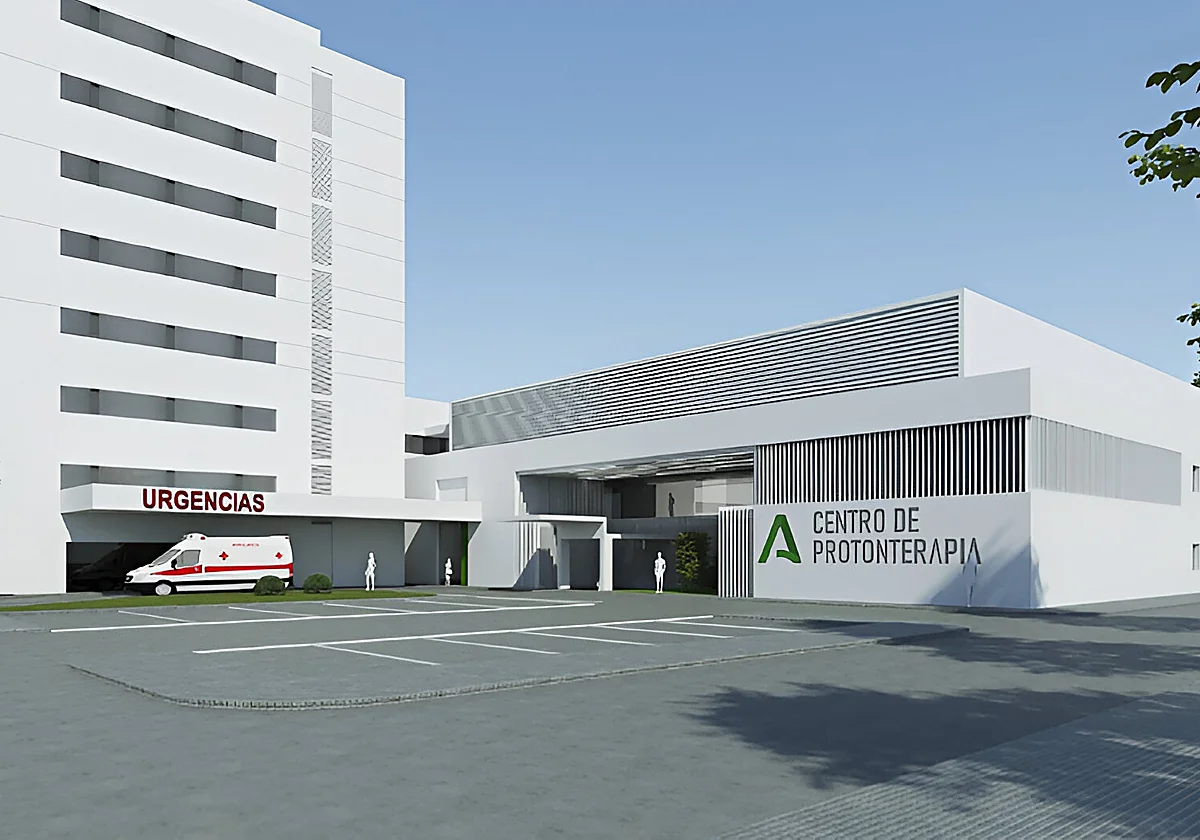
Zoom
Design of the new proton therapy centre. SUR Health New proton therapy centre at Hospital Materno in Malaga put out to tender by Junta for 12.5 million eurosIt will take around two years to build the 'bunker' that will house the equipment for cancer treatment, donated by the Amancio Ortega foundation
Thursday, 18 December 2025, 19:17
The Junta de Andalucía regional government has put out to tender the refurbishment and extension of Hospital Materno in Malaga for the construction of the proton therapy centre - one of the most advanced radiotherapies available today for treating cancer. The tender was announced on Wednesday.
This large-scale work will take around 24 months, with a budget of more than 12.5 million euros, IVA Spanish sales tax included. European funds will provide 85% of this investment. Interested construction companies can submit their bids until 16 January.
The proton equipment is the IBA Proteus One model, of the IBA Proton Therapy brand, for which a bunker has to be built. The device has been donated by the Amancio Ortega foundation, set up by the billionaire head of the Inditex fashion company. It will be primarily used to treat cancer in children and adolescents.
Another proton therapy device will go to Hospital Militar in Seville. The implementation of the project, as SUR reported in November 2021, will involve an investment of more than 60 million euros in the Andalucía region, of which 52 million euros will be injected by the textile industry magnate and another ten million euros by the Junta.
The proton therapy equipment is part of a 280-million-euro donation from the Amancio Ortega foundation to Spain's national Ministry of Health for the purchase of ten devices, two for Andalucía and the rest for the Basque Country, Barcelona (two), A Coruña, Valencia, Madrid (two) and Gran Canaria.
The new Andalusian proton therapy centre will open its doors to patients from Extremadura, Castilla La Mancha, Ceuta and Melilla
Andalucía will also facilitate access for patients from other regions (southern Extremadura, Castilla-La Mancha and the region-cities of Ceuta and Melilla) to proton treatment at the new centre. It will also attend to patients from other EU countries, boosting oncology treatment.
Technique
Proton therapy allows "a more localised release of the applied radiation, which results in a better distribution of the dose and less radiation to the surrounding healthy tissue". This reduces late adverse effects on the organs and tissues surrounding the tumour, as well as the risk of subsequent development of other tumours, which is particularly relevant for children, as they have a longer life expectancy.
The proton therapy centre will be located on a plot of land outside Materno Infantil, next to the paediatric emergency room - specifically, at the northeastern end of the adjoining lot and also on top of the building on the basement level (floor -1) that is used for tomotherapy.
The building includes a large, three-storey bunker, "located at the level of floor -2, reaching the level of the ground floor and next to the new tomotherapy building". In addition to the bunker, other adjacent spaces such as waiting rooms, auxiliary service areas, offices, etc. will be fitted out, all of them located on floors -2, -1 and ground floor, but also extending over the tomotherapy building on floor -1, occupying the ground and first floors of this building. The centre will complement the oncology unit.
The equipment will be installed prior to the completion of the work, with a crane and through a removable sandwich panel roof, which will be removed and placed daily
"The purpose of the work is to allow the installation of a proton therapy equipment, a system of great complexity both for its dimensions and for the technical requirements, associated installations and auxiliary elements necessary for its operation. Due to these special characteristics, the installation of the equipment must be closely coordinated with the execution of the building itself, resulting in an overlap between the two activities," the tender specifies.
Placing the equipment in the bunker
The equipment and its auxiliary components must be brought into the building by a crane, through the roof. "These openings will be structurally closed once the installation of all the equipment has been completed. The project has considered the installation of a removable sandwich panel roof, which will be removed and replaced daily during the installation of the equipment," the project specifications state. Some phases of the work cannot be closed until the installation of the equipment is completed.
For this reason, there will be a first phase, which includes the extension of the building, and a second phase at the end of the installation that will close the spaces that are left pending from the first stage. Only then will the work on the roof be completed and the installations definitively integrated.
The treatment bunker is on two levels, with a height of 12 metres above ground level and three metres below ground level in the central area. It has a very specific shape and requires thick concrete shielding. "The bunker will be located parallel to the tomotherapy building, but separated from it, which allows it to be built with limited infill over almost its entire surface area."
On level -2 will be the low-voltage panels, water systems and the transformer room; level -1 will house the part of the unit that must be located next to the treatment room; at ground level will be the outpatient section of the unit, which extends over the CT scanner building; and on the first floor will be the staff area, also extending over the CT scanner building to accommodate the roof and the clinical connection with the hospital.
The layout is organised around a circulation corridor running parallel and adjacent to the bunker, repeated across all four floors.