The NFL season is finally back in full swing, and the first run of PFF data from the Week 1 early window is now populated in Premium Stats and Premium Stats Pro.
One important note before diving in: Everything below is based on PFF's initial grading. Every single play will undergo a thorough review before grades are finalized by noon Monday, and as longtime PFF readers will already know, some of these grades and statistics could change after that process.
For now, though, this is what the first pass of the data tells us, and all of it is available with a PFF+ subscription.
1. Deshaun Watson's return couldn't have gone much worse
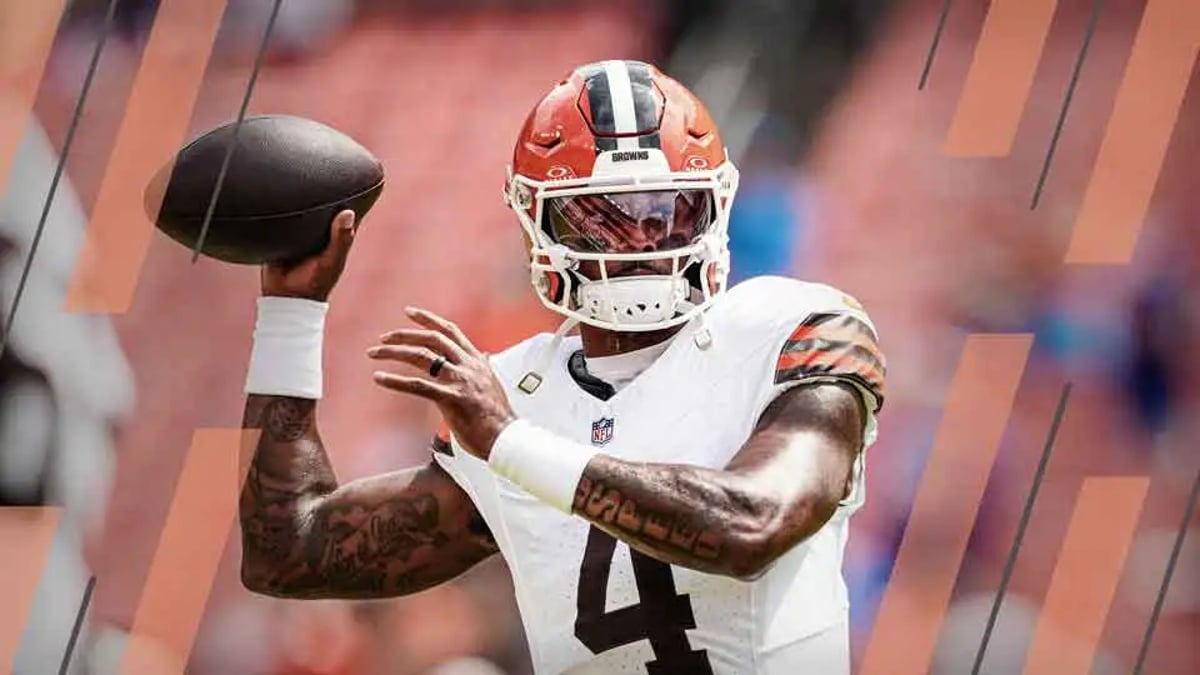
Deshaun Watson's return to Cleveland's starting lineup ended in a 34-10 loss to Jacksonville, and there wasn't much in the first-run data to suggest the result was misleading.
Watson completed 16 of his 22 attempts for 205 yards, one touchdown and one interception, but PFF's initial charting charged him with three turnover-worthy plays compared with only one big-time throw. His 40.1 PFF passing grade was the lowest among quarterbacks in the early window.
Cleveland managed only 271 total yards and converted 13% of its third downs, with two turnovers and a failed fourth-down attempt repeatedly handing possessions back to Jacksonville.
And this wasn't simply a case of the offensive line making life impossible for its quarterback. Watson averaged 3.43 seconds to throw and took four sacks. Combined with the three turnover-worthy plays, that makes this a particularly concerning opening performance.
2. Trevor Lawrence dismantled Cleveland's defense
While Watson struggled, Trevor Lawrence delivered one of the cleanest quarterback performances of the early slate. Lawrence completed 18 of his 23 attempts for 245 yards and four touchdowns without an interception, finishing with a 150.6 passer rating and an 86.2 PFF passing grade.
Jacksonville scored touchdowns on both of its red-zone possessions and averaged 3.4 points per drive, with Lawrence consistently turning opportunities into points. The Jaguars‘ passing game generated +0.82 EPA per pass play, which will likely be one of the highest marks of the season.
3. Zay Flowers was almost impossible to cover
Zay Flowers didn't need anything close to a full game's worth of opportunities to take over Baltimore's 41-23 win over Indianapolis.
The Ravens receiver caught five of his six targets for 150 yards and a touchdown despite running only 11 routes. That works out to a ridiculous 13.64 yards per route run, and his initial 94.0 PFF receiving grade was the best among receivers in the early window.
Flowers' explosiveness was the headline act in a dominant offensive showing. Lamar Jackson threw for 324 yards, Baltimore piled up 496 total yards and the Ravens averaged 7.8 yards per play.
Baltimore finished with 0.293 EPA per play compared with Indianapolis' -0.203, and Flowers was at the center of the damage despite seeing relatively little volume.
4. Derrick Henry is still a touchdown machine
Flowers provided the fireworks through the air, but Baltimore's running game wasn't exactly quiet. Henry handled 24 designed carries and turned them into 144 yards and three touchdowns, earning an initial 82.0 PFF rushing grade.
Henry's workload and production gave Baltimore exactly what it has come to expect from its veteran running back: Of his 144 total rush yards, 104 came after contact, and he forced three missed tackles.
5. Chicago's running game steamrolled Carolina
Scoring 59 points will produce plenty of gaudy numbers, but Chicago's rushing performance in its 59-37 win over Carolina stands above the rest.
The Bears ran for 292 yards and six touchdowns, with D'Andre Swift leading the way. Swift carried 19 times for 125 yards and three scores, forcing seven missed tackles and averaging 4.16 yards after contact per attempt.
And he wasn't alone. Kyle Monangai needed only 10 carries to reach exactly 100 rushing yards and added another touchdown. Seventy-nine of his yards came after contact, and he forced two missed tackles of his own.
MONTHLY PFF Plus NEW – PRICE DROP!$9.99
per month, billed monthly
Choose Monthly PFF+ monthly, $9.99 per month What you unlock MOST FLEXIBLE- PFF+ content and tools
- Articles, Fantasy tools, NFL and College tools, Betting
- Access to mock draft simulator
- Guru AI football chatbot insights with limited tokens
$99.99$8.33 /mo
per year, billed annually
Go Annual PFF+ annual, $99.99 per year What you unlock BEST VALUE- PFF+ content and tools
- Articles, Fantasy tools, NFL and College tools, Betting
- Access to mock draft simulator
- Guru AI football chatbot insights with limited tokens
- Premium Stats
- Micro transactions available for additional tokens
$199.99$16.67 /mo
per year, billed annually
Go Pro PFF Pro, $199.99 per year What you unlock ELITE- PFF+ content and tools
- Articles, Fantasy tools, NFL and College tools, Betting
- Access to mock draft simulator
- Guru AI with higher base token level
- Upgraded Premium Stats Pro
- Micro transactions available for additional tokens
- Revamped player and team pages
- Enhanced data and visualizations
- Improved Interface
- Programmatic data access for modeling (API/scrape)
6. Bryce Young was excellent despite Carolina allowing 59 points
There aren't going to be many games in which a quarterback throws for 361 yards and three touchdowns only to walk away with a 22-point loss.
Bryce Young just experienced one. The Panthers quarterback completed 26 of his 38 attempts for 361 yards, three touchdowns and one interception, earning an initial 82.6 PFF passing grade. More importantly from a PFF perspective, Young produced two big-time throws against only one turnover-worthy play.
7. Josh Allen and Dalton Kincaid powered Buffalo past Houston
Josh Allen wasted little time putting together his first big statistical performance of the season, throwing for 334 yards and two touchdowns in Buffalo's 36-31 win over Houston. Allen recorded three big-time throws against one turnover-worthy play, earned a 77.8 PFF passing grade and generated 0.59 EPA per play.
Dalton Kincaid was one of the biggest beneficiaries, catching five of his six targets for 130 yards. The Bills tight end averaged 5.91 yards per route run.
8. Chris Olave exploded for 182 yards — and New Orleans still lost
No receiver in the early window finished with more receiving yards than Chris Olave, but even his monster afternoon wasn't enough to get New Orleans over the line.
Olave turned 13 targets into 10 catches for 182 yards, averaging 3.31 yards per route run in the Saints' 31-30 loss to Detroit.
Quarterback Tyler Shough supplied plenty of production himself, throwing for 410 yards and three touchdowns. His afternoon was much more volatile from a PFF perspective, though, as he recorded four big-time throws but also three turnover-worthy plays and threw two interceptions.
9. Jahmyr Gibbs and Aidan Hutchinson powered Detroit on opposite sides of the ball
Detroit needed almost everything it could get to escape New Orleans with a one-point victory, and two of its biggest stars delivered on opposite sides of the ball.
Jahmyr Gibbs handled 29 designed carries for 156 yards and two touchdowns, forcing eight missed tackles along the way.
Aidan Hutchinson was just as disruptive on defense. The Lions edge defender generated nine total pressures and two sacks, adding three additional defensive stops.
10. T.J. Watt wrecked Atlanta's afternoon
Few players in the early window affected their game in as many ways as T.J. Watt.
The Steelers edge defender earned an initial 90.5 overall PFF grade and an 89.8 pass-rush grade in Pittsburgh's 20-13 win over Atlanta, recording two sacks and two more defensive stops. He even added an interception for good measure.
Aaron Rodgers was excellent on the other side of the ball, earning an 87.3 PFF passing grade after completing 24 of his 40 attempts for 222 yards and a touchdown without recording a turnover-worthy play.