Health
One in eight women will get breast cancer in their lifetime, but most will survive itNew therapies and early diagnosis have increased five-year survival in these tumours to 85 per cent
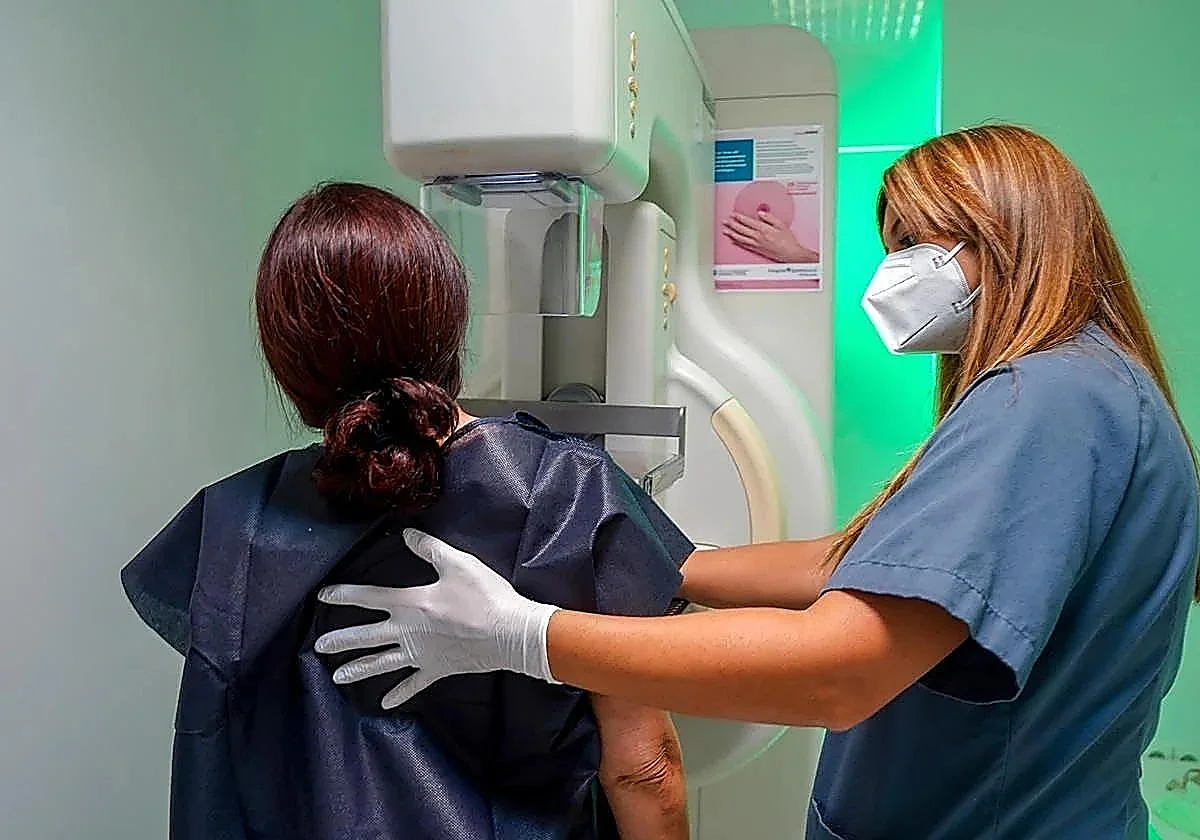
A woman undergoes a mammogram. (SUR) 05/05/2026 a las 12:56h."One in eight women will develop breast cancer in their lifetime". This is how the oncologist at the Hospital Clínico Universitario Virgen de la ... Victoria, Bella Pajares, put it in a statement to SUR.
"It is the most frequent tumour in women and far ahead of the next most common, which is colon cancer, it is practically twice as common in Spain," she explains. Despite this, it is one of the tumours "that has improved the most, both in terms of cure and quality of life, which means that, although the incidence and prevalence figures are high, life expectancy and the quality and cure of patients is also high," she adds.
The five-year survival rate for breast cancer is over 85 per cent, according to the latest available data, "which is very encouraging thanks to early diagnosis campaigns and advances in treatment: it is a very common tumour, but survival is very high, so the message must be very positive," stresses Dr Bella Pajares.
When a woman receives news of this nature, she must pay attention to "what surrounds the purely medical, lifestyle, social relations, family relations, the physical issue: the first thing is to have time to come to terms with the moment, the diagnosis and that her life will change in the coming months", a period she must use to "find the necessary tools to get out of it".
"Attending to all spheres"
Dr. Pajares insists on a holistic approach: "You must take care of all spheres of your person, the physical, the most important, the right diet, physical exercise, rest, restorative sleep and take care of your periods of activity and rest. Also be aware of how you are mentally, whether you need to be working or on sick leave, how much time you need, what is your moment on an emotional level. As I often say to patients: 'You haven't seen yourself like this before, have you?' So, if you don't ask for psychological help now, to a group of people like you who are going through the same thing, when are you going to do it?
"It is essential to try to surround yourself with all those things that nourish you so that the process of health, treatment and illness can be experienced in the healthiest possible way and as an opportunity for personal growth," says oncologist Bella Pajares
In her opinion, it is essential to "try to surround yourself with all those things that nourish you so that the process of health, treatment and illness is experienced in the healthiest possible way and as an opportunity for personal growth".
There are signs that may indicate the presence of a tumour in the breast. In some cases you may or may not notice any painful lump, but in other cases you may notice something visual, conspicuous: a lump or mass, some hardness in the breast area. It may or may not be painful.
Often there is an asymmetry in the breast, that is, the two breasts that have always been the same, one larger than the other or whatever, so you see something that visually makes you think that the breast is different and, sometimes, secretion from the nipple". Of course, he stresses, there are tumours that give signs and others that do not.
The first test performed is an imaging test, "a mammogram that is sometimes accompanied by an ultrasound scan". "They may have been requested because the patients noticed a nodule, they may have been requested by a doctor or the family doctor". Or, on the other hand, they may have undergone the screening programmes of the Junta de Andalucía. If the result is suspicious, the patient is called for a biopsy, which rules out or confirms the presence of a malignant tumour.
If the result is negative, the patient sometimes requires a second check-up after six or twelve months. If the result is positive, she enters "a multidisciplinary protocol, which is an integrated breast cancer care process in which her case is discussed: at the Hospital Virgen de la Victoria we meet every Friday to discuss the cases of the patients individually, with their mammography, biopsy, age, menopausal status, if there are diseases and comorbidities to personalise the treatment as much as possible".
Committee
This committee decides whether the patient should have surgery upfront or receive systemic treatment before the operation, or whether she needs any additional tests such as a breast MRI, she explains.
A clinical committee decides whether the patient has surgery upfront or receives systemic treatment before the operation
Prevention is key. "There are factors such as family history and age that we cannot control, but we can avoid drinking alcohol, which is one of the factors with the highest risk of breast cancer, we can try to avoid obesity, being overweight, which after the menopause is a risk factor for the development of breast cancer," she says. But there is more: doing sport, avoiding a sedentary lifestyle, "and also avoiding hormone replacement therapy after the menopause, if it is very prolonged".
Secondary prevention would be to enter all screening programmes, "to have mammograms in the age range" available, between 49 and 71. The idea is to continue to expand them. There has also been an improvement in metastatic breast cancer. "Breast cancer is not a single entity, we have hormone-dependent tumours, triple negative tumours and tumours whose proliferation depends mainly on HER2 proteins, which are HER2-positive tumours. There are advances in all three subtypes.
Lymphoedema
Lymphoedema is a chronic and irreversible sequela that can occur after breast cancer treatment, especially when nodes are removed from the armpit. It consists of an accumulation of lymphatic fluid that causes noticeable swelling in the arm and the back of the hand. Oncologist Bella Pajares points out that the arm "sometimes hurts, is very tense and limits its mobility and function", affecting women's quality of life and hindering their work. In the past, an axillary emptying was performed, removing all the lymph nodes, and then came the sentinel node technique, which allows only one or two nodes to be removed, not the whole armpit.
"We can now, in some tumours with a good prognosis and in certain selected patients, with the axilla without ultrasound evidence or clinical examination of an affected lymph node, not touch the axilla surgically, which means that the risk of lymphoedema no longer exists. This surgical advance is as important as any of the drugs," says Dr Bella Pajares.