Zoom
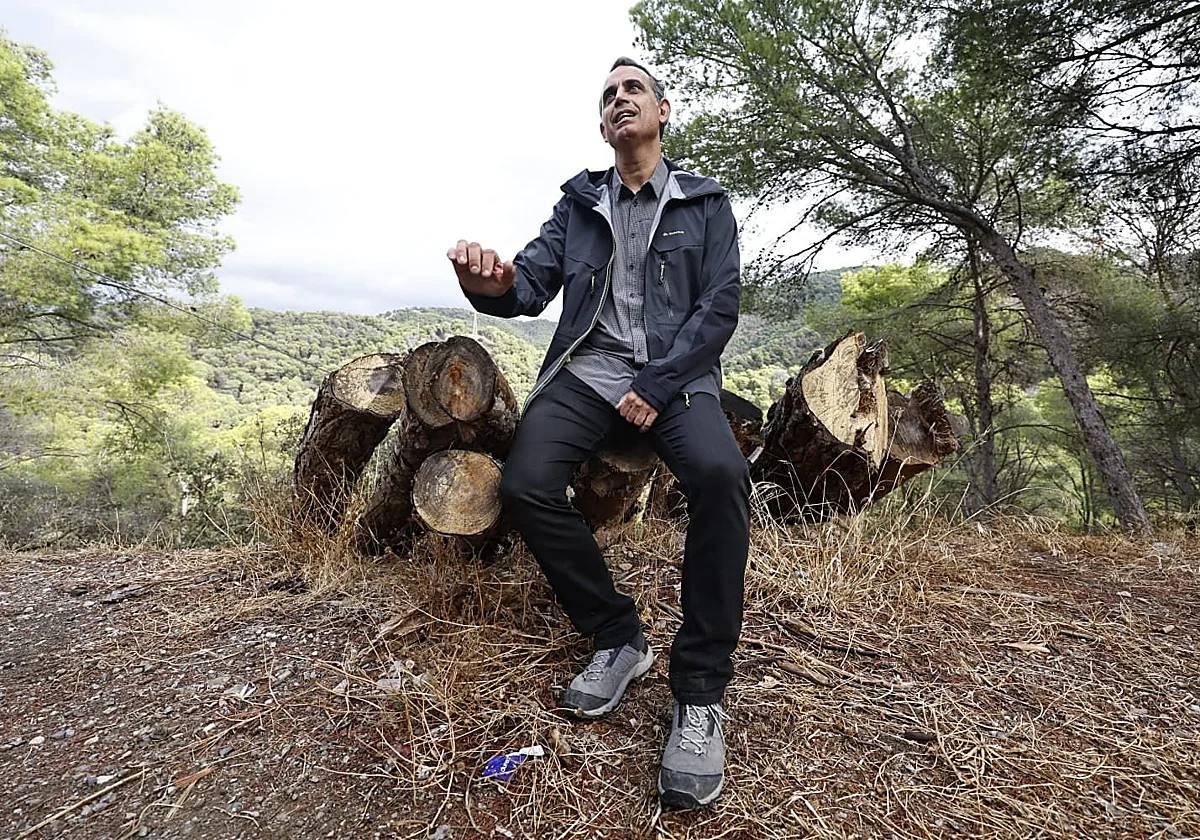
Pablo Blanco, during his interview in Los Montes de Málaga. SALVADOR SALAS Environment Pablo Blanco: 'The priority is to restore the connection between the people of Malaga and their mountains'New Year, new boss: "Cutting and extracting timber is not a crime, nor is it illegal, nor does it endanger these ecosystems. On the contrary, it benefits them," asserts the new director of the Montes de Málaga Natural Park
Malaga
Thursday, 8 January 2026, 12:49
Pablo Blanco, 52, has roots in Cadiz and the Alpujarra part of Almeria, but he can now proudly proclaim he is also from Malaga: "It's where I've lived the longest." After passing the competitive exams for such jobs, he could have chosen almost anywhere in Andalucía, but he opted for Malaga. His decision was influenced by the positive work environment in its two departments linked to the environment, as well as by the extensive area of public forests in the Costa del Sol province. That passion has just led to him becoming the new director of conservation for the Montes de Málaga Natural Park, the main green space around Malaga city, which also encompasses Casabermeja and Colmenar.
- What motivated you to come and work in Los Montes?
- Well, it's related to my calling. I grew up in the protected natural areas of Cadiz and the Alpujarra in Almeria. By the time I was 14 years old, I knew I wanted to study forestry engineering. I was already familiar with the profession because I've always been very involved with forest management and rangers in my town. I have extensive experience in public administration, as an environmental agent, working on livestock trails, the Infoca firefighting service, managing public water resources and responding to emergencies. In short, it was a no-brainer for me.
Ecological importance: "Los Montes is a model of forest management for Spain and the rest of the world"
- What makes Los Montes de Málaga so special?
- There are two things that make Los Montes special: it's a forest area that has direct contact with the city, it's what's called a forest-urban interface in the context of wildfires. That is, a large population lives right next to it and there's direct traffic from the urban area to the protected natural space or the public forest. This results in a constant flow of visitors and people who live nearby and have direct contact with it. This has consequences for their daily lives, both in terms of quality of life, because it's a place for recreation and sports, also because people live right by the hills and forests. I love this connection, since we often have a very urbane perspective on our natural systems. The Mediterranean environment is made up of ecosystems and landscapes shaped by humankind: I'm very interested in the role of humans in the environment and this is a magnificent example of that.
- How does this manifest itself?
- In Malaga, we're not aware of it, but Los Montes is a model of forest management for Spain and the rest of the world, due to the hydrological and forestry restoration done here after one catastrophic event: the 1907 flood. Together with Sierra Espuña, Lozoya in Madrid and Canfranc in the Aragonese Pyrenees, it serves as a model of successful management. This intervention, where a conservationist approach prevailed, generated the entire framework of environmental awareness that we have today. Reforestation with conifers was far from being a crime, it has been a successful intervention that needed - and still needs - human management to accelerate natural processes.
Disengagement: "There's a loss of generational ties among the people of Malaga"
- I have the feeling that it's a great unknown, many people don't realise it's just 15 minutes from the centre of Malaga.
- We've realised that and it will be a priority for us in the coming years, the need to restore the connection between the city and its mountains. We're not aware of what we have because it's used so immediately. That is, a percentage of the population uses this space without knowing it, because they go out to exercise, walk or cycle from their homes... Even to the shops, which are only open on the weekends nowadays. Why is that? Because we're not taking care of it, we're not properly managing the space and what's available. What's happening is a loss of generational ties, dating back to the heyday of wine and grapes, which gave rise to several districts. There have been several generational shifts and that connection is being lost. Previous generations used to go up to Los Montes a lot, but not so much anymore. Those who use the space today have lost that cultural and historical connection, but I recognise that it's still there, hidden away, and we have to recover it.
- How can it be recovered?
- By making it more visible. We really do have a lot of visitors, around 65,000 a year, but they mainly come to the urban area, that is, the southern part of the park. We need to organise activities, such as the Montes de Málaga Natural Park awards, which this year recognised Rafael Haro, a key figure in the declaration that made the Sierra de las Nieves mountain range a national park. And we're going to work with the sports clubs and associations that carry out activities within this natural park, of which there are many. We want to involve them in conservation, maintenance and restoration. We also have reforestation and clean-up projects planned, including maintenance plans for our cultural heritage, of which we have a great deal. We're also working on the control of invasive exotic species... What we want to do is to involve, above all, young people, where we have the most potential.
"Our governing board is very involved, we're once again achieving high participation. We're also trying to get as much as possible into the educational community: we have a VET [vocational training] module, a higher-level vocational training cycle in forestry management and we would like this to be their space outside the classroom for practical internships.
Large visitor turnover: "We have around 65,000 visitors a year, especially in the urban area"
Death of the pine trees
- What can we do to combat the brutal decline we're seeing in conifers?
- The decline in forest mass is a cyclical process of death and rebirth when it's due to natural phenomena, but it's fatal when it's due to any other factor that isn't natural, that is, associated diseases and catastrophic events. These are phenomena that occur in nature. No conclusive determinations have yet been reached, but what we interpret here is that it's part of a 'natural' process accelerated by the climate change scenario and the last, lengthy drought.... The last one was much more severe than even those of the 1990s or earlier times. We are aware that in Malaga the average daily temperature is increasing but, above all, the night-time temperature is rising significantly...
- So, what's going on?
- What we have are plantations of trees, which were planted to restore highly degraded environments throughout the peninsula in the 50s and 60s, which have now reached the end of their useful life. What we're seeing is an 80-year-old pine forest, while the Aleppo pine, which was the most widely used species in the Montes de Málaga, has a lifespan of 100 years in these situations.
"On top of that there are extremely high tree densities, poor soil and we have had a very severe drought. Therefore, the process of natural death has accelerated. We're witnessing all this firsthand, concentrated in just a few years. The density of dead trees is alarmingly high. But, at the same time, there is a process of transition from one vegetation type to another.
"So, on the one hand, it's bad because we're seeing dead trees but, at the same time, gaps are appearing and, underneath, a sub-level of holm oak and other species is emerging.
Future of the park: "We want to involve young people. We have great potential."
- How's it going to be done?
- The first thing is to make the access routes safe. Trees are constantly toppling over and we have a lot of visitors. This mountain range has an excellent network of tracks and trails that are very helpful in preventing fires and are heavily used by the public, so we're going to focus initially on that feature. Then will come forestry treatments, we already have several projects approved to work on the forest mass. But, right now, we're going to focus on making the access routes safe and observing how nature evolves because, at the base of these dead pines, other native species are already appearing: the vegetation is regenerating naturally.
- Which species will be chosen for future reforestation?
- Given the climate change scenarios, we'll have to turn to species better adapted to high temperatures and drought, from the cupressaceae (cypress) family: junipers, savin junipers.... Just as we're looking for refuge areas for the Spanish fir (abies pinsapo), we've identified some species that work very well in reforestation efforts. These species are extremely resistant or adapted to these phenomena, such as tetraclinis articulata (arar), a cypress native to the Mediterranean environment. It's already present in Los Montes, because forestry engineers planted it in some places and it's spreading naturally. It thrives in reforestation projects, practically without the need for irrigation.
Reforestation: "We're searching for species adapted to high temperatures, like cypresses."
Necessary logging
- Will timber be extracted?
- People will see that forestry operations are resuming in Los Montes. In the case of timber and biomass, this is nothing more than forest management of the area. That is, we have a forest mass that completely covers the ground and it's dying due to a natural process of decay, which can be purely due to climate change and forest structure.
"Through careful management, harvesting creates gaps for other vegetation types to emerge with a greater chance of success. But, for that to happen, we have to extract timber from here, both in logs (for sawmills) and for biomass. That depends on the market, but I want to emphasise that cutting and extracting timber is not a crime, nor is it illegal, nor does it endanger these ecosystems. On the contrary, it benefits them. Some actions may seem destructive at first glance, but what lies behind them is the opposite: the creation of opportunities. Human activity is present in our environment, we don't have any natural forests on the Iberian peninsula.
- What precautions should visitors take?
- Over the next few months, we'll have heavy machinery working and the workers may experience stressful situations due to the presence of people, who need to be respectful of the work to avoid creating dangerous situations. We ask people to be aware that a machine operator may not see a cyclist or a runner passing close by and to be very respectful of the signage and on-site personnel.
Wild boar in Malaga: "There's a high density of these animals taking refuge in glens and streams"
Wild boars in the city
- There are increasingly more wild boars in the city and some suggest they're coming down from Los Montes park....
- There is public concern in the city over the number of groups of wild boar entering the urban environment on a daily basis. And it's true that it has been suggested that these wild boars may be coming from the public forests or the Montes de Málaga Natural Park. Therefore, we're going to conduct another survey to determine the population density.
"However, wild boars look for places to hide during their resting periods, in areas of dense vegetation. The Montes de Málaga, due to its almost complete pine forest cover, has very few scrubland areas where they can find shelter at these times. And there's another factor: like any living being, they seek to feed while expending the least amount of energy possible. So, they are actually in urban areas because we generate so much waste that it is easier for them to find food. They take refuge mainly in damp glens and waterways, in the streams where the city meets the forest.
- Are you trying to say that wild boars don't come down from Los Montes?
- Of course there are wild boars in Los Montes, but that high density of them is in what has traditionally been known as the outskirts of the city. There they are protected and go to the city to feed because it is much easier and more convenient for them than looking elsewhere where there are fewer resources. But we are going to work on the edge of the park, we are going to conduct surveys an if action is necessary, we will take action.