Zoom
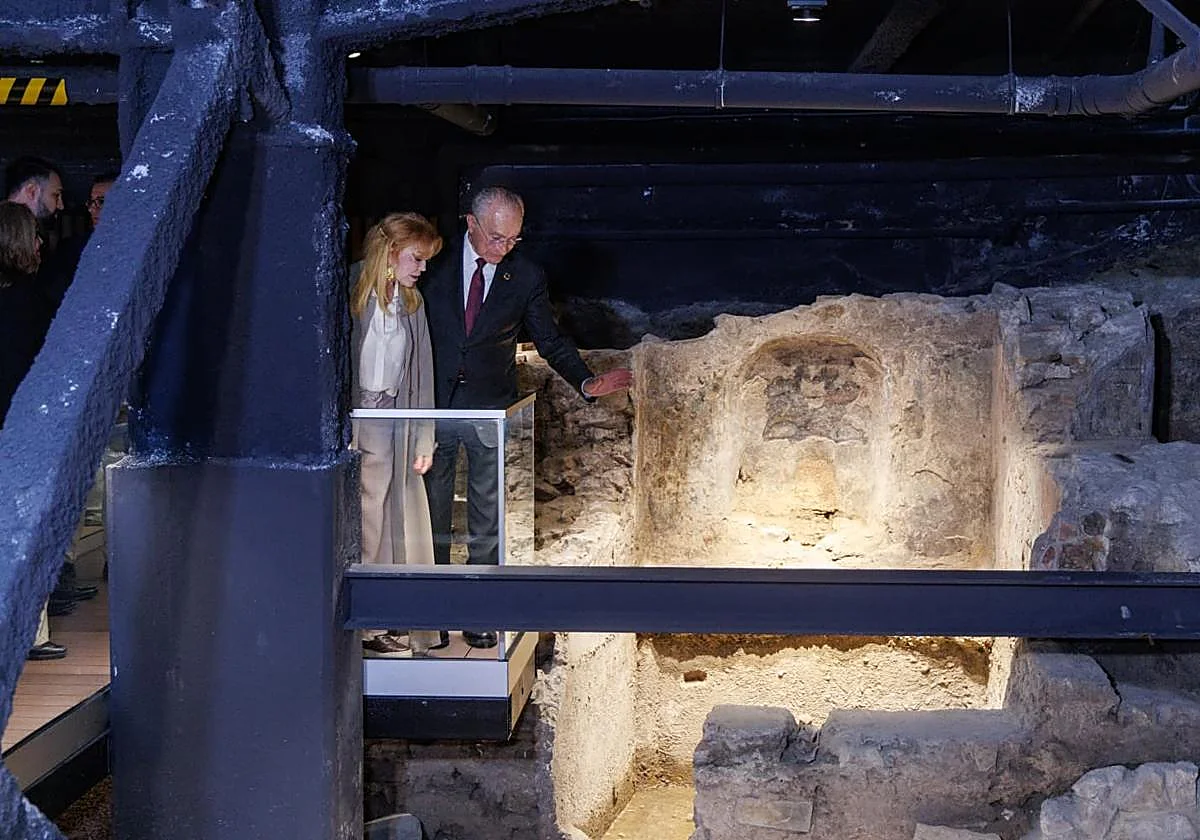
The Mayor of Malaga and Baroness Thyssen visit the archaeological remains. Marilú Báez Roman Malaga rises: Thyssen Museum opens long-awaited ‘buried city’ to publicAfter 20 years of meticulous excavation, the museum’s archaeological site offers an immersive journey into the 1st-century salt-fish industry and domestic life of ancient Malaca
Wednesday, 4 March 2026, 17:24
As you descend beneath the Museo Carmen Thyssen, the air grows heavy. Humidity spikes to 80 per cent and the temperature settles at a constant 19 degrees.
This is the threshold of Roman Malaga as it existed 20 centuries ago. It was a thriving, maritime trade hub defined by its salted fish factories and bustling commerce.
Baroness Carmen Thyssen, founder and primary benefactor of the museum, visited the remains alongside Mayor of Malaga Francisco de la Torre and described the discovery as "marvellous".
But opening the site to the public has not been plain sailing. The visit of the Baroness was the culmination of two decades of challenging work.
The primary delay in welcoming the public was not the archaeology itself, but the battle against the elements - specifically, controlling the high water table that has historically flooded the area.
Elevated walkways now guide visitors across 700 square metres of history. The site preserves the remains of a Roman domus (house), a fish-salting factory, and a tavern where the homeowners sold their wares. Key artefacts on display include amphorae, fragments of netting needles, and glass vessels. Most notably, the site houses what is believed to be the oldest painting in Malaga: a vibrant depiction of fish crowning a monumental fountain.
“What is truly interesting is the long period of occupation,” explains Aurora Zafra, head of archaeology for Malaga City Council. The site shows at least four centuries of continuous industrial and residential activity. Located on the outskirts of the ancient walled city, across the Guadalmedina river, this was an industrial quarter where enterprising families prospered.
The residence is designed around a brick-paved courtyard. To one side lies the production area, featuring four large basins used for preserving fish in giant jars.
The owner of the salted fish factory and the town built a monumental fountain
To the left sits the site's "jewel": a monumental nymphaeum. This marble-covered fountain, decorated with mosaics and niches, served both a practical and aesthetic purpose. “The owner was sensitive enough to provide the house with water, but with an artistic vision,” says museum director Lourdes Moreno. “It was a display of social status.”
The tour concludes at a unique tavern that once opened onto one of the district’s busiest streets, serving as a retail outlet for garum (the prized Roman fermented fish sauce). The site even offers a glimpse into the later Byzantine era, with tombs from a necropolis built after the Roman city collapsed.
Technology bridges the 2,000-year gap; visitors can scan QR codes to virtually reconstruct the tavern walls and the fish fountain via their mobile phones.
The project faced significant engineering hurdles. "The water table has always been very high here," noted Mayor De la Torre. Specialists from the CSIC eventually developed a system of four wells and eight motors to keep the site dry.
Due to the delicate preservation requirements of the ancient paintings, capacity is strictly limited to 20 people every 30 minutes. General admission is €15, with free entry on Sunday afternoons. Specialised virtual guided tours are also available, though currently fully booked through April.
Visits to the archaeological complex must be booked in advance, given its limited capacity. They will be from Tuesday to Sunday, from 10am to 8pm hours, with a general rate of 15 euros (10 euros, for concessions). On Sunday, from 4 pm onwards, admission will be free.
In addition, a virtual guided tour has been set up for only 10 people per shift and 20 euros per ticket, which is already booked up for March and April.
There is water all over the subsoil. It smells of wet earth and you can even hear the current. And that has been the great challenge of this archaeological recovery: the water table has always been very high in this area of the city and a stream once flowed through here. Controlling the flooding of this area has been the greatest challenge faced by the experts and the reason why the opening has been delayed for more than 20 years since its discovery during the restoration work on the Palacio de Villalón. It has been a process of trial and error, with the collaboration of different specialists and the CSIC, until a system of four wells has been found, with two motors each, which maintain a stable flow of water, which also oscillates according to the time of year. "The story of what we are going to see is a bit long," anticipated the mayor, Francisco de la Torre, as soon as he took the floor, recalling the complicated process of the intervention.
Visits to the archaeological complex must be booked in advance, given its limited capacity. They will be from Tuesday to Sunday, from 10am to 8pm hours, with a general rate of 15 euros (10 euros, for concessions). On Sunday, from 4 pm onwards, admission will be free.
In addition, a virtual guided tour has been set up for only 10 people per shift and 20 euros per ticket, which is already booked up for March and April.