7 min read
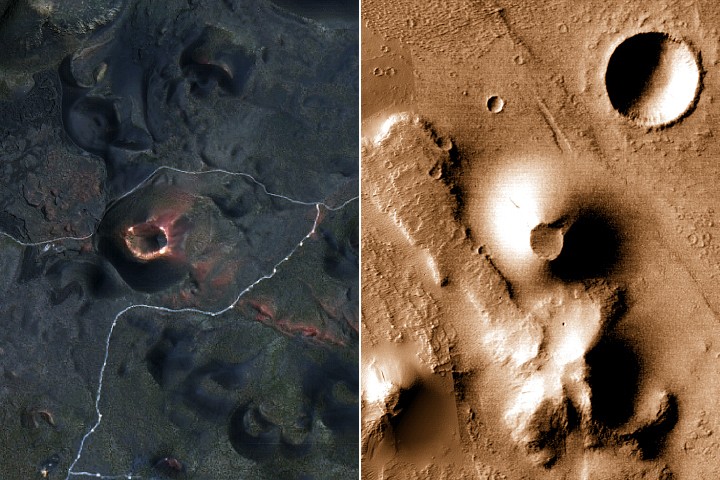
Scoria Cones on Earth and MarsImage of the Day for March 2, 2026The hill-shaped features are a sign of explosive volcanic activity—a rarity on the Red Planet.
NASA Earth Observatory
Mar 02, 2026 ArticleSince the 1970s, planetary geologists have known that volcanic features cover large swaths of Mars. Early Mariner 9 images revealed massive shield volcanoes and lava plains on a scale unlike anything on Earth. Olympus Mons, the tallest volcano in the solar system, stands nearly three times higher than Mount Everest. Alba Mons, the planet's widest volcano, spans a distance comparable to the length of the continental United States.
Both Olympus Mons and Alba Mons were primarily built by basaltic effusive eruptions—relatively calm outpourings of "runny" lavas that spread across the surface in sheets. This is thought to be the most common type of volcanism on Mars, accounting for the vast majority of its volcanic landforms. However, a small portion was produced by explosive volcanism of the sort that forms volcanic cones, pyroclastic flows, and ashfalls.
The dearth of explosive volcanic features on Mars has long puzzled geologists. With an average atmospheric pressure 160 times lower than Earth's and only a third of the gravity, explosive eruptions should theoretically occur more easily on the Red Planet, said Petr Brož, a planetary geologist with the Czech Academy of Sciences. That rarity is part of what makes features like the volcanic cones (shown above) found in Mars' Ulysses Colles region so compelling to planetary geologists.
"They appear to be scoria cones—a clear sign of explosive volcanism," Brož added. "They were the first identified in the Tharsis region in the 2010s, and they helped paint a broader and more complete picture of Martian volcanism."
The CTX (Context Camera) on NASA's Mars Reconnaissance Orbiter captured this image (second image above) of Ulysses Colles above on May 7, 2014. Ulysses Colles is located at the southern edge of Ulysses Fossae, a group of troughs within the Tharsis volcanic region.
The OLI (Operational Land Imager) on Landsat 8 captured an image with similar cones in the San Francisco Volcanic Field (SFVF) in northern Arizona on June 19, 2025 (top). Planetary geologists consider the cones in the two locations to be highly analogous. Both images also include grabens—linear blocks of crust that have shifted downward.
In both images, the scoria cones appear as rounded hills crowned with circular vents, while lava flows spread outward as dark, textured areas around the bases of the cones. At both locations, seemingly younger and smaller lava flows appear to spill from some cones, while older, more weathered flows lie in the background.
"Understanding similar features on Earth helps us know what to look for on Mars and interpret processes that we can’t observe directly," said Patrick Whelley, a NASA volcanologist who is part of a team that develops field equipment and techniques for Moon and Mars exploration.
SP Crater (above left), located in Arizona’s San Francisco Volcanic Field, features a 7-kilometer-long lava flow that extends northward and has been used for NASA astronaut geology training. In two places, the flow has spilled into a graben, creating a distinctive half-moon pattern along its left side.
On Earth, scoria cones form when gas-rich magmas soar high into the air and solidify into small particles of material called scoria that accumulate in steep-sided structures. While similar processes create cones on Earth and Mars, there are important differences. Martian scoria cones are typically taller, wider, and have gentler slopes, Flynn said. That makes sense. With lower gravity and atmospheric pressure, volcanic fountains can loft erupted magma higher and farther from the vent, producing larger cones.
There are far more scoria cones on Earth, where tens of thousands exist and account for about 90 percent of volcanoes on land. On Mars, "we have only identified tens to a few hundred candidates," Broz said. It could be that explosive volcanism was never common on Mars, or it could be that it was but that explosive features have been covered up by younger, effusive flows or destroyed by erosion, he added.
Whelley noted that on Mars, it remains unclear whether the Martian lava flows or the scoria cones formed first. The lava flow could be older, with the cone forming on top. Or, the cone may have formed first and later become plugged, forcing lava to spill from its side. Determining the order of events is one of the "puzzles of geology" that planetary geologists try to solve when studying Martian features remotely, he said. "Visiting places like the San Francisco Volcanic Field and studying the geology of analogous features up close on Earth helps us know what clues to look for when interpreting Martian geology."
Below (left) is a closer view of a scoria cone on Earth, southeast of SP Crater, called Sunset Crater. It erupted about 800 years ago, making it the youngest scoria cone in the San Francisco Volcanic Field. The analogous cone in Ulysses Colles (right), in contrast, is thought to be billions of years old.
Note that eruptions that create scoria cones are "mildly explosive," usually Strombolian events, characterized by intermittent lava fountains, said Ian Flynn, a planetary geologist at the University of Pittsburgh. They differ from the far more violent explosive eruptions that send ash columns billowing tens of kilometers into the air, as happened at Hunga Tonga-Hunga Ha'apai in the South Pacific, he added.
Mars also shows evidence of highly explosive "super eruptions," but that type of eruption leaves behind a different geologic signature: large depressions called paterae and broad, thin deposits of ash and other erodible material sculpted into landforms such as yardangs.
Planetary comparison is valuable for understanding the geology of distant worlds, Brož said. Without such comparisons, it becomes harder to determine how landforms on other planets or moons may have formed at all.
But caution is essential. "In planetary science, it's often said—only half-jokingly—that even if something looks like a duck, behaves like a duck, and sounds like a duck, it may not actually be a duck," he added. It's easy, for instance, to confuse scoria cones with mud volcanoes.
Researchers are highly confident that the Ulysses Colles cones formed through explosive volcanism based on the surrounding volcanic landscape, but in more ambiguous terrain it can be difficult to tell. Mars is fundamentally different from Earth, he cautioned. Brož's laboratory research suggests, for instance, that mud flows on Mars can look much like certain types of lava flows, and that, under certain conditions, they can even boil and levitate. "We also have to avoid being constrained by terrestrial experience," he said. "If we fail to think outside the box, we may overlook important possibilities."
NASA Earth Observatory images by Lauren Dauphin, using Landsat data from the U.S. Geological Survey and Mars Reconnaissance Orbiter.Story by Adam Voiland.
Downloads
Earth: June 19, 2025
JPEG (3.21 MB)
Mars: May 7, 2014
JPEG (7.74 MB)
References & Resources
- Brož, P. Everything you wanted to know about Martian scoria cones, but were afraid to ask. Accessed February 27, 2026.
- Brož, P., et al. (2021) An overview of explosive volcanism on Mars. Journal of Volcanology and Geothermal Research, 409(15), 107125.
- Brož, P., et al. (2014) Shape of scoria cones on Mars: Insights from numerical modeling of ballistic pathways. Earth and Planetary Science Letters, 401(15), 14-23.
- Brož, P. & Hauber, E. (2012) A unique volcanic field in Tharsis, Mars: Pyroclastic cones as evidence for explosive eruptions. Icarus, 218(1), 88-99.
- Eos (2021, May 7) Tiny Volcanos Are a Big Deal on Mars. Accessed February 27, 2026.
- Gullikson, A. (2021) A Geologic Field Guide to S P Mountain and its Lava Flow, San Francisco Volcanic Field, Arizona. Accessed February 27, 2026.
- Mouginis-Mark, P. (2022) Martian volcanism: Current state of knowledge and known unknowns. Geochemistry, 82(4), 125886.
- NASA (2026) Planetary Analog Explorer. Accessed February 27, 2026.
- NASA Earth Observatory (2018, October 9) Flood Basalts on Earth and Mars. Accessed February 27, 2026.
- U.S. Geological Survey Astrogeology Science Center (2021, August 31) S P Mountain Field Guide. Accessed February 27, 2026.
- U.S. Geological Survey San Francisco Volcanic Field. Accessed February 27, 2026.
- Richardson, J.A., et al. (2021) Small Volcanic Vents of the Tharsis Volcanic Province, Mars. Accessed February 27, 2026.
- Whelley, P., et al. (2021) Stratigraphic Evidence for Early Martian Explosive Volcanism in Arabia Terra. Geophysical Research Letters, 48(15), e2021GL094109.
You may also be interested in:
Stay up-to-date with the latest content from NASA as we explore the universe and discover more about our home planet.
Krasheninnikova Remains Restless 3 min readThe volcano on Russia’s Kamchatka Peninsula continues to erupt after centuries of quiescence.
Article A Hot and Fiery Decade for Kīlauea 6 min readThe volcano in Hawaii is one of the most active in the world, and NASA tech makes it easier for…
Article Home Reef Adds On 3 min readThe Tongan volcano expanded its mid-Pacific real estate during its latest eruptive phase.
Article Keep ExploringDiscover More from NASA Earth Science
Subscribe to Earth Observatory Newsletters
Subscribe to the Earth Observatory and get the Earth in your inbox.
Earth Observatory Image of the Day
NASA's Earth Observatory brings you the Earth, every day, with in-depth stories and stunning imagery.
Explore Earth Science
Earth Science Data