Zoom
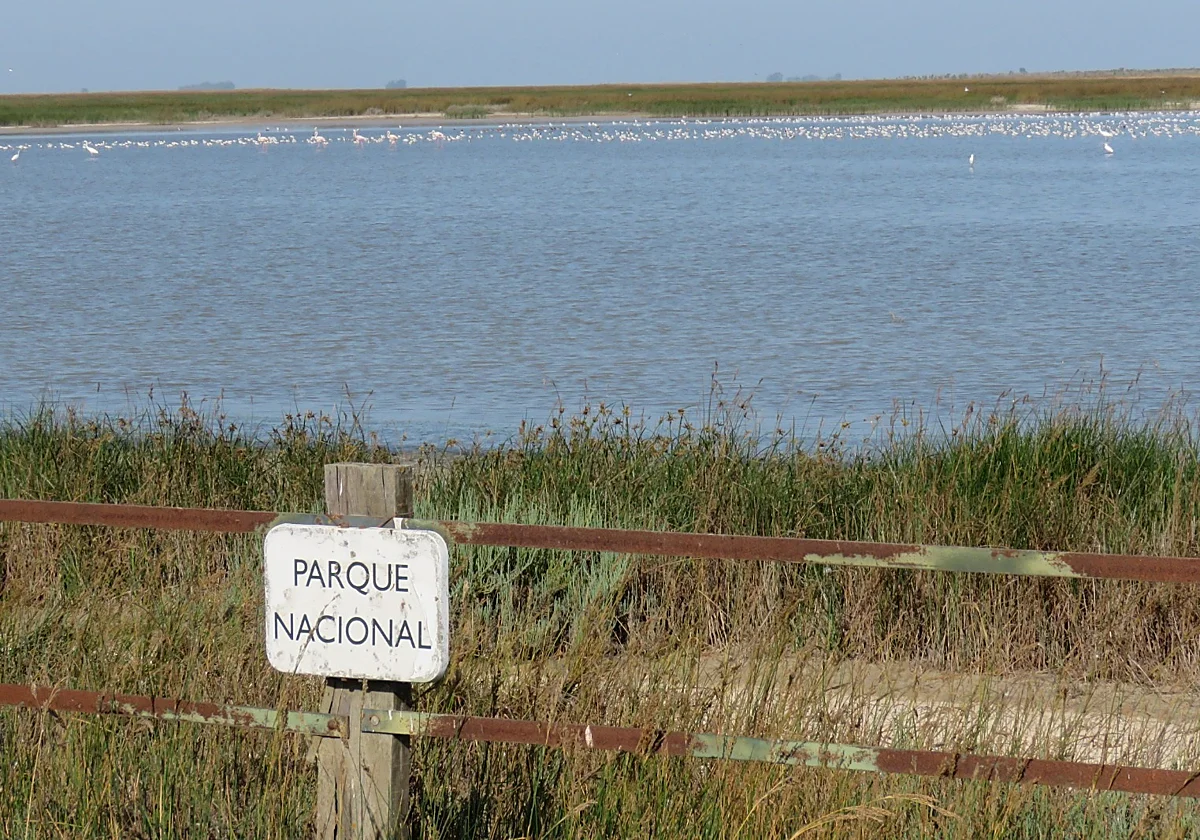
One of the open water spots in Doñana's marshlands. Environment Spain's National High Court accepts appeal filed by the Junta regarding demarcation of Doñana marshesThis court has also agreed to the Andalusian regional government participating in the proceedings as the Junta disagrees with the boundary demarcation supported by central government
Seville
Thursday, 9 April 2026, 15:56
Spain's National High Court (Audiencia Nacional, AN) has admitted the contentious-administrative appeal filed by Andalucía's regional government against the boundary demarcation supported by the Spanish government in the marshes of Doñana Natural Park due to disagreements on the limits of the tidal influence zone.
The AN has also agreed to accept the Junta's appearance in this process, a process that will address demarcation of the state maritime-terrestrial public domain assets in this area of Doñana marshes. This demarcation is promoted by the Ministry for Ecological Transition and the Demographic Challenge and includes land in two provinces of Andalucía: in Huelva, the towns of Almonte and Hinojos and, in Seville, the municipality of Aznalcázar.
The Junta lodged this appeal against the ministerial order of 10 October 2025, which approves the demarcation of a 118,772-metre stretch of these marshes, arguing that the Ministry's proposal "exceeds the natural limits of tidal influence and is not properly justified, also noting that the ecosystems, habitats and species present in the area are not related to the ebb and flow processes of the tides, as is argued in the order".
The regional government also argues that any delimitation of the public maritime-terrestrial domain must adhere to rigorous criteria and a thorough understanding of how the area actually functions. Organisations and institutions such as the Doñana Natural Area (END), the town councils of Almonte and Hinojos, WWF, Ecologists in Action, the Doñana biological station, the Guadalquivir hydrographic confederation (CHG) and the Friends of Doñana association share the Junta's opposition to the ordered demarcation. They all maintain that the marshland only receives fresh water, not salt water, and, therefore, should not be subject to this measure.
The regional ministry for sustainability and the environment had previously informed the Ministry in Madrid of its opposition to the demarcation, submitting a formal request that went unanswered. The regional ministry's position is based on reports submitted by the Doñana Natural Area, which questioned the reference to the so-called 'river mountain' as an artificial barrier.
According to the Junta, "this mountain prevents the marshland from connecting with the tide and it was specifically designed to facilitate the flooding of the marshes, whose dynamics respond to rainfall and river flow, not marine activity".
The boundary demarcation now under litigation in this court affects 56 per cent of the public lands within the area, including all the marshlands in the province of Seville. These lands were acquired by the state in 2006 from private owners and subsequently transferred to the regional government via a transfer of ownership decree.
The High Court requires the Ministry for Ecological Transition to submit to this judicial body the administrative file or files to which the contested action refers, within a non-extendable period of 20 days, or an authenticated copy thereof.
Furthermore, the AN has ordered the Ministry to notify all potentially interested parties of the existence of these appeal proceedings so that they may appear as defendants within nine days. The court ruling also contemplates the possibility of a separate proceeding to decide on the precautionary measures requested by regional government. As such, this parallel procedure will determine whether the execution of the boundary demarcation is provisionally suspended while the court considers the merits of the case.
The Ministry must also inform this judicial body of the existence of any other contentious-administrative appeals that may be subject to joinder, according to the country's procedural laws. Furthermore, this judicial body states that an appeal for reconsideration may be filed against this decision within five days following the notification date.