Zoom
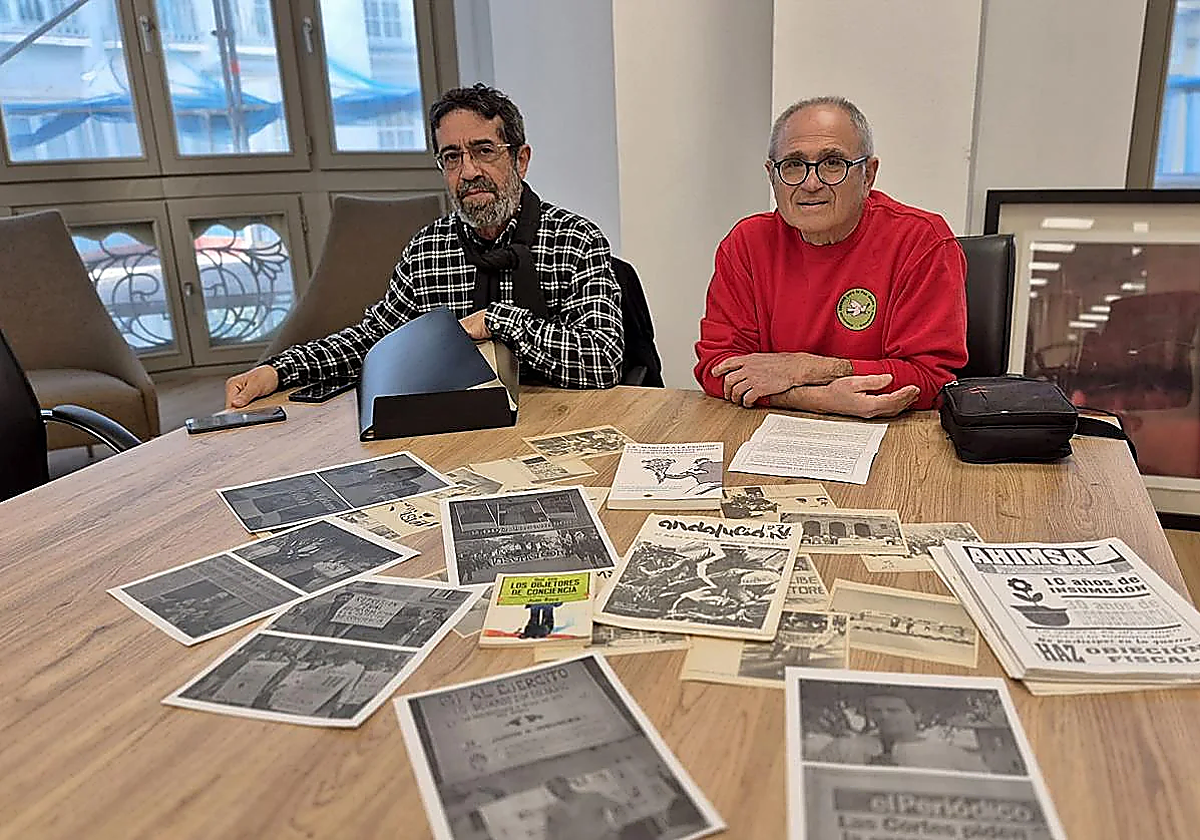
Antonio Arjona and Antonio Ruiz at SUR's headquarters in Malaga, showing materials they have gathered from their time as anti-conscription activists. Pedro J. Quero 25 years since the end of Spain's mandatory military service Spain's 'No to War' has revived the conscientious objector movementFrom the 70s onwards, the refusal to do military service gradually took hold among young people: from non-violence activists to those who did not want to put their lives on hold
Cristina Vallejo
Monday, 13 April 2026, 15:30
This year marks a quarter of a century since the end of mandatory military service in Spain.
It was a battle that the conscientious objector movement and later the draft resistance movement, had been waging for decades. From the 1970s onward, especially with the end of the dictatorship, and generally in the 1990s, the refusal to perform military service took root among young Spaniards for various reasons: from radical militants and non-violence activists to those who didn't identify with the Army but weren't as politically active, and then those for whom military service meant a disruption to their studies or work that they wanted to avoid.
The two men from Malaga who share their stories in this report, Antonio Arjona and Antonio Ruiz, have maintained their anti-war activism until today.
For most, the movement culminated in the end of mandatory military service, but for them it was an incomplete victory, because a professional army came with increased military spending. As pioneers of non-violence in the province, Arjona and Ruiz look back with some bitterness on what happened in 2001. "In reality, when compulsory military service was abolished, the problem wasn't entirely solved. For us, the threat of having to do military service did disappear, but society had a bigger problem, which was that military spending was increasing," they tell SUR's journalists during an interview at the newspaper's headquarters.
History
Arjona and Ruiz bring hundreds of clippings and documents from their time as anti-conscription activists at SUR.
While the first major movement against military service occurred in 1909, leading to the Tragic Week in Barcelona, the first cases of strict conscientious objection took place in 1959 and involved two Jehovah's Witnesses who were sentenced to serve until the age of 38, when military service age ended.
Then, in 1967, a group of friends from the Comunidad del Arca, a Christian-inspired organisation that followed Gandhi in Barcelona, organised a camp on non-violence and more assertively voiced their opposition to the militarisation of society.
In the final years of Franco's dictatorship, several young men of military age undertook civilian service in a deprived neighborhood of L'Hospitalet de Llobregat as an alternative to military service, but this was not accepted. They were imprisoned and only released thanks to the 1976 pardon. That same year, a new law was passed recognising only conscientious objection on religious ground. The objectors' rejection of this law was absolute and in 1977 the conscientious objection movement was officially founded. The government responded by announcing a temporary extension for conscientious objectors until a definitive law could be drafted, which would not be approved until 1984.
This new law, however, was also unpopular with the movement. Firstly, because activists felt the law failed to recognise the right to conscientious objection: it was seen as a mere exception to the general obligation of military service. Regarding the alternative community service it required for those who didn't do military service, the movement believed it actually provided a source of cheap labour for many organisations that could be creating well-paid jobs.
"We were against all of that: I might want to do community service, but I objected to the state forcing me to do it as an alternative to military service. This meant that the right to conscientious objection wasn't recognised because I didn't want to participate in the militaristic and arms-related schemes. Almost all conscientious objectors voluntarily performed community service in our neighborhoods. In fact, the first group of objectors formed in Malaga worked in hospitals. We wanted to provide some service to society, but not to the state," Arjona and Ruiz say.
They state that the movement, led by Pepe Beunza, started the 'Voluntariado para el Desarrollo' initiative and submitted signatures to parliament to have it recognised as an alternative to military service. In L'Hospitalet a group of conscientious objectors started a self-managed voluntary civil service, but they also ended up being arrested.
Arjona and Ruiz never dodged the draft. They were conscientious objectors. In high school, during the final years of the Franco regime, Arjona had a somewhat unusual teacher of Formación del Espíritu Nacional (Formation of the National Spirit), because instead of teaching dictatorship propaganda, he taught the history of political thought. Later, at Hospital Civil, while studying nursing, he lived in a "revolutionary environment". "The university rose up against the regime. All sectors of the workforce rose and everyone supported everyone else. That is, if we were studying and there was a workers' strike, we went on strike too. This is the context in which conscientious objection was born," Arjona says.
He actually learned about the movement in a parish group where a conscientious objector from the non-violent group he would later join spoke. "The concept of conscientious objection aligned with my principles, with my way of understanding life and people's relationships. We can't keep crushing each other, we have to collaborate, develop mutual support," Arjona says.
How did his parents take his decision? He says that his father, who always voted for socialism in the democratic era, didn't want him to get involved in any trouble. Based on his experience during the dictatorship, he thought that getting involved in politics was synonymous with getting in trouble, so he wasn't particularly happy about it.
Antonio Arjona fulfilled part of the ritual that led him to military service and registered 1976, at the age of 19. Since he was at university, he requested deferments for his studies until 1979. In 1980, by draft, he was assigned to the San Fernando military base. He went and declared that he wasn't going to serve. Because Gutiérrez Mellado's order was in effect, stipulating that conscientious objectors would be granted a special deferment until a law was passed, his only problem was the uncertainty regarding what text the government would present and what would be voted on in the lower house.
Arjona began to build his life, working as a nurse, getting married, always with the lingering threat of military service. When the law was finally passed, he never heard from the Army again.
The same thing happened to Antonio Ruiz. He filed a declaration of conscientious objection with other coworkers at the Paseo de la Farola, where the Navy headquarters was located, and he never heard anything more about it. "They didn't call me, they didn't send me any letters saying I had to submit any documentation, nothing," Ruiz says.
When he went to Malaga University, he quickly became politically active, yearning for justice, non-violence and "a basic principle: you mustn't kill people".
The conscientious objectors' struggle, though with earlier antecedents, began in earnest in the 70s, spread throughout the 80s, even through legislation and lasted until 2001, when the government effectively abolished conscription, although the law mandating the full professionalisation of the Army dated back to 1999.
The movement's echoes resonate to this day. During the anti-war rally held in Malaga on 7 March, the conscientious objectors alluded to the fact that this protest and the 'No to War' movement, specifically the Iraq War, originated from the seeds of anti-war sentiment sown by the conscientious objection movement.
Arjona and Ruiz also speak about the organisational and protest methods used by the conscientious objector movement. "We were incredibly original and many of our actions were copied. One of the first things we did throughout Spain was to climb onto phone booths with banners. We held military parades dressed in garbage bags, chained ourselves to the military government building and walked through the streets dressed as prisoners. Our demonstrations weren't usually massive, nor did they rely on shouting, but we tried to engage people, not scare them, but make contact. From our non-violent perspective, an action should lead people to become involved, so we had people in the demonstrations whose job it was to start conversations and bring passersby in," the two activists say.
They also carried out laborious campaigns for tax conscientious objection, that is, to try to deduct from their income tax return the portion that went to the Ministry of Defence. The procedure was truly laborious, because it involved filling out the form, including a deduction for the amount they calculated they didn't have to pay, and sending a letter to the tax agency with all the documentation.
Conscription in Europe
With the rise in armed conflicts, some European governments have raised the possibility of reinstating mandatory military service. What do these conscientious objectors think? "Having an army serves no purpose and what they're trying to sell us is the idea that we have to spend more on defence," Arjona and Ruiz say.
Their concept of 'non-violence' is very broad: it doesn't stop at the 'no to war' sentiment that has recently resurfaced after more than 20 years, following the attacks of Israel and the US against Iran, which has once again destabilised the entire Middle East. "You can be a pacifist at a given moment because you're against a specific war, but someone who is non-violent goes further and is against all violence, not only physical violence, but also structural violence," they state.
They say they were moved by the massive anti-war demonstrations following the invasion of Iraq and by the new protests with the same slogan against Netanyahu and Trump's military campaign in the Middle East. They believe both rallies are heirs to the non-violent spirit of the conscientious objectors, but also to Spain's own history. "This is a country marked by the Civil War. Our parents and grandparents passed that on to us and we don't want any more wars. That's the general sentiment," they say.
When asked whether it's always possible to be non-violent, Arjona and Ruiz say that, during times like Germany's invasion of Poland or Russia's invasion of Ukraine, a non-violent person reacts, for example, by organising care for the wounded, ensuring food for the population, among other tasks.
"We would work in another field, but we're not going to pick up a rifle or start shooting," they state. "Armies spend billions of euros preparing for war. How much do we spend to organise non-violent popular defence?"