Zoom
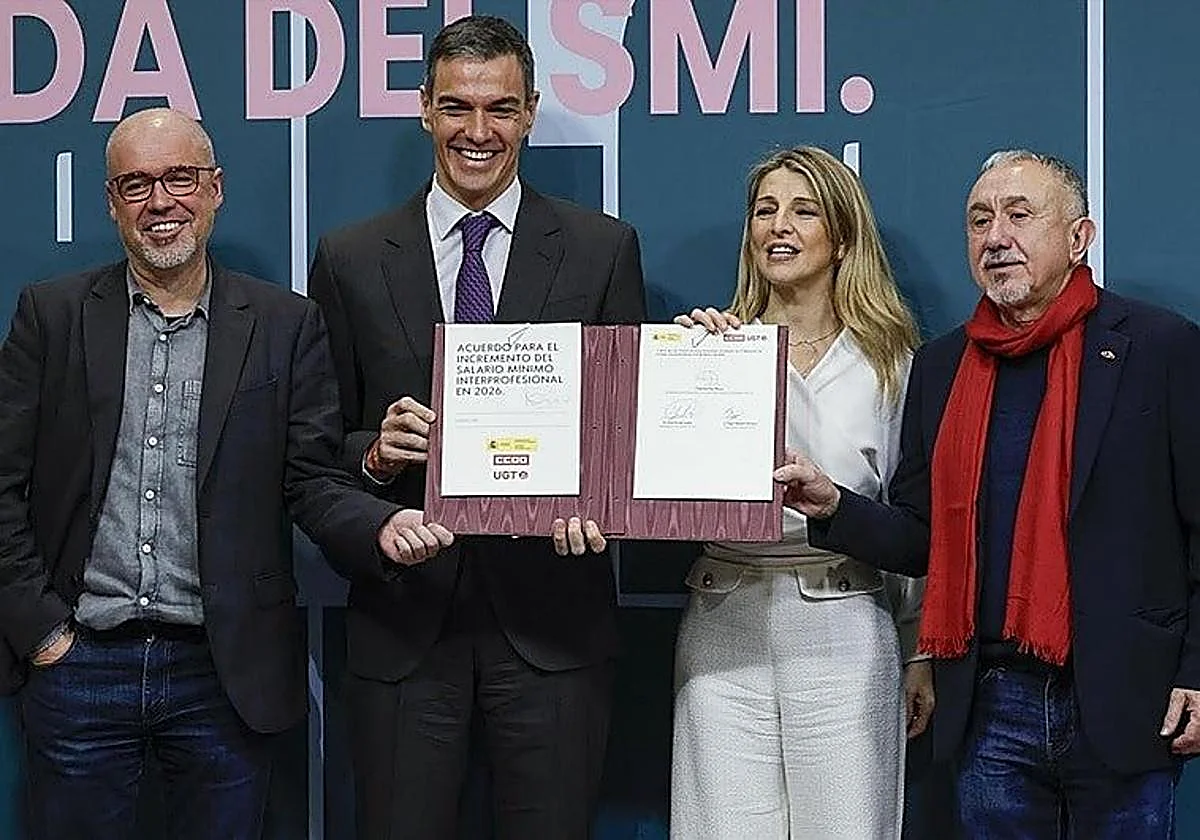
Prime Minsiter Pedro Sánchez and the Second Deputy Prime Minister, Yolanda Díaz, with General secretaries of the CCOO and UGT, Unai Sordo (l) y Pepe Álvarez (r) EFE Employment Spain's Prime Minister, Pedro Sánchez, announces increase in minimum wageor the first time ever, a Spanish prime minister visited the offices of the ministry of labour this week to take part in the signing of an agreement to raise the statutory minimum wage to 1,221 euros a month
Lucía Palacios
Madrid.
Friday, 20 February 2026, 12:08
For the first time ever, a Spanish prime minister visited the offices of the ministry of labour this week to take part in the signing of an agreement to raise the statutory minimum wage to 1,221 euros a month. The Spanish cabinet went on to approve the increase on Tuesday.
The government has been attempting to reach an agreement on the minimum wage with unions and employers since 2020, but in the end the photo opportunity for Pedro Sánchez went ahead without business leaders after those negotiations stalled.
Sánchez's appearance, and his criticism of representatives of business groups for failing to reach a deal, provided an opportunity to counter the impact of recent regional electoral defeats for his PSOE party in Aragón and Extremadura. On the same day, he also announced the launch of a fund designed to address Spain's pressing housing crisis.
The minimum wage increase will be exempt from taxation, as the government has updated the income tax tables and tax-free allowance to allow low-income earners to keep the full tax deduction.
Around 2.5 million workers - according to the ministry of labour - will benefit from this new rise, back-dated to 1 January, adding 37 euros per month to their pay. Employers will still be able to avoid the rise, however, by legally reducing payments of extras, such as for age or certain working conditions, a loophole the government is still trying to close.
The rise in minimum wage impacts workers especially in agriculture, hospitality and retail, as well as those living in the Canary Islands, Extremadura, Murcia, and Andalucía, according to a workers' union study.