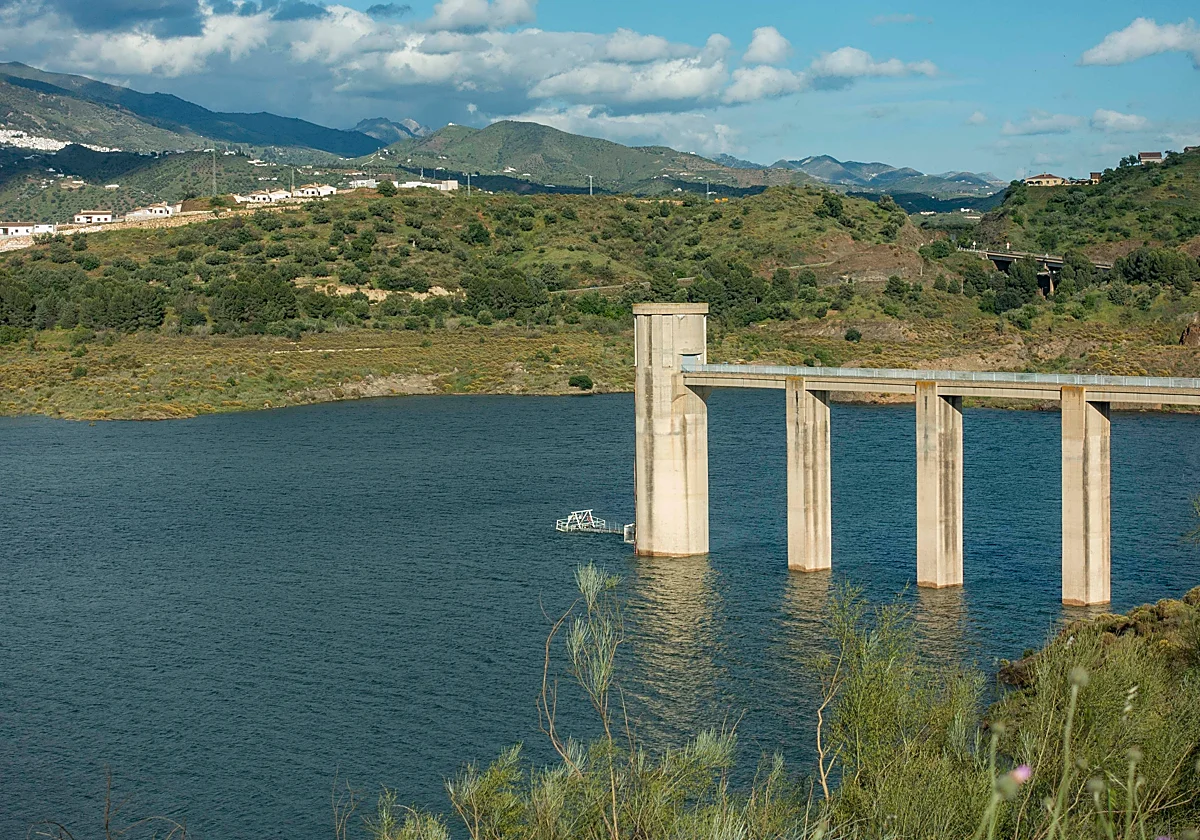
Zoom
La Viñuela reservoir. José Luis Escudero Water welfare Storm Emilia leaves first notable rise in Malaga province reservoirs: this the one that has gained the mostThe rainfall has been well distributed in regulated headwaters and well areas and promises a sustained increase with runoff
Malaga
Tuesday, 16 December 2025, 14:00
Malaga province's reservoirs have recorded an increase for the first time this hydrological year, thanks to the rainfall accompanying storm Emilia. The distribution of the rains, which came down hard in the early hours of Tuesday morning, has brought with it the first appreciable rise in the reservoirs so far this year. La Viñuela, in the Axarquia district, has benefited the most so far. This is especially important after the harsh years of drought that the area has experienced, although this situation was reversed after the 'danas' and storms a few months ago.
Geographical distribution
The rainfall analysis has left good records in the upper reaches of the Guadalhorce. This is water that flows directly into the reservoir system. The same is true of the rivers regulated in La Concepción, between Marbella and Istán. The rain has also irrigated strategic areas such as the Grande river, whose water is partially used in the Aljaima weir, which water company Emasa manages in Cártama. There is also a system of wells there - another important resource for Malaga city. There has also been an increase in the level at El Limonero and Casasola. Although they are for flood prevention, they always serve as an auxiliary guarantee.
280
million cubic metres of water in the reservoirs at midday on Tuesday, expected to significantly increase with the runoff
Between midnight on Monday and midday on Tuesday alone, the reservoirs rose by two million cubic metres. Without context, this figure may seem insignificant, but it is the water consumed by 30,000 inhabitants over the course of a year. The expected run-off implies that these contributions could at least triple in the next few days. At midday, surface water reserves exceeded 280 million cubic metres. This is 2.5 more than last week and 108 more than this time last year.
1.5
million cubic metres La Viñuela has gained in just a few hours - tenth of the annual consumption of the Axarquia district
La Viñuela has gained more than 1.5 million cubic metres in a week. It is on its way to 72 million cubic metres. Guadalteba, on the other hand, has stored the most water, with around 80. La Concepción exceeds 36 million cubic metres and the figure will probably continue rising for several days, given the contributions to the Guadaiza-Guadalmina-Guadalmansa water transfer system. The Guadalhorce, for its part, is approaching 45 million cubic metres and the Conde, 30.
Rain in headwaters
In 24 hours, the rains have left 47mm in Alcaucín and 30mm in the reservoir of La Viñuela; up to 26mm in the aforementioned network that flows into La Concepción; up to 18 in the upper Guadalhorce; and more than 14mm in Aljaima.
Watercourses and gauging
None of the watercourses have reached concerning levels. Among the most important for water supply, the Guadalhorce was carrying almost ten cubic metres per second at the aforementioned Aljaima weir. This is six times the consumption of Malaga city. The bad news is that the surplus can hardly be stored and flows downstream, which shows how strategic it is to continue studying a dam on the Grande river. This course, coming from the snows, flowed with almost seven cubic metres at midday.
For its part, the Guadalhorce carried 6.41 at Bobadilla; the Guadalteba, 1.33 and the Turón, 1.29.