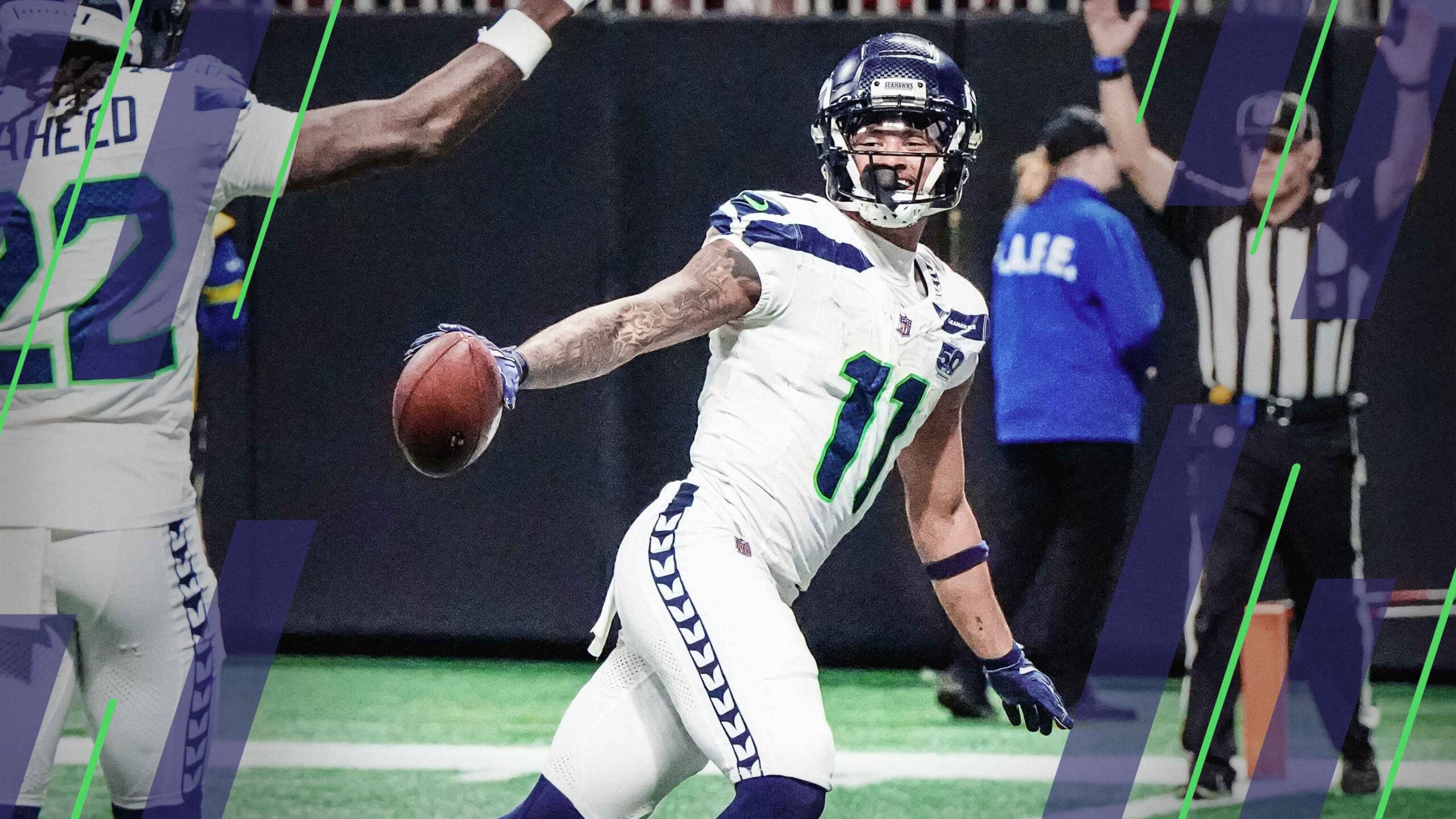
In this article, we’ll break down the most important storylines for Super Bowl 60 on both sides of the ball. But before turning our attention to the key matchups on offense and defense, we’ll first take a quick look at special teams.
Could special teams decide the Super Bowl?
A lot of Super Bowls in the past have been decided by a game-winning field goal, and that could certainly happen again in a close game. With these two teams specifically, however, the return units stand out as potential difference-makers.
Both are capable of producing game-changing plays. The Seahawks led the league in return touchdowns (four), while the Patriots ranked second (three). The two longest punt returns of the season also belong to these Super Bowl teams, with Seattle recording a 95-yard return and New England posting a 94-yard return.
They are not only splashy, though, they are also consistently good, as the following chart shows.
The Patriots ranked second in the NFL in punt-return grade (91.2), while the Seahawks finished fifth (87.0). In terms of average return yardage, New England ranked first in the league (17.3 yards), with Seattle placing third (15.4 yards).
A single explosive play on special teams or the ability to consistently gain field position through strong returns could swing a game that is not expected to be high-scoring. The betting market total currently sits at 45.5, roughly the NFL average across all games, but it is the lowest Super Bowl total since the 2015 season.
When the Seattle Seahawks have the ball
Earning passing looks
The Seahawks, under offensive coordinator Klint Kubiak, run a classic Shanahan-style offense. The philosophy is to operate from a narrow set of similar-looking formations, many of which are condensed and feature heavy personnel groupings.
That approach forces defenses to respect the run, even when it is not particularly efficient. Seattle ranked near the top of the league in under-center usage (second) and heavy personnel usage (sixth, defined as two or fewer wide receivers on the field) while ranking near the bottom in formation width and pass rate.
A low formation width reflects the Seahawks’ frequent use of condensed formations. Only 34.7% of their eligible receivers aligned outside, the second-lowest rate in the league behind Sean McVay’s Rams. By contrast, 25.0% of Seattle’s eligible players aligned in-line, primarily tight ends, the highest mark in the NFL. Tight end A.J. Barner aligned in-line or in the backfield on 88.0% of his snaps, and no tight end with a comparable full-time role (600-plus offensive snaps) recorded a higher rate.
Their average formation width — defined as the distance between the leftmost and rightmost eligible receivers before the snap — is just 22.3 yards, ranking 30th in the NFL. Only the 49ers and Bears deploy more condensed formations.
Seattle’s pass rate sits at just 53%, tied for the lowest in the NFL. Even after accounting for frequent positive game script, the Seahawks still rank 27th in pass rate over expectation at -4%, showing how committed they are to running the football. That approach is intentional: the goal is to force defenses into run-stopping looks and then capitalize on favorable passing situations.
It has worked. Outside the red zone, Seattle’s heavy personnel has been met with sub-packages only 16% of the time, leading defenses to stay in base personnel on 46% of Seahawks offensive snaps — second only to Baltimore (47%).
Opponents have responded by crowding the box, as Seattle has faced an average of 7.0 defenders in the box per play, the highest rate in the NFL. Loaded boxes (eight or more defenders) have appeared on a league-high 33% of snaps, four percentage points more than any other team, while light boxes (six or fewer) have been seen just 32% of the time, the lowest rate in the league.
Notes on play action
When we think about offenses built like Seattle’s, play action is usually the first concept that comes to mind. The idea is straightforward: force defenses to prioritize stopping the run, then use play action to create downfield opportunities for Sam Darnold, who possesses one of the strongest arms in the league.
The Seahawks do lean into this at times, but an interesting trend across Shanahan-derived offenses is that many no longer rely on play action as heavily as expected.
That’s likely because creating favorable passing looks before the snap has proven to be more important than the play-action fake itself. Over the past decade, passes off play action have generated 0.12 EPA per dropback, compared to just 0.04 EPA per dropback without play action. At face value, that suggests a massive advantage. However, much of that gap is driven by selection bias — teams tend to use play action in situations where the defense is already compromised.
The contextual differences are stark. On non-play-action dropbacks, offenses are in heavy personnel just 18% of the time, face base defense on only 11% of snaps and see an average of 6.0 defenders in the box. On play-action dropbacks, those numbers jump to 53% heavy personnel usage, 37% base defense and an average of 7.2 box defenders.
These are meaningful differences that explain more of the passing success than the play action fake itself.
Just looking at simple splits based on play action and facing base defense already shows that the effects are similar.
QualifierUsing play actionFacing base defenseEPA/playSuccess RateEPA/playSuccess RateYes0.1250%0.1351%No0.0446%0.0546%This analysis is still flawed because play action and facing base defense are largely correlated, so we have to account for both qualifiers simultaneously.
When passing against sub-packages without play action, offenses generated 0.03 EPA per play. When going under center and forcing base defenses — still without using a play-action fake — that number jumps to 0.13 EPA per play. Adding play action on top of that increased efficiency only slightly, to 0.14 EPA per play. This suggests that most of the benefit comes from earning favorable passing looks rather than from the play-action fake itself. It is also telling that using play action against sub-packages (0.10 EPA per play) is overall less successful than not using play action against base defense.
When using more qualifiers to describe defensive intent, it becomes even clearer that forcing the defense to respect the run is more important than the play-action fake. If defenses are in sub-packages, have six or fewer players in the box and disguise the coverage shell pre-snap, play-action passes generate just 0.05 EPA per play. By contrast, non-play-action passes against base defense, heavier boxes and non-disguised coverages generate 0.13 EPA per play.
When looking at other pass outcome metrics, it becomes clearer what the play-action fake can provide once favorable passing looks have already been earned: explosive plays. When passing against base defense, play-action usage yields the following splits:
Without play actionWith play actionTime to throw on targets2.31s3.10sAverage Depth of target7.510.4Yards per play6.27.5Yards per attempt6.78.515+ yards completion11%19%25+ yards completion4%7%Sack rate4.6%5.8%Success rate51%50%Once the defense is forced into a favorable passing look, play action is meant to buy just enough extra time to attack explosively — resulting in a higher average depth of target, more deep completions and, ultimately, more yards per play and per attempt. However, that upside comes with tradeoffs. Play action is associated with a higher sack rate and lower success rate, and because the quarterback must turn his back to the defense, it becomes harder to process post-snap movement.
That makes offenses more vulnerable to disguised coverages and slot pressure in particular.
For an offense like the Seahawks' — whose philosophy centers on earning favorable passing looks — limiting sacks and maintaining a high success rate are paramount. As a result, Seattle does not deploy play action at an especially high rate.
The Seahawks use play action on 28% of dropbacks, just two percentage points above the league average. Eight teams use it more frequently. While 28% might have sounded high several years ago when most offenses lived almost exclusively in shotgun, it is a modest rate for a team that operates heavily from under center. And because Seattle already passes less often than most teams, its play-action usage relative to total offensive plays is actually below average.
That said, when the Seahawks do use play action, they make it count. They generate 0.27 EPA per play (fifth in the NFL) and average 10.6 yards per attempt (second) — illustrating that they are choosing their spots wisely.
The weaknesses
Overall, the Seahawks have arguably generated the most favorable passing looks of any team in the league, and they have been wildly successful when opponents make things “easy” on them.
When facing base personnel, Seattle’s passing offense generated 0.35 EPA per play, ranking fourth in the NFL. Sam Darnold earned an 86.0 passing grade in those situations, and his throws generated a league-best 10.3 yards per attempt.
Because of the sheer volume of dropbacks against base defense, the Seahawks produced 68 total EPA in those situations — first in the league by a comfortable margin — while their 56% success rate ranked sixth. A similar picture emerges when looking at snaps without coverage disguise. When defenses show either single-high or two-high shells pre-snap and stay in those looks post-snap, Seattle’s passing offense ranks third in success rate (53%) and sixth in EPA per play (0.15).
Things look far less rosy when defenses anticipate the pass. Against sub-packages, the Seahawks generated just -0.01 EPA per pass play, ranking 20th in the league. Nearly identical results show up when defenses disguise their coverage shells (-0.02 EPA, 19th) or align with six or fewer defenders in the box (-0.08 EPA per play, 25th) — essentially signaling that they do not fear the run.
Against those pass-expecting looks, Sam Darnold recorded more turnover-worthy plays (13) than big-time throws (11). The list of quarterbacks with more big-time throws against nickel or dime defenses than Darnold includes several part-time starters, such as Joe Flacco, Tyler Shough, Marcus Mariota, Jacoby Brissett, Tua Tagovailoa and J.J. McCarthy.
Given all of this, it is not surprising that Seattle’s offense began to sputter once defenses adjusted their approach. The Seahawks’ strategy of earning favorable passing looks is still generally working, but defenses are no longer as easily manipulated. Coincidence or not, after Seattle made a high-profile trade for wide receiver Rashid Shaheed at the deadline, opponents began devoting more resources to stopping the pass:
Weeks 1-9Weeks 10-18Seahawks pass rate in neutral situations50%57%Seahawks' 11 personnel43%48%Opponents’base defense50%44%Opponents matching heavy personnel with base87%81%Opponents disguising coverage27%36%Opponents disguising coverage against heavy personnel21%31%On the positive side for Seattle, that shift helped unlock the Seahawks’ running game. From Week 10 to 18, Seattle’s running backs averaged 0.08 EPA per carry (third) and 4.9 yards per attempt (sixth), a massive improvement from the first nine weeks of the season, when they posted -0.16 EPA per carry and just 3.8 yards per attempt (both ranking 27th in the league).
Kenneth Walker III and Zach Charbonnet ranked fourth and second, respectively, in PFF rushing grade from Week 10 on. Charbonnet, however, will miss the Super Bowl after being placed on injured reserve.
At the same time, Seattle’s ability to move the ball through the air fell off sharply. Since Week 10, the Seahawks rank just 21st in EPA per play through the air (-0.03) while averaging an at-best pedestrian 7.1 yards per attempt.
Sam Darnold’s 58.9 PFF passing grade in that span ranks 25th among the 28 quarterbacks with at least 200 dropbacks. Only Baker Mayfield, Jacoby Brissett and Shedeur Sanders recorded more turnover-worthy plays over that stretch, but all three also produced more big-time throws than Darnold.
Despite that clear decline in passing efficiency, Seattle went 8-1 down the stretch and secured the No. 1 seed, even while fielding a passing offense that graded as clearly below average.
With such a pronounced split entering the Super Bowl, the natural question becomes whether New England’s defense is equipped to exploit it.
The Patriots generally lean into matching heavy offensive personnel with sub packages, doing so on 44% of snaps during the regular season. While that figure may not seem extreme, it ranks eighth-highest among all NFL defenses. Given Seattle’s offensive tendencies, it would not be surprising to see New England push that number even higher on Sunday.
On paper, the Patriots can afford to do so. When defending heavy personnel out of nickel looks, New England allowed just 4.1 yards per carry and -0.21 EPA per rush.
Maintaining that level of run defense while staying in sub-packages is a prerequisite for the Patriots if they are going to win this game.
How to stop Jaxon Smith-Njigba?
When discussing the Seahawks’ offense, Jaxon Smith-Njigba must be front and center.
Smith-Njigba's 93.1 PFF receiving grade and 3.42 yards per route run would have easily led the league if not for Puka Nacua’s historically great season. Smith-Njigba’s impact even transcended Seattle’s second-half struggles, as he still totaled 845 receiving yards (third), six touchdowns (fourth) and 38 first downs (third) from Week 10 on — a stretch in which the Seahawks ranked among the league’s worst passing offenses by most metrics. No team relied more heavily on its No. 1 receiver than Seattle.
Like most elite receivers, Smith-Njigba consistently shreds man coverage, particularly Cover 1. For good reason, defenses limited those looks against him — he faced just 72 Cover 1 snaps all season — but he was targeted on 30 of them, producing 359 receiving yards and an absurd 4.99 yards per route run.
Man coverage has become increasingly rare across the league, with teams using it on just 23% of coverage snaps on average. The Patriots lean into it slightly more, playing man coverage at a 29% rate. More notably, they deploy Cover 1 at the sixth-highest rate in the NFL (24%).
They would be wise to limit that usage in this matchup, not only because of Smith-Njigba, but also because the Seahawks as a whole thrive against man coverage. Seattle ranked fourth in the league in efficiency versus man at 0.32 EPA per pass play, while struggling against zone coverage, where they generated just 0.03 EPA per play (18th).
Of course, Seattle will eventually catch New England in man looks — either by design or through match principles that effectively turn zone into man — and when that happens, someone must account for Smith-Njigba. The Patriots’ natural answer is Christian Gonzalez, last year’s second-team All-Pro and a Pro Bowl selection this season.
Whether Gonzalez will consistently follow Smith-Njigba, however, remains unclear. Last season, Gonzalez split his alignment evenly between the left and right sides, regularly shadowing top receivers such as D.K. Metcalf, Garrett Wilson, Ja’Marr Chase, Marvin Harrison Jr., Davante Adams and Tyreek Hill. This year, his deployment has been far more static: 644 snaps against the left outside receiver compared to just 203 on the right, indicating a clear preference for one side.
When Gonzalez does travel, it is often to the boundary, though not consistently enough to establish a firm tendency. Overall, he has shadowed far less frequently than he did a year ago.
That shift appears to stem from two factors. First, the new Patriots coaching staff under head coach Mike Vrabel has adopted a different coverage philosophy, leaning less heavily on man coverage. Second, New England added a capable counterpart in Carlton Davis III, a cornerback who does not shy away from high-end matchups opposite Gonzalez.
Gonzalez’s lone true shadow assignment during the regular season came against Emeka Egbuka, whom he followed across both sides of the formation and into the slot. He also saw snaps on both sides against Jerry Jeudy, Drake London and Tee Higgins, though none of those matchups amounted to full-game shadow coverage.
In the playoffs, Gonzalez flipped his regular-season tendencies, lining up more often on the left side of the defense (across from the right outside receiver) than on the right against both the Texans and the Broncos. Against Houston, he did not shadow a specific receiver, instead lining up against both Xavier Hutchinson and Jayden Higgins more than 20 times each. Notably, Gonzalez aligned on the boundary side on every single outside corner snap in that game.
Against Denver, his usage shifted slightly. Gonzalez lined up across from Courtland Sutton on 24 of his 36 coverage snaps and followed him into the slot twice. This was the closest Gonzalez came to a true shadow assignment this season, aside from his Week 10 shadowing of Emeka Egbuka.
Robert Saleh recently discussed how true shadow assignments can create issues for defenses and often clash with modern zone- and match-based philosophies. As a result, the league-wide number of shadow assignments has steadily declined over the past decade, dropping from more than 100 per season to roughly 30. Given Gonzalez’s deployment in 2025 compared to last year, the Patriots’ new coaching staff appears to align with that philosophical shift. As such, having Gonzalez travel with Smith-Njigba for an entire game would represent a departure from their typical approach. That said, the Patriots have already shown in the playoffs that they are willing to adjust Gonzalez’s usage, and with two weeks to prepare, all options remain on the table.
It’s also worth noting that under Bill Belichick, the Patriots were famously willing to double an opponent’s No. 1 receiver and force the rest of the offense to beat them. While Belichick is no longer in New England, Mike Vrabel spent a significant portion of his playing career under him, meaning the concept is certainly familiar.
While we can’t predict whether the Patriots will deploy that strategy here, we can examine how the Seahawks have performed against man coverage when Jaxon Smith-Njigba is not the primary target. In those situations, Seattle generated just 0.02 EPA per pass play — roughly identical to its efficiency against zone coverage.
That is not a perfect proxy, since most of those snaps did not involve defenses dedicating extra resources to Smith-Njigba via bracket coverage or true doubles, but it does highlight how dependent the Seahawks’ passing offense is on their star receiver. In fact, when comparing every team’s efficiency against man coverage with and without their most-targeted receiver, no team showed a larger drop-off than Seattle without Smith-Njigba.
Given all of this, asking Christian Gonzalez to live on an island against Smith-Njigba for four quarters does not appear to be the optimal approach. Instead, both a zone-based strategy that limits opportunities for isolation and a more traditional doubling approach are viable ways to reduce Smith-Njigba’s impact. It would not be surprising to see the Patriots mix both strategies throughout the game in an effort to slow down Seattle’s passing offense.
Trench warfare
The Seahawks have gotten very good offensive tackle play this season, particularly in pass protection.
Because of their heavy use of condensed formations, neither Abraham Lucas nor Charles Cross has been asked to block on an island at a high rate, but when they have been, both have more than held their own and performed at an above-average level.
On the flip side, the Patriots’ defensive line strength doesn’t come off the edge, meaning Sam Darnold should be relatively protected in that area.
The interior is a different story. Jalen Sundell, Grey Zabel and Anthony Bradford aren’t poor linemen by any means, but they represent the weakest link in Seattle’s pass protection, as all three graded slightly below average as pass blockers. That’s where the Patriots will look to attack, particularly with Milton Williams, who has been excellent when deployed in sub-packages and given one-on-one rushing opportunities.
Christian Barmore has also been above average as a pass rusher, both when facing double teams and when isolated one-on-one. The Seahawks ranked 23rd in the NFL against interior pressure during the regular season, averaging -0.40 EPA per play when pressure came up the middle.
New England blitzed at a league-average rate during the regular season but dialed up the aggression in the playoffs, blitzing on 44% of opposing dropbacks. Whether the Patriots can consistently win those interior matchups — and supplement them with timely, effective blitzes — could ultimately determine whether Sam Darnold, more than six years after famously “seeing ghosts” against this defense, is haunted once again or leads Seattle to victory.
Are all the issues gone?
Speaking of leading his team to victory, that’s exactly what Sam Darnold did against the Rams in the NFC championship game. Given the Seahawks’ struggles over the second half of the season, it wouldn’t have been shocking if they had followed the path of the 2021 Tennessee Titans or the 2023 Miami Dolphins — teams that leaned heavily on defenses selling out to stop the run, only to fall short in the playoffs.
Seattle’s offense wasn’t truly tested in the Divisional Round against the San Francisco 49ers, as the defense and special teams controlled that game from start to finish.
The Rams, however, were able to put the Seahawks in a much different situation. As one of the few teams capable of scoring consistently against Seattle’s league-best defense, Los Angeles did just that in the NFC title game.
That success allowed the Rams to put Darnold under real scoring pressure, deploying sub-packages on 60% of snaps and disguising coverage on more than one-third of his dropbacks. Based on Seattle’s regular-season performance against those looks, the advantage should have swung decisively toward Los Angeles. Instead, the Seahawks answered the call:
- Against light boxes (21 snaps), the Seahawks were highly efficient through the air, averaging 0.77 EPA per pass play while throwing for 11.3 yards per attempt and two touchdowns.
- Even when the Rams leaned into pass-first looks with nickel or dime personnel (29 snaps), Seattle continued to move the ball, posting 0.39 EPA per pass play and 9.6 yards per attempt.
- Perhaps most impressively, the Seahawks punished interior pressure. On just six snaps with pressure up the middle, they generated 60 passing yards and three touchdowns, averaging a staggering 1.00 EPA per play.
Many of the Seahawks’ apparent regular-season weaknesses suddenly vanished in the NFC Championship Game. That naturally raises the question of whether the 17-game regular-season sample is more predictive, or whether Seattle’s offense is simply peaking at the right time.
Looking at the Patriots’ defense — even after setting aside their matchup against a backup quarterback in a snowstorm — New England has shown a clear ability to identify and amplify opposing offenses’ weaknesses in the playoffs. In the Wild Card and Divisional rounds, they dominated the Los Angeles Chargers’ and Houston Texans’ offensive lines, generating pressure rates of 56% and 48%, respectively.
That postseason surge is notable because the Patriots were not viewed as a dominant pass-rushing unit during the regular season. After accounting for time to throw and situational factors, they generated pressure at only the 14th-highest rate in the NFL. Yet when the playoffs arrived, they found ways to manufacture disruption and overwhelm vulnerable units.
The central question now is whether New England can once again magnify a known weakness — this time against Seattle’s passing offense when defenses sell out to stop the run — or whether the Seahawks can continue to overcome those issues, or even punish the Patriots on the ground if they lean too heavily into light boxes. The answer to that question may ultimately decide Super Bowl 60.
When the New England Patriots have the ball
On paper, this matchup sets up as a clear strength-on-strength battle between the Seahawks defense and the Patriots offense.
Seattle’s defense, led by head coach Mike Macdonald, carried the team to 14 wins and the NFC’s No. 1 seed. On the other side, the Patriots’ offense was the primary driver of their own 14-win season, narrowly missing out on the AFC’s top seed due to a tiebreaker.
What makes the Seahawks defense special?
The Seahawks are a zone-based defense, playing zone coverage on 79% of snaps — the fourth-highest rate in the NFL. They live in two-high shells, showing middle-of-the-field-open looks on 84% of snaps, with only Vic Fangio’s Eagles using two-high looks more frequently.
Out of those shells, Seattle plays the league’s highest rate of Cover 6, yet remains fairly unpredictable overall. They disguise coverage on 41% of snaps, the seventh-highest mark in the NFL.
None of that, on its own, is particularly new or unique. What truly separates the Seahawks from other defenses — both this season and historically — is how they handle the run. Specifically, Seattle is willing and able to match opposing heavy personnel (two or fewer wide receivers) with sub personnel (five or more defensive backs) at an extreme rate. They do so on 87% of those snaps, a true unicorn number across the league, as only five teams even exceed 50%.
The Seahawks and Ravens are the only two teams to do this more than two-thirds of the time — and Seattle comes close to doing it on virtually every snap, regardless of opponent or situation.
Since they also — like essentially every NFL team — match 11 personnel with sub packages, the Seahawks almost never leave nickel or dime personnel. They can live in those looks because of a strong defensive line, with Leonard Williams and Byron Murphy anchoring the interior and DeMarcus Lawrence (85.0 PFF run-defense grade) wreaking havoc off the edge.
It’s also notable that Seattle doesn’t have a weak link against the run. Every Seahawks defender with at least 200 run-defense snaps except one has earned a 70.0-plus run-defense grade. Cornerback Devon Witherspoon exemplifies that commitment. His 10 run stops rank 10th among cornerbacks league-wide, and most impressively, he missed just one tackle against the run — easily the fewest among corners who regularly provide run support.
A strong defensive line and corners willing to play the run are important, but those traits alone aren’t unique. The player who truly makes this system work is a rookie: Nick Emmanwori.
Emmanwori represents one of the NFL’s newest defensive trends. Rather than filling the nickel role with a cast-off corner deemed unsuitable to play outside, teams are increasingly deploying core defenders — players who rarely leave the field — in that spot. This evolution was necessary as offenses began to dominate from the slot, moving their best wide receivers inside more frequently and deploying receiving tight ends who were too quick for linebackers and too physical for traditional slot corners.
Emmanwori can cover wide receivers, match up with receiving tight ends and still hold up against the run versus in-line blockers. Essentially, he can fill every interior role in Seattle’s defense. Against spread looks, he functions as a slot corner (387 snaps). Versus condensed formations and heavy personnel, he can align as a linebacker in the box (289 snaps) or even take reps on the edge of the defensive line (91 snaps).
That versatility is what ultimately allows the Seahawks to stay in nickel or dime personnel for an entire game. It not only keeps them structurally prepared to defend the pass at all times, but also makes them largely immune to no-huddle tactics. Offenses can’t catch Seattle in an unfavorable personnel grouping when the defense never needs to substitute its nickel off the field.
The key is that the Seahawks can deploy the same personnel group while presenting different defensive answers. In particular, they can neutralize the “fake tight end” — a nominal tight end used primarily as a receiver to force heavier defensive looks. Against Seattle, that strategy loses its value. If drawing run-stopping personnel no longer creates advantageous passing looks, a true wide receiver would typically be the more effective option.
The results back that up. The Seahawks have allowed just 1.1 yards per route run and 6.0 yards per target to tight ends aligned in the slot. That’s a difficult matchup for Hunter Henry, who has lined up in the slot or outside on 60% of the Patriots’ pass plays this season.
This approach helped make the Seahawks the best defense in the NFL, ranking first against the run and fourth against the pass. With the top of the leaderboard tightly packed, that pass-defense ranking effectively places them alongside the Browns, Broncos, Texans and Vikings at the very top of the league.
Their ability to stop the run out of nickel was nearly flawless. Seattle logged by far the most snaps defending runs against heavy personnel while staying in nickel or dime, and allowed just -0.24 EPA per carry and a 30% success rate in those situations — the best and second-best marks in the NFL, respectively.
Pair that with an opportunistic pass rush that uses stunts at the highest rate in the league and a strong secondary led by cornerback Devon Witherspoon (86.7 PFF coverage grade), and the result is a complete defensive unit. The Seahawks are disciplined in both their run fits and zone-based match coverages, allowing the lowest rate of explosive runs (8.3%) and the second-lowest rate of explosive passes (10.9%) in the NFL.
Drake Maye’s MVP season
However, the Rams have shown multiple times that the Seahawks defense can be beaten, and the Patriots — led by Drake Maye — represent the toughest test Seattle will face outside of its three matchups with Los Angeles this season. In theory, New England’s offense has the tools to hold its own against this unit.
Unlike most opponents, the Patriots are not dependent on earning favorable passing looks. They ranked first in the NFL against sub packages, generating 0.32 EPA per pass play with a 56% success rate and 9.0 yards per attempt. That profile carries across nearly every defensive look Seattle prefers to deploy.
New England also led the league in EPA per pass play (0.24) and yards per attempt (9.2) against zone coverage. The same dominance shows up against light boxes (0.42 EPA/play, 9.2 yards per attempt), disguised coverages (0.43 EPA/play, 9.0 yards per attempt) and two-high shells (0.31 EPA/play, 8.1 yards per attempt). In other words, this is an offense structurally built to withstand exactly the types of looks the Seahawks defense is designed to create — and a major reason for that is just how well Drake Maye is already playing in his second NFL season.
Over the past 12 years, arguably only Patrick Mahomes and Lamar Jackson — both eventual MVPs — have produced better sophomore seasons. Even then, they did so in a league environment that was far less focused on limiting explosive passing plays than today’s defenses.
Not built for stronger competition?
There is one glaring problem: the Patriots’ offense has been very poor in the playoffs. Over their last three games, they averaged just 4.4 yards per play and -0.17 EPA per play — production that would have ranked 29th during the regular season.
The AFC championship game can be partially explained by the snowstorm in the second half, but weather was not a factor against the Chargers or Texans, and New England still struggled to move the ball, particularly once pressure reached Maye.
Critics have questioned the Patriots’ schedule all season, and this playoff run — even with a Super Bowl appearance — has done little to fully silence those concerns.
The Patriots’ offensive struggles against three high-end defenses are a major reason why the Seahawks enter the Super Bowl as clear favorites. After all, Seattle’s defense may be even better than any unit New England has faced so far this postseason.
After adjusting for time to throw and situational factors, the Seahawks generated pressure at the sixth-highest rate in the NFL — comparable to the Chargers and Broncos, though still a step below Houston’s league-best pass rush. That sets up another challenging environment for Drake Maye, whose offensive line has failed to build on a strong regular season. Rookie left tackle Will Campbell, in particular, has struggled in the playoffs.
If the Patriots are going to counter that pressure, Maye will need cleaner, more immediate answers built into the offense — but identifying where those solutions come from is the critical question.
How to beat the Seahawks defense?
With the Seahawks defense so disciplined on the back end and so versatile up front, how can the Patriots attack them?
The NFL is a copycat league, and when facing the league’s best, you copy what works. No offense had more consistent success against Seattle this season than the Rams. While the Patriots are a very different offense, there are still elements worth borrowing. Most importantly, when playing against perhaps the best-coached and most disciplined coverage unit in the NFL, the goal must be to force defenders out of their rules.
Rams head coach Sean McVay did exactly that. He repeatedly stressed Seattle’s zone structure with in-breaking routes that outside corners were not carrying, creating throwing windows over the middle for Matthew Stafford. Puka Nacua, in particular, shredded the Seahawks on these concepts in the teams’ second regular-season meeting, including the would-be game-winning touchdown in overtime.
Seattle eventually adjusted in the NFC Championship Game by asking its outside corners to carry those in-breakers. McVay immediately countered, sending Nacua on a corner route against Riq Woolen for an easy deep touchdown after Woolen bit on the possibility of another in-breaking route. Importantly, the Rams didn’t expose a glaring flaw — Seattle’s defense is not prone to giving up intermediate or deep-middle completions. Instead, McVay succeeded by forcing hesitation and conflict within an otherwise sound structure.
The heatmap below illustrates that reality. The Seahawks consistently funnel targets — and completions — to the short areas of the field, trusting their disciplined underneath coverage to rally, tackle and limit explosive gains.
Only three defenses allowed fewer EPA on targets over the intermediate and deep middle of the field this season — one of them being the Patriots. Rather than searching for a weakness that largely doesn’t exist, the Rams leaned fully into one of their own strengths, pushing it to an extreme and forcing the Seahawks defense to react instead of dictate terms.
Once the Rams understood how Seattle adjusted, they capitalized with explosive plays.
The Patriots don’t rely on throws over the middle to the same extent as some offenses, but they are more than capable of attacking that area. Only the Lions and Rams generated more EPA when throwing between the numbers during the regular season.
Drake Maye has repeatedly shown the ability to manipulate underneath defenders with his eyes and layer throws into tight windows over the middle of the field. (He’s capable of doing the same toward the sideline, of course.) If New England can stress Seattle with in-breakers early and often in the Super Bowl, they could force the Seahawks’ zone structure to behave more like a predictable man-match system, opening opportunities for Maye to target Stefon Diggs and Kayshon Boutte on potential downfield shots.
The connection with Boutte has been outstanding all season on deep throws, while Diggs has remained the more reliable and consistent target overall. While the Patriots’ receivers are unlikely to generate separation as easily as Puka Nacua, Maye’s deep ball gives New England some margin for error. At this stage of their careers, Maye is throwing a better deep ball than Matthew Stafford, allowing him to succeed even with tighter coverage.
Maye leads the league in EPA per attempt on deep sideline throws into tight coverage and trails only Jacoby Brissett in PFF passing grade on those attempts. Only the Cincinnati Bengals generated more first downs on such throws.
Creating enough opportunities for Maye to take those shots — particularly in clearly defined one-on-one situations — would go a long way toward helping the Patriots find answers before Seattle’s pass rush begins to consistently affect the pocket.
Another way for New England to dictate terms and force the Seahawks to react is through Maye’s scrambling ability. No quarterback scrambled more often than Maye this season, and only Baker Mayfield, Justin Herbert, Josh Allen and Lamar Jackson generated more total value on scrambles.
If Maye can punish Seattle early with timely scrambles for first downs, it could force the Seahawks to devote additional resources to accounting for him as a runner — a shift that may alter coverage dynamics on the back end and create exploitable windows for the Patriots’ passing game.
Conclusion
This year’s Super Bowl features no shortage of compelling storylines that could ultimately decide the outcome, chief among them whether the Seahawks offense can continue to overcome the flaws it showed during the regular season or if the Patriots offense can leverage its strengths to dictate the matchup.
Overall, the Seahawks are rightfully favored, but they also appear to be under more pressure to win. As dominant as Seattle’s defense looks right now, teams built in this mold have historically operated within relatively short championship windows. It’s possible that modern defenses maintain their edge for several more years, allowing the Seahawks to remain contenders longer than expected, but the Patriots can reasonably feel confident that they’ll be in the mix for years to come after drafting a franchise quarterback who could anchor the position for the next decade.
That said, as their division rival in Buffalo has learned all too well, consistently being in contention guarantees nothing. Opportunities like this are rare, and New England would surely welcome the chance to capitalize on its first one this Sunday — an opportunity almost no one saw coming back in August. Just like 25 years ago, when the Patriots won their first Super Bowl behind a second-year quarterback.