Innovation
Talented Malaga University students design hand prosthesisThe BioMec team ranked fifth at a national engineering competition in Valencia this past May
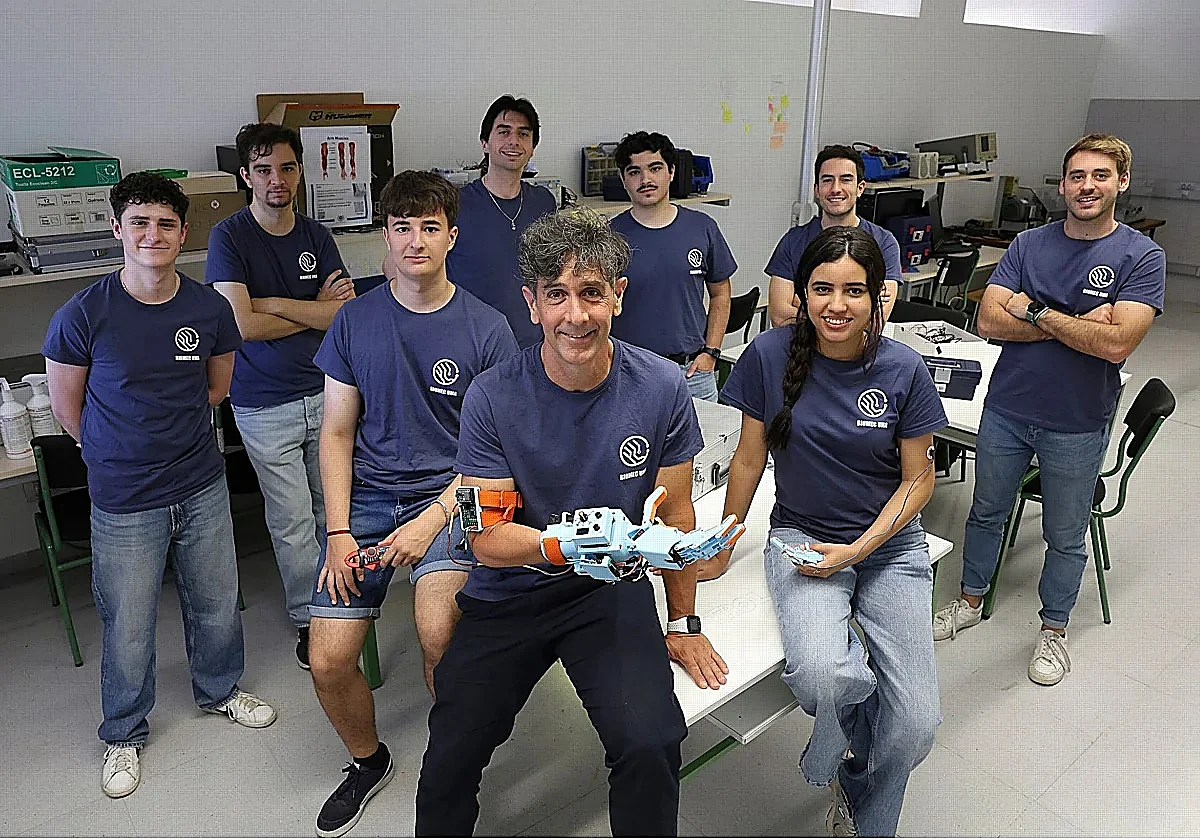
Añádenos en Google The Malaga University students posing with Alejandro Jiménez, an amputee who helped them with the project. (Migue Fernández)Matías Stuber
08/06/2026 a las 15:52h.Having a prosthesis is like holding a tool. Guillermo García, 22, has two hands but thinks a lot about what it would be like to have only one. Or none at all. For the past few months, this student at Malaga University (UMA), who is pursuing a double degree in Industrial Engineering and Industrial Design, has been working with other students and a group of professors to develop a bionic prosthesis that can partially replace the function of the hands.
People with prosthetic hands can only dream of having the same dexterity. Ten years ago, the first artificial hand that informed the user about the firmness of their grip came onto the market. This technology is now standard. There are still many ways to continue improving the prosthesis.
With support from the Mechanical Engineering department and the BIOCLINA research group, these young people, part of the BioMec team, set themselves the goal of designing and manufacturing a myoelectric hand prosthesis.
This type of technology consists of a system capable of recording the electrical signals generated by the user's muscles when they contract and then translating those impulses into real movements of the artificial hand. The technical challenge was enormous and time was tight. The aim was to be ready for the second university prosthetic hand competition at Universidad Politécnica in Valencia on 15 May.
What began as a student project with minimal resources became a remarkable achievement that day. The UMA team was crowned the fifth best in Spain and the first in all of Andalucía.
This feat takes on epic proportions in retrospect, as the team competed against university departments with years of experience and significant budgets in the field.
To get there, they relied on the indispensable help of Alejandro Jiménez, 53, who lost his hand in a work accident in 2014. "One of the team members approached me at the gym. He told me about the project and that they were looking for an amputee to develop and test a prosthesis," he tells SUR.
"I didn't hesitate. If it's to help, then so be it," he says. Alejandro was a TEDAX (explosive ordnance disposal specialist) with the National Police. He was injured while handling a grenade in Seville.
He confirms that the biggest challenge with prostheses lies in the lack of sensation and the response time. "From the moment you give the command through the forearm or biceps muscle until the prosthesis responds, there's often an uncomfortable delay," he explains.
Alejandro's attitude towards young people is a prime example. Smiling, refusing to taboo a traumatic experience and helping without expecting anything in return.
The technical challenge was colossal and the timeframe "ridiculous", but the students compensated for their lack of experience with industrial doses of talent, enthusiasm and sleepless nights.
While other competitors were refining models from previous years, the students from Malaga had to develop their prototype against the clock, demonstrating that a lack of resources can be overcome with ingenuity. "We've barely had any funding. We bought the materials ourselves. Now it seems that we'll have more resources for next year," Guillermo says.
The competition in Valencia
At the ultimate test in Valencia, the prosthesis had to demonstrate a real-world utility in a circuit of 14 everyday tasks. Actions that are automatic for most people, such as holding and carrying a three-kilo shopping bag, opening a drawer to retrieve a comb, handling a one-litre bottle of water or stacking plastic cups into a pyramid, represent an extreme challenge of precision, strength and control for a mechanical prosthesis.
This is where the surprise came, as the Malaga team proved to have the most agile prototype in the country. With an astonishing efficiency of just 24 seconds per test, BioMec UMA devoured the circuit in a record time of three minutes and 39 seconds, officially becoming the fastest in the competition.
Alejandro flawlessly completed 13 of the 14 tests on the circuit. However, an untimely overheating of the motors forced the team to play it safe to protect the component.
Despite this unexpected technical setback, Alejandro's expertise and the robust design allowed them to officially complete nine tests, securing fifth place. In the end, BioMec UMA returned from Valencia without a gold medal, but having demonstrated that Andalusian talent doesn't need large budgets to compete on equal footing with the forefront of national medical engineering.
There is also pride among the professors who oversee this project: Professor of Mechanical Engineering Salvador Moreno and Professor of Biomedical Engineering Alejandro Peña. "They have worked with complete autonomy. We have been there as a support network, in case of any questions," they both say.
For next year, the UMA team are aiming for first place.