3 min read
The Birthplace of the United StatesImage of the Day for July 3, 2026It was here the founders shaped the future of American government.
NASA Earth Observatory
Jul 03, 2026 ArticleEditor’s note: In honor of America’s 250th birthday, Earth Observatory is revisiting stories about the landscapes that helped shape U.S. history. The images and text on this page were originally published on July 4, 2017. Explore the full collection here.
Situated between the Schuylkill and Delaware rivers, Philadelphia was founded in 1682 by William Penn as the seat of a Quaker colony. Later, its location just upstream of the Delaware Bay and Atlantic Ocean made it an industrial, commercial, and cultural hub of the American colonies.
When the area’s original inhabitants, the Lenni Lenape (Delaware) Indians, lived here, much of the land was forested. Swedish and Dutch settlers had already traveled in the area when Penn finally came to it and signed a treaty with the Lenape to establish a city. He called his colony—now the state of Pennsylvania—Sylvania, after its sylvan, wooded appearance. Current-day Philadelphia had “a high and dry land next to the water, with a shore ornamented with a fine view of pine trees growing upon it,” according to a historical account.
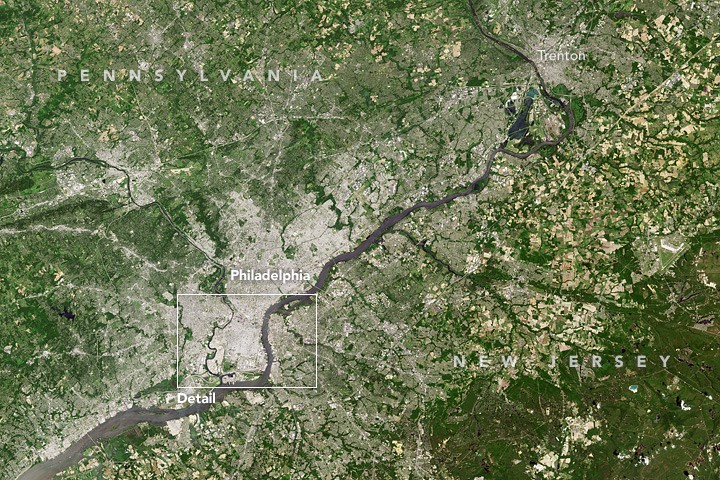
More than 300 years after Penn’s arrival, this landscape remains verdant, despite its urban development. The natural-color image above shows Philadelphia and the surrounding area as it appeared on June 1, 2013, when the Operational Land Imager (OLI) on the Landsat 8 satellite passed overhead.
Nearly a hundred years after Philadelphia was established, the Founding Fathers of the United States met in this thriving city roughly at the geographic center of the 13 colonies. It was here that they debated, composed, and signed the documents that would become the blueprints of the American government. In 1776, they signed the Declaration of Independence in Carpenter’s Hall, not far from the red-brick building that then housed Pennsylvania’s colonial government; in 1787, they signed the Constitution in the same place. (Carpenter's is now known as Independence Hall.) Between 1781 and 1788, it was also the seat of the U.S. government.

Today, Philadelphia is the fifth largest city in the U.S., with more than 6 million people living in its metropolitan area. The city saw its heyday as a manufacturing hub in the 1800s. Currently, its largest sectors include education and health services.
Traces of the city’s history remain embedded in its landscape. A belt of large, tall buildings makes up Center City, the area around Independence Hall. To the south lies a dense grid of smaller houses—South Philadelphia, home to the city’s Italian Market. At one point, this was a satellite town to the city; the two merged in 1854, when the area’s population surged. It remains a diverse area today, home to a large African American community, as well as the remnants of once sizable Italian, Irish, and Jewish immigrant populations.
NASA Earth Observatory images by Jesse Allen, using Landsat data from the U.S. Geological Survey. Story by Pola Lem.
Downloads
June 1, 2013
JPEG (7.42 MB)
June 1, 2013
TIFF (57.54 MB)
References & Resources
- National League of Cities, The 30 Most Populous Cities. Accessed June 30, 2017.
- Penn Treaty Museum, Introduction to the Lenni Lenape, or Delaware Indians. Accessed June 30, 2017.
You may also be interested in:
Stay up-to-date with the latest content from NASA as we explore the universe and discover more about our home planet.
An Early “Decoration Day” Celebration 4 min readIn a precursor to Memorial Day, people in Charleston, South Carolina, honored fallen Civil War troops with flowers, songs, and…
Article Star-Spangled City 4 min readTwo hundred years ago, a battle in the port city of Baltimore inspired the writing of America’s national anthem.
Article Colonial National Historical Park 2 min readThe colonial communities of “America’s historic triangle” played defining roles in the road to American independence.
Article Keep ExploringDiscover More from NASA Earth Science
Subscribe to Earth Observatory Newsletters
Subscribe to the Earth Observatory and get the Earth in your inbox.
Earth Observatory Image of the Day
NASA's Earth Observatory brings you the Earth, every day, with in-depth stories and stunning imagery.
Explore Earth Science
Earth Science Data
Open access to NASA’s archive of Earth science data