- The 2022 Texans struggled at multiple positions: Linebacker Christian Harris and center Scott Quessenberry both own the infamous worst marks at their spots.
- Brandon Browner was a flag magnet in 2015: The Saints corner accrued 23 penalties that season as he floundered in coverage.
Although top-tier NFL talent naturally attracts the most attention, players who struggle also spur great interest. From C.J. Stroud’s porous postseason to the Los Angeles Chargers’ lowest-ranked offensive line, that was certainly evidenced during the 2025 campaign.
It can be easy to want to forget especially difficult seasons, but some are particularly ignominious. Differentiating between bad years is an innately tough task, but PFF’s more holistic grades and advanced data can help.
After examining the best years at every position in the PFF era, let’s take a spin in the other direction with the lowest-graded single seasons since 2006.
Note: A player had to play at least 50% of maximum positional snaps in a season to qualify, unless otherwise noted.
Quarterback: Blaine Gabbert, JacksonvilleJaguars (31.2 – 2011)
Gabbert’s 2011 season stands out, but not in a good way. His 31.2 overall PFF grade is the lowest by over nine grading points in PFF history. Across 475 dropbacks, Gabbert posted a solid 3.0% big-time throw rate but added a 4.2% turnover-worthy play rate. Also, his 62.2% adjusted completion percentage is the worst ever for a qualifier.
The 2006 season was also a notorious one, featuring two quarterbacks to produce sub-46.5 grades: J.P. Losman (40.4) and Rex Grossman (46.3). Although Matthew Stafford just won MVP, his rookie campaign was a real issue with a 45.2 overall mark in 2009. Recent seasons have also produced disappointing years in the form of 2014 Blake Bortles (46.7), 2018 Josh Rosen (49.1) and 2019 Kyle Allen (49.7).
Running Back: Maurice Morris, Seattle Seahawks (35.8 – 2006)
Morris played a decade-long career after being a second-round pick in 2002, with his first year as a starter arriving four years later. However, that didn’t materialize as projected. Morris compiled a 39.2 PFF rushing grade — actually not even the lowest that season — in part by forcing only 15 missed tackles on 169 carries and sitting at a 22.8 PFF Elusiveness rating. Morris was also largely ineffective as a weapon in the pass game, averaging 0.25 yards per route run over 189 passing snaps. Altogether, Morris’ grade is the lowest for any running back to play 350 or more snaps.
Overall, running back grading skewed toward lower numbers prior to 2009. From 2008, the Bengals’ Chris Perry (36.3) and Titans’ LenDale White (41.2) occupy the second and third spots in the list. Likewise, the Packers’ Ahman Green (42.0) and Bears’ Cedric Benson (42.4) also rank in the top six. Six separate players also finished below a 47.8 in 2009.
Wide Receiver: Andre Patton, Los Angeles Chargers (45.7 – 2019)
Patton’s lone season seeing offensive snaps came in 2019 with the Chargers, and it proved to be a lamentable one. Across 507 total snaps over 12 games, the former undrafted free agent secured only 15 targets and six catches on a 43.6 PFF receiving grade. Patton’s 0.18 yards per route run is the lowest mark ever for a wideout with at least that many targets in a season.
The 2017 campaign also experienced two of the lowest-graded wideout campaigns via the Panthers’ Russell Shepard and the Colts’ Kamar Aiken, who both finished below a 47.5 grade. Darrius Heyward-Bey (47.6) wasn’t much better as a rookie with the Raiders, while Nelson Agholor (48.7) didn’t win over Eagles fans in 2015.
Tight End: Tre’ McKitty, Los Angeles Chargers (32.2 – 2022)
The Chargers hoped to infuse a spark in their receiving game by taking McKitty in the third round, but his time in Los Angeles very much underwhelmed. Indeed, his tenure featured the lowest-graded season ever by a tight end to play 500 or more snaps. McKitty’s 2022 campaign saw him garner only 12 receptions, averaging 0.40 yards per route run on 17 targets. He also struggled mightily as a blocker with sub-49.0 marks in both pass- and run-blocking.
The last four seasons have experienced a slew of elite years from tight ends, but also several of the worst in the record books. The Dolphins’ Julian Hill sat at a 37.2 in 2024, while the Panthers’ Ian Thomas secured a 42.8 grade in 2020. Last season, Jonnu Smith collected only a 46.8 grade in his lone year with the Steelers.
Explore PFF Fantasy ToolsSee projected points and full stat lines across PPR, Half PPR, Standard, DFS, IDP, and BestBall formats. Import your league to view projections tailored to your exact scoring settings. Fantasy Football ProjectionsProjected points and full stat lines across every major scoring format—or sync your league to see projections built for your exact settings. (opens in new tab)Overall and position draft rankings by scoring type. We combine PFF grades, strength of schedule, and teammate quality to model upside and downside—among the most accurate in Fantasy Pros’ annual ranking competition over the last five years. Fantasy RankingsSeason-long draft rankings by position and scoring type—powered by PFF grades, strength of schedule, and teammate context to capture upside and downside. (opens in new tab)Customizable, printable cheat sheets for PPR, Half PPR, Standard, 2QB, IDP, Dynasty, and Rookie leagues. Players are tiered by position from our draft rankings, with ADP from popular fantasy platforms factored in. Fantasy Draft Cheat SheetPrintable, customizable cheat sheets for PPR, Half PPR, Standard, 2QB, IDP, Dynasty, and Rookie leagues—players tiered by position using our rankings and ADP. (opens in new tab)Sync your fantasy league to unlock the Live Draft Assistant and custom Lineup Optimizers—real-time pick suggestions, waiver wire targets, and sit/start recommendations built for your scoring formats and roster rules. Fantasy League SyncConnect your fantasy league to unlock the Live Draft Assistant and custom lineup tools—real-time picks, waiver targets, and sit/start advice for your scoring and roster rules. (opens in new tab)Subscribe For Full Access (opens in new tab)Tackle: Demontrey Jacobs, New England Patriots (38.2 – 2024)
While the Patriots relished a Super Bowl appearance in 2025, the year before was incredibly trying. That was especially true along the team’s offensive line, with Jacobs firmly in the spotlight. In his first season of extended action, Jacobs started at both right and left tackle but surrendered 49 pressures and nine sacks. His PFF blocking grades in both categories fell below a 43.0.
The Giants’ selection of Evan Neal has yet to pan out, and a specific low point was his 41.8 overall PFF grade as a rookie — the second-worst among qualified starting tackles in any year. Moreover, the 2016 season incorporated two of the worst tackle seasons by grading in the Seahawks’ George Fant (42.7) and the Broncos’ Donald Stephenson (44.1).
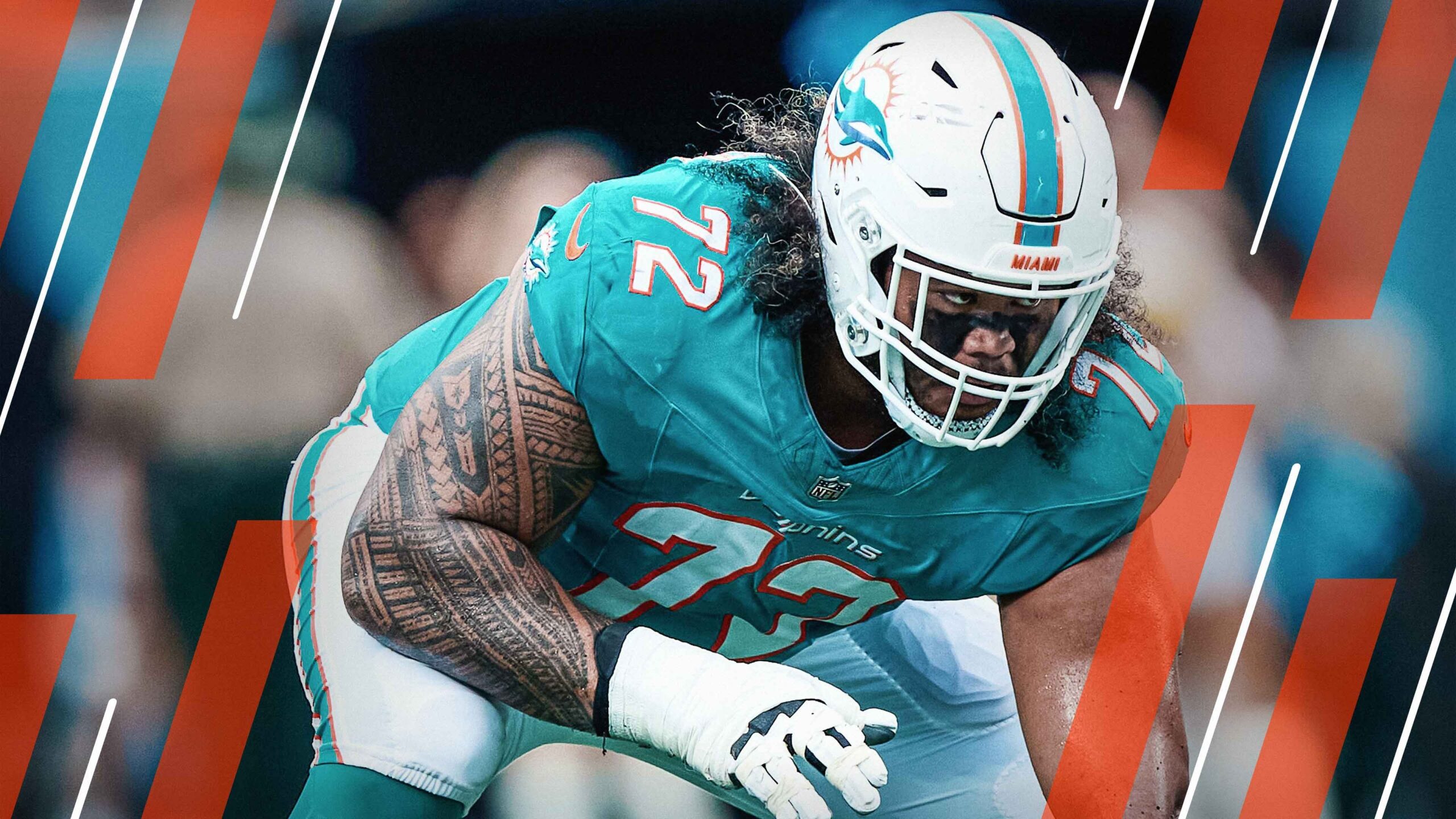
Guard: Jonah Savaiinaea, Miami Dolphins (28.4 – 2025)
Savaiinaea had the opportunity to start as a rookie for Miami after being the team’s second-round pick, but the results were far from desired. He produced the lowest single-season PFF grade for a starting guard ever, and by a sizable margin at that. The Arizona product posted a 14.1 PFF pass-blocking grade after being credited with a league-high eight sacks and 45 pressures, and his 37.3 PFF run-blocking grade was also second-worst among qualifiers.
The 2025 season also wasn’t kind to Mekhi Becton, who faltered to a 37.1 overall grade in his only year with the Chargers. The Texans’ Kenyon Green (37.7), Saints’ Andrus Peat (39.8) and Giants’ Justin Pugh (41.6) also make the list with their performances over the last eight seasons.
Center: Scott Quessenberry, Houston Texans (36.6 – 2022)
Following a four-year stint with the Chargers, Quessenberry joined the Texans prior to the 2022 season. However, he had a tough time acclimating to his new franchise. Across 990 snaps, Quessenberry was ineffective in the pass game by surrendering seven sacks and 36 pressures on a 25.8 PFF pass-blocking grade. Even on the ground, Quessenberry finished with the position’s lowest PFF run-blocking grade at a 43.7.
Two years prior, the Broncos’ Lloyd Cushenberry III endured a rookie learning curve with a 40.5 overall grade. The same can be said for the Giants’ John Michael Schmitz, who compiled a 41.4 grade in 2023.
Edge Rusher: Pat Jones II, Minnesota Vikings (37.5 – 2023)
The Vikings’ defense was mostly ineffective during the 2023 season, and Jones didn’t alleviate concerns. Across 388 pass-rush snaps, Jones totaled only 32 pressures on a league-worst 45.6 PFF pass-rush grade. Jones wasn’t much better against the run with a 39.8 PFF run-defense grade, and he also missed 16.7% of tackles.
While Alex Wright has blossomed into a solid player for the Browns, his rookie season was the second-lowest-graded at a 38.4 mark in 2022. Former Raider Jay Richardson had a tough go of it in 2008 with a 38.6 overall grade, while the Texans’ Whitney Mercilus received low marks with a 39.5 grade in 2020.
Read more
Read moreThe highest-graded seasons by NFL position in PFF history
By Bradley Locker
(opens in new tab) →Interior Defender: Tyson Jackson, Kansas City Chiefs (29.5 – 2009)
Jackson enjoyed a decent career after being the third overall pick in 2009, but he didn’t start out of the gate fruitfully. Despite playing 688 snaps with Kansas City that year, Jackson totaled only eight pressures on 290 pass-rush snaps, as well as just 11 stops. His work against the run was particularly poor with a 28.5 PFF run-defense grade, tied for the second-worst for any interior defender in PFF history.
Last season wasn’t kind to a pair of young defensive linemen in the NFC West, with the Cardinals’ Darius Robinson (30.1) and the 49ers’ Alfred Collins (35.0) not considerably ahead of Jackson. Keyunta Dawson accrued a similar 32.7 grade with the 2008 Colts, while the Panthers’ LaBryan Ray played to a 33.0 grade in 2024.
Linebacker: Christian Haris, Houston Texans (28.3 – 2022)
Harris was able to see the field plenty as a third-round rookie, appearing on 711 snaps in 2022. However, that didn’t yield favorable results. The Texans linebacker finished last that season in PFF coverage grade (29.6) and second-to-last in PFF run-defense mark (29.1). On top of that, Harris’ 16.3% missed tackle rate ranked 51st out of 52 qualifiers that season.
The 2021 campaign featured three of the lowest linebacker grades ever in the Giants’ Tae Crowder (29.1), Bears’ Alec Ogletree (29.2) and Steelers’ Devin Bush (34.4). Also up in the annals are Miles Burris’ 29.3 grade in 2014, Patrick Queen’s 29.7 in 2020 and Ernie Sims’ 30.5 mark in 2008.
Cornerback: Brandon Browner, New Orleans Saints (27.5 – 2015)
Browner’s final season in the NFL proved an insurmountable one. Although he played 1,023 snaps that year in New Orleans, he compiled a 27.5 PFF coverage grade. While Browner didn’t finish with the worst mark in any of snaps per target, snaps per reception or passer rating allowed, penalties were his death knell. Indeed, Browner was assessed for a staggering 23 penalties, his third season with at least 15 in his short career.
The early 2010s were also ripe for some historically poor cornerback seasons, including the Rams’ Justin King (29.6) in 2011 and the Texans’ Brice McCain (31.8) in 2013. While former Patriots star J.C. Jackson regressed to a 34.8 grade in 2023, he failed to qualify by playing just 524 snaps that season.
Safety: Major Wright, ChicagoBears (30.2 – 2013)
Wright was a third-round selection by the Bears in 2010, but he struggled in three of his four seasons in Chicago. The lowest-graded one came in 2013, when he ranked in the bottom four of both PFF coverage and run-defense grades. Wright’s 0.2% run stop rate sat in the 1st percentile, and his coverage grade at safety was in the 5th percentile.
The Raiders have claimed three of the worst single seasons by safeties in PFF history, from Brandian Ross (30.5) in 2013 to Johnathan Abram (36.8) and Isaiah Pola-Mao (39.8) more recently. The Vikings’ Jamarca Sanford (30.5), Buccaneers’ Dashon Goldson (31.6) and Titans’ Michael Griffin (32.7) weren’t far off.
Unlock PFF Premium StatsPFF Premium Stats gives you access to every player grade and advanced statistic. Analyze performance from every angle with powerful filters, situational splits and position-specific metrics that go far beyond the box score.
NFL Premium Stats (opens in new tab)College Premium Stats (opens in new tab)Kicker: Dustin Hopkins, Cleveland Browns (27.9 – 2024)
Hopkins was a serviceable kicker for the better part of a decade, but things came to a halt in 2024. That season, he made only 18 of his 27 field goal attempts — a 66.7% clip that ties for the second-worst in PFF history (which only extends to 2013 for specialists). Hopkins went 9-for-16 on kicks of 40 or more yards, and he also missed three extra points.
While Hall of Famer Adam Vinatieri is one of the best to ever do it, his 2019 season was a disaster with a 28.8 PFF field goal grade. Analogous seasons include the Vikings’ Dan Bailey (29.3) in 2020 and the Bengals’ Mike Nugent (30.0) in 2016.
Punter: Jeff Locke, MinnesotaVikings (43.0 – 2015)
The Vikings spent a fifth-round pick on Locke in 2013, but that high billing didn’t pan out. Locke finished as the league’s lowest-graded punter twice in his four years in Minnesota, with the worst coming in 2015. That season, Locke averaged only 41.1 yards per punt — the third-lowest single-season mark in PFF history — and only 39.4% of his attempts landed inside the 20-yard line.
The Chargers have experienced some lowly punting since 2013, including Mike Scifres (43.9) in 2015 and Donnie Jones (44.7) in 2018. Last year, Tress Way underperformed for the Commanders with a 44.0 PFF punting grade, the third-worst ever.