Zoom
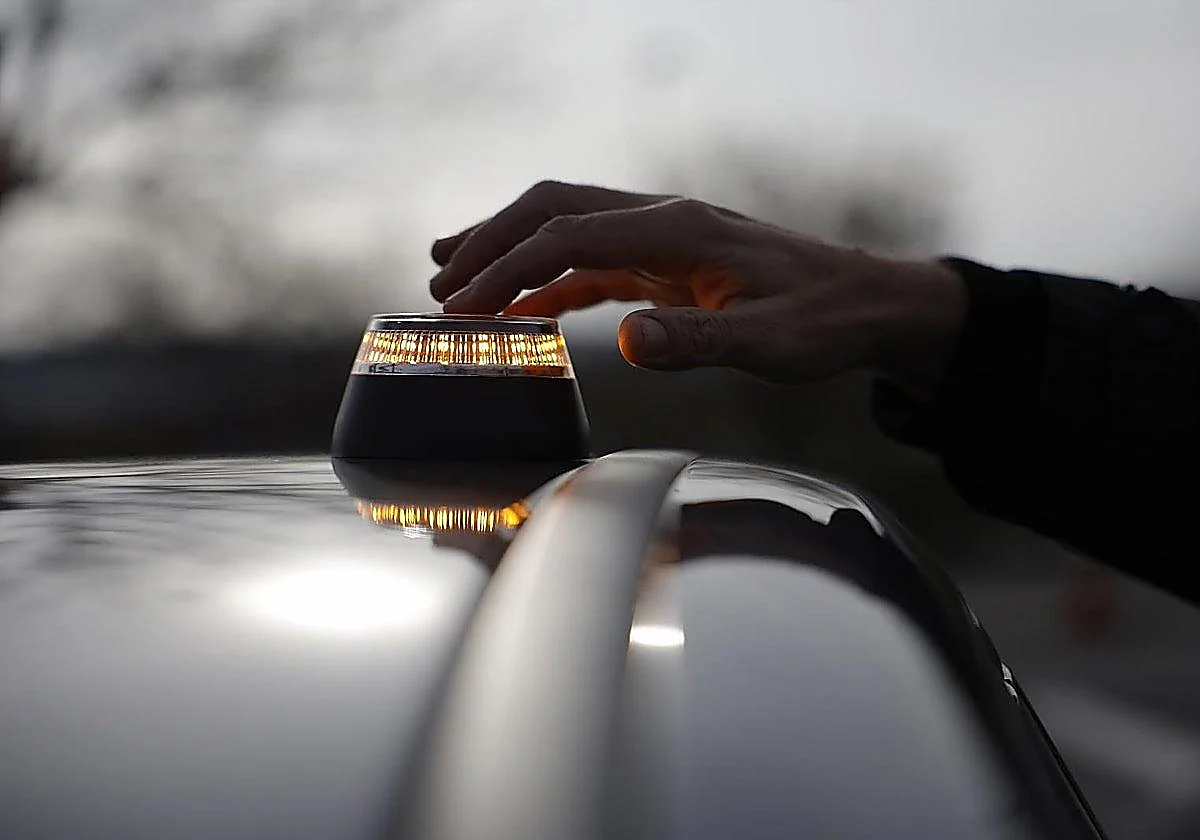
A V-16 roadside warning beacon. Efe Motoring V-16 emergency beacons: there will be a 'reasonable' grace period during which no one will be fined for not carrying oneMinister Marlaska responds to the critics: "It's visible, safer than the warning triangles and only provides geolocation data for the stranded vehicle"
Madrid
Friday, 9 January 2026, 16:34
Interior Minister Fernando Grande-Marlaska announced on Thursday that the Guardia Civil's traffic units will be flexible during the first few weeks of the mandatory use of the V-16 connected beacon.
The system, as of 1 January, has replaced emergency triangles and is required in 30 million vehicles across Spain. Marlaska stated that "there will be a reasonable grace period", during which drivers will be warned, but no fine will be imposed (the fine is 80 euros), although he did not specify whether this "reasonable period" would last for weeks or months. Marlaska made these statements at the presentation of the 2025 road traffic accident statistics, a year that totalled 1,119 deaths, 35 fewer than in 2024.
The Interior Ministry estimates that around 25 people are killed each year in Spain after being hit by other vehicles while trying to signal an incident on the road, a situation that the minister himself has described as "extremely dangerous". This has led the Spanish government to implement this change, making Spain the first country in Europe to make it compulsory to carry this new device.
According to the minister, other European states are awaiting the results in Spain before implementing the measure. Countries such as the United Kingdom and Luxembourg have already suspended the use of warning triangles on motorways due to how dangerous their use can be. "Anyone who has ever got out of their car to place a warning triangle knows the risk involved", acknowledged Grande-Marlaska, defending the V-16 as an essential tool "to stop this carnage".
He also pointed out that the V-16 is especially relevant for people with disabilities or reduced mobility, as the system allows them to signal a breakdown or other roadside incident from inside the vehicle.
Activated by 3,000 vehicles a day
Since the beacon became compulsory on 1 January, an average of around 3,000 vehicles per day have signalled an incident using the V16, which is sold under various brands for around 40 euros. "We can be reasonably optimistic about compliance with the law," said Marlaska.
The flashing light beacon allows drivers to signal a breakdown or accident without leaving the vehicle. It is visible from up to one kilometre away and is also integrated into the connected vehicle system, making it easier for the incident to reach other drivers' navigation systems and the variable information display panels on that particular road.
For Marlaska, this combination of visibility and connectivity represents a significant leap forward in road safety. When asked if this geolocation might give criminals clues about a vehicle breakdown on a remote road, the minister pointed out that the system also alerts the department of Tráfico's virtual platform and, from there, all nearby traffic units of the Guardia Civil, which, in his opinion, "ostensibly reduces the risk".
He then added, "But I insist, the objective of the beacons is to increase road safety. It is not for revenue collection or enforcement purposes. It is about guaranteeing safety and doing so in a reasonable manner."
Although the requirement to carry the V-16 has been in effect since 1 January, the Interior Minister stressed that the law will be applied using some common sense and he reiterated that, for "a reasonable time", awareness-raising and information-sharing will be prioritised over fines. "That reasonable, proportionate time will be determined by the competent authorities in this matter, which is Spain's Directorate General of Traffic (DGT) and the traffic department of the Guardia Civil. This isn't a matter of one month, two months, three months..."
Marlaska insisted that the measure aims to reduce pedestrian fatalities while attempting to place warning triangles near an out-of-action vehicle, a task that claims the lives of around 25 people each year. "Since 2014, many road safety operators have been warning of the risk of drivers being run over while doing so. In 2019, the roadside assistance sector also requested safety measures for tow truck operators attending to broken-down vehicles.
"These measures were included in a Royal Decree in which, incidentally, we already advocated for geolocation as a key element in alerting other road users to incidents", he stated.
When asked about a potential violation of privacy related to use of the V-16 and vehicle geolocation, Marlaska avoided entering into a debate that he considers unrelated to road safety, but reiterated that this Royal Decree was drawn up in consultations with 85 associations of the National Traffic and Road Safety Council, with no objections raised, and also favourably endorsed by the Spanish Data Protection Agency. "The only data transmitted is the vehicle's geolocation, without personal identification", and he reaffirmed that the measure responds solely to road safety criteria.
Helping reduce pedestrian fatalities
The minister is confident that the majority of Spanish vehicles already carry a V-16, "because it has been mandatory since 1 January", and that "soon it will be mandatory for all vehicles." He insisted that it was "essential" to adopt some measure "to stop "this carnage" of fatal pedestrian accidents on the roads. "We have opted for the V-16 beacon because we are convinced that it will help reduce this factor and because it fits in with our connected mobility strategy to reduce the number of road deaths."
He was also questioned about concerns over the beacon's visibility, especially on sunny mornings, on sharp bends or at changes in gradient. For the minister, the V-16 warning sign, as a substitute for warning triangles, "avoids the risk of getting out of the vehicle, incorporates lighting visible from a kilometre away and is integrated into the connected vehicle system to send information about the incident to the navigation systems of vehicles travelling on that road and to nearby variable information panels". Therefore, he said that it is necessary to "adapt our driving" to these circumstances. "Our objective is not to issue fines or raise revenue, what motivates us is the obligation to save lives," he repeated. "Anyone who wants to argue other reasons, perhaps I would first take them to the National Hospital for Paraplegics in Toledo so that we can assess what is truly important when we talk about traffic, road safety and guaranteeing life. I don't play games with life and saving lives", he added.