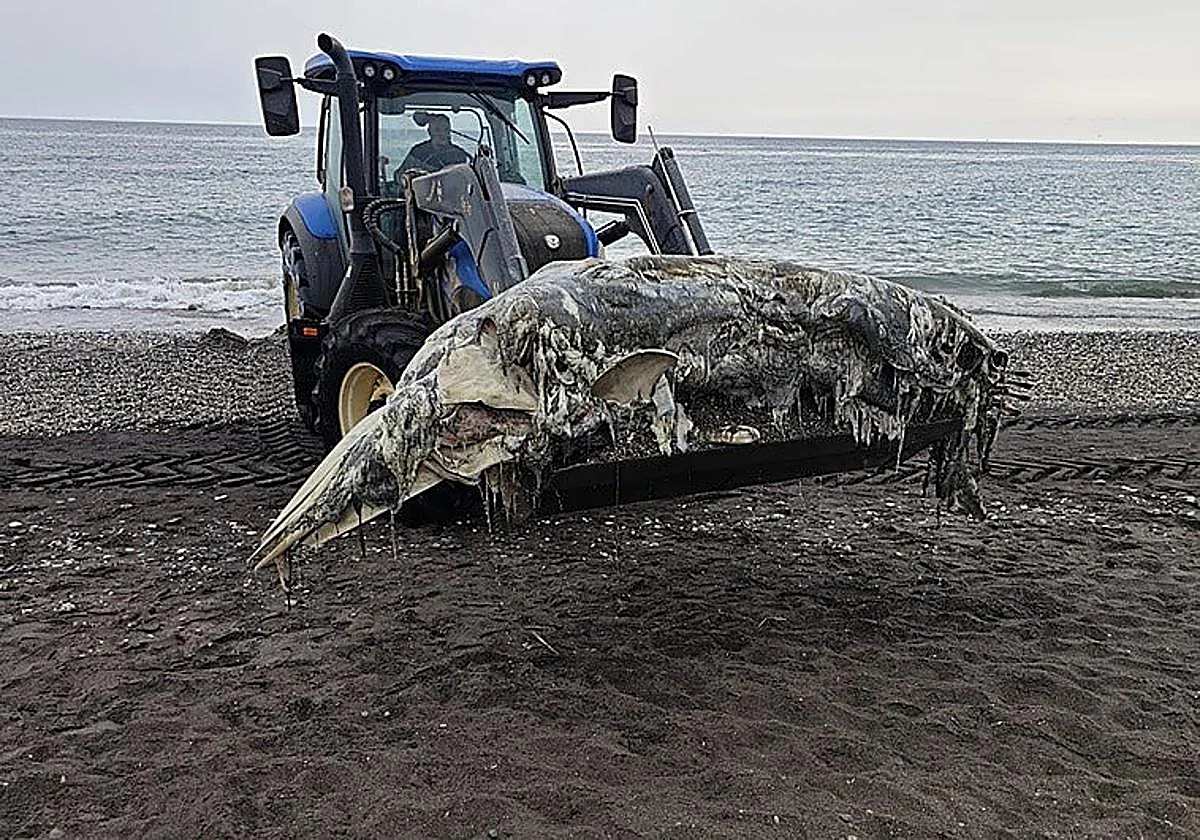
The image on the eastern Costa del Sol was shocking due to the advanced state of decomposition of the carcass and it required heavy machinery to remove it
Eugenio Cabezas
Wednesday, 8 April 2026, 11:29
The remains of a large cetacean, presumably a whale, washed ashore on Tuesday 7 April on Ferrara beach in Torrox-Costa on the eastern Costa del Sol. Local residents spotted the animal and alerted the authorities after spotting the carcass.
The image was shocking due to the advanced state of decomposition of the carcass and it required the intervention of municipal workers with heavy machinery to remove it.
The discovery was made around 3pm, when several beachgoers reported the presence of a large carcass on the beach, partially submerged. According to municipal sources speaking to SUR, the standard protocol for these types of incidents was activated, mobilising the town hall's operational services to secure the area and remove the remains as quickly as possible.
The town hall explained that the Andalusian regional government's department for the environment, the competent authority for these types of situations, has been notified. Regional authorities are scheduled to travel to the Torrox recycling centre on Wednesday, where the remains of the animal will be taken for final disposal.
Marine biologist Juan Antonio López, from Malaga, is the most certain in his diagnosis. "It's almost certainly a fin whale, and I'd say a common fin whale. The jaw gives it away, and so does the size," he explained. He believes that the specimen could measure "at least between nine and 10 metres, taking into account the missing part of the tail," which would suggest a young individual, between 10 and 15 years old.
However, not all specialists share this hypothesis. Marine biologist Juan Jesús Martín said that "the photos and the advanced state of decomposition make it difficult to identify, but it looks like a fin whale." Expert Jesús Bellido suggests it might be a beaked whale, although he acknowledges that "without a good look at the jaw and given how deceptive the coloration can be in this state, I couldn't say for sure."
This type of incident is not common on the Axarquía coast, although cetacean strandings have been recorded on the Malaga coast on other occasions. The last such incident in Torrox occurred in July 2007. The causes are usually related to illness, disorientation, interaction with boats, or changes in sea conditions, among other factors.
In any case, the animal's advanced state suggests that it had been dead for several days before reaching the shore, possibly carried by the currents. The loss of body parts and tissue degradation make identification difficult, as well as determining the cause of death.
The whale's appearance generated considerable interest in the area for several hours, with numerous onlookers gathering to observe the find, while municipal workers worked to remove it to prevent health problems. The town hall reiterated the importance of not approaching or handling these types of stranded animals and always notifying the authorities to ensure a safe and legal response.