Estimated Reading Time: 13 minutes
Explore PFF Tools Mock Draft Simulator Be the GM for any team in the 2026 NFL Draft with a fully immersive simulation that lets you trade picks and players for a realistic, in-depth draft experience. 2026 NFL Draft Big Board Trevor Sikkema’s personal rankings, complete with three-year player grades, position rankings and in-depth scouting reports for the top prospects in the class. Big Board Builder Create your own customized draft rankings, with Scouting Mode at its core — a fully customizable grading system that puts the entire evaluation process in your hands. NCAA Premium Stats Our exclusive database, featuring the most in-depth collection of NCAA player performance data.The 2026 NFL Draft’s edge defender class is loaded — to the point that PFF’s lead draft analyst Trevor Sikkema currently has nine edge defenders ranked inside the top 50 on PFF's predictive big board. It’s a group defined by depth, high-end traits and legitimate first-round talent.
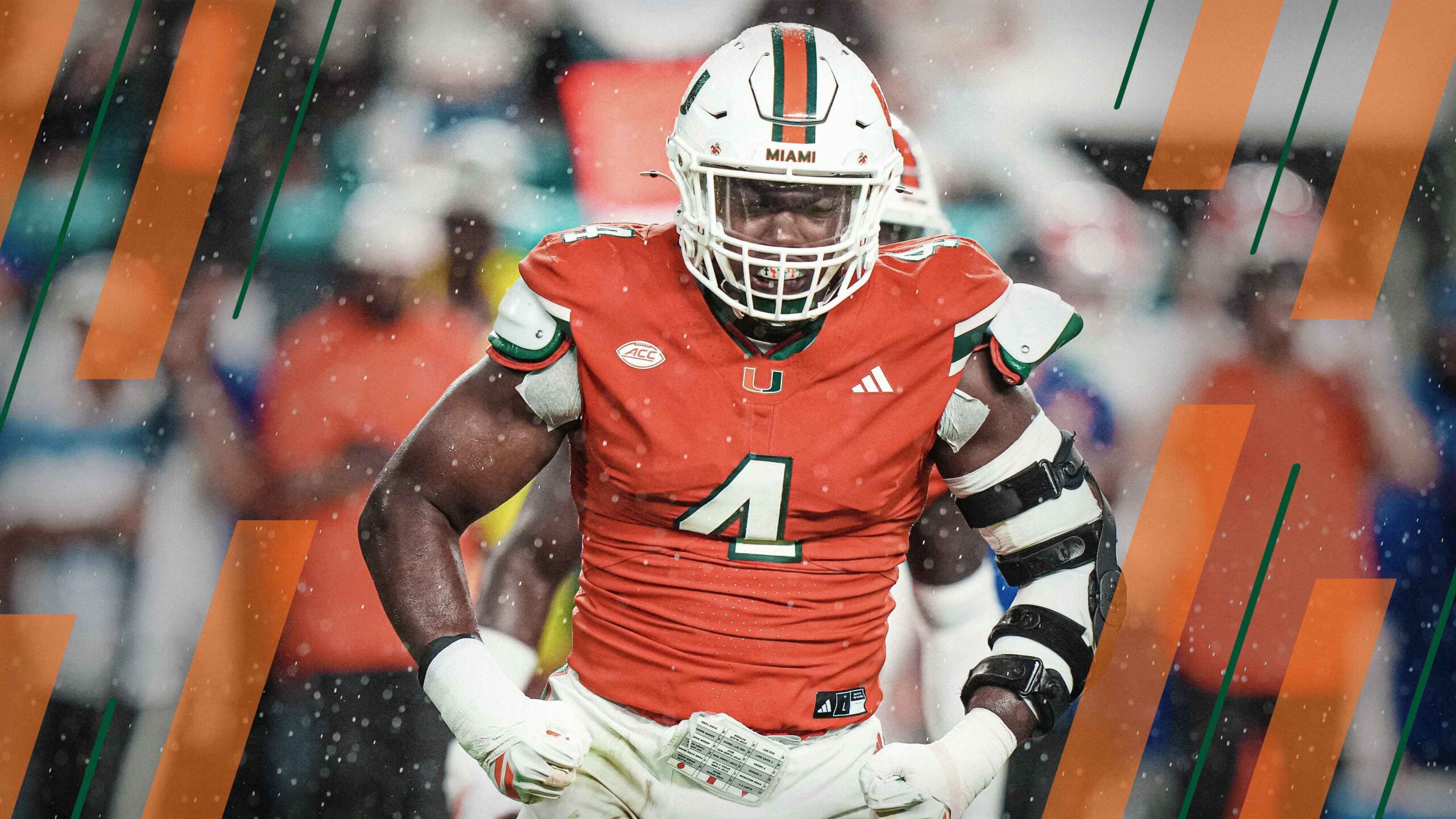
Texas Tech's David Bailey has drawn early praise after leading college football in regular-season pressures, while Auburn’s Keldric Faulk has earned similar acclaim from respected voices across the draft community. But when the full body of work is considered, the edge defender who stands above the rest is Miami‘s Rueben Bain Jr.
The Miami, Fla., native finished the 2025 season with a dominant 92.4 pass-rush grade, leading college football in total pressures over the whole season (83, including the postseason) while posting a 23.5% pass-rush win rate across an unmatched 561 pass-rush snaps — more than 160 additional rushes than any other top-15 player by win rate.
And Bain’s impact didn’t stop on passing downs. His 86.2 PFF run-defense grade ranked ninth nationally, supported by a 2.4-yard average depth of tackle that consistently disrupted opposing ground games around the line of scrimmage.
Rushing the passer
Listed at an unofficial 6-foot-3 and 275 pounds, Bain is an extremely dense and physical pass rusher who has surprising athletic ability for someone his size.
Not only is Bain the best power rusher in this class and consistently shows his ability to bull through opposing offensive linemen, but his athletic ability and technical refinement give him access to the high (outside of the opposing offensive linemen's outside shoulder) and low side (inside the opposing offensive tackle's inside shoulder).
Rueben Bain Jr. being as big as he is should not move live this. Watch here as he corners the LT and pressures the WB with a speed pass rush.
— Newt Westen (@NFLDraft_Westen) November 17, 2025
He does this at 275 lbs… pic.twitter.com/dcX0R0UOCC
Bain's strong get-off and upfield burst routinely stressed offensive tackles' pass sets when he pinned his ears back to rush the passer, while his bend and footwork enabled him to corner and flatten to the pocket through contact with momentum to close quickly on the quarterback, giving him access to high-side wins routinely.
Massive third down sack from Miami’s Rueben Bain Jr. Just look at him convert speed to power.
— Bobby Football (@Rob__Paul) December 20, 2025
Came into today top 10 in the country in pressures and pass rush win rate pic.twitter.com/44tsd9kAK6
Moreover, Bain's impressive get-off and upfield burst for his size enable him to build a ton of momentum going into the point of contact, making his speed-to-power rushes the most potent in the class, especially when afforded with a runway to build that momentum from wide alignments (30% pass-rush win rate when aligned as a 7-9 technique defensive end).
Rueben Bain- speed to power pic.twitter.com/HdDgXnBLEi
— (Foots The King) (@FootsDaKing) December 18, 2025
Additionally, as you can see in the above clip, Bain has the technical prowess to sequence into another technique when a blocker tries to anchor against his power rush, a key when going against the bigger and stronger offensive linemen in the NFL.
They say if you can’t get pressure rushing 4 then you aren’t a great defensive line, well Rueben Bain Jr. just got to the QB while rushing 3.
— BKS Sports (@BKSecretsports) January 1, 2026
Top-10 pick, explosiveness is other worldly and his speed is devious pic.twitter.com/6lm5Y0GRPW
Bain also does a great job countering inside when offensive tackles overset to counter his speed or try to sit down and anchor against his potent power rushes.
Regardless of whether he's looking to win with speed, power or an inside move, Bain uses excellent integrated hand technique and footwork to break down blockers and generate wins.
From a footwork perspective, Bain masterfully manipulates his pacing and step frequency, and uses stutter and euro-step footwork to create inefficiencies in blockers' pass sets and weight distribution, creating advantages (such as shortened corners) that Bain can use to generate consistent wins.
At the NFL level, offensive tackles are too technically sound to be beaten consistently without pass rushers employing manipulative footwork around the arc.
In terms of hand technique and pass-rush repertoire, Bain uses a wide array of moves that give him options to beat offensive tackles, regardless of the type of strike they are using. If an offensive tackle is a high-hand puncher, Bain will use swipes and cross-chops to parry strikes. If an offensive tackle is a low-hand, double-underhand technique blocker, Bain will opt to use powerful bull rushes or thunderous clubs.
The Miami product has answers for anything offensive tackles may throw out at him on the edge.
Just some fun plays from my Rueben Bain watch. Please please please GMs don't overthink a slam dunk pick. pic.twitter.com/T7PuwYCOrS
— William Birach (@CoachBirach) January 23, 2026
Additionally, he has the rare ability due to his ankle, knee and hip flexibility to utilize a “ghost” move to slip the strike before cornering and flattening to the quarterback with pace.
Bain's pass-rush ability is also extremely effective when he's aligned inside, as he loves to use powerful club moves to bounce offensive linemen out of his way as he attacks the backfield. However, he does show more technical warts on the inside, as his pad level can swell at times, while his feet can stop churning when looking to generate maximum power on his club moves, which can give blockers time to recover and stymie his rush. Still, NFL teams would be wise to move him inside on occasion to create mismatches against subpar pass protectors.
The ability to win inside, outside and through opposing offensive linemen with power, finesse or technique is a primary reason why Bain was one of college football's best pass rushers in 2025.
Bain's biggest concern in the pass-rush department is the fact that he often attacks the pocket with reckless abandon, enabling more elusive quarterbacks to escape his grasp on occasion. He needs to do a better job of staying balanced when attacking the pocket to avoid leaving production on the field at the NFL level.
Defending the run
Bain's physical dominance is most evident when defending the run, as he routinely overpowers offensive linemen and tight ends to reset the line of scrimmage at the point of attack. He plays with good hand placement and strong hands to create extension after initial contact to make for easy sheds, and he has a very effective “shrug” technique to shed blockers and make plays on the ball carrier. He also uses a push-pull technique, pulling blockers over their toes to shed blocks.
Rueben Bain Jr. once again displaying his versatility.
— Football Scout 365 (@DraftAnalyst365) January 20, 2026
He throws a club arm, displaces the blocker, and blows up this run.
This first-down stop effectively ended the drive before it started.
pic.twitter.com/nrXnnyKY3T
Bain also displays an impressive range defending the run, as he can not only make plays in his primary gap but also further away from his primary gap responsibility. His quickness and hand technique also enable him to generate quick wins and disrupt the backfield, which can lead to production for him or his teammates.
Even when he is on the backside of zone concepts, Bain's motor and burst enable him to chase down ball carriers from behind.
One of the concerns for Bain is that he's not the most disciplined or gap-sound defender. He routinely takes the path of least resistance, making him susceptible to missteps on screens and draw plays, as he gets too far upfield. He will also backdoor the B-gap against zone concepts to cross blockers' faces, which provides an open edge if he doesn’t get to the ball carrier. It's a double-edged sword because it did give Bain access to some tackles for loss and overall backfield disruption, but when it doesn't work, it creates fissures and voids in his team's run defense. A couple of big runs Miami gave up last year were due to Bain's lack of gap integrity on a certain play.
Bain's tackling ability also needs to improve once he enters the NFL, as he recorded a missed tackle rate above 15% in each year he played for the Hurricanes.
Let's talk arm length
Bain treats blockers like children lol pic.twitter.com/dXJVq86FRh
— John Owning (@JohnOwning) January 22, 2026
Bain's accolades, production and NFL-level skills paint the picture of an elite prospect, but he's not without some concerns — namely, his lack of arm length.
Per The Athletic's Dane Brugler, Bain's arm length should measure in around 30 3/4 inches — inside the 10th percentile among NFL edge defenders.
It doesn't matter.
Arm length is often treated as a prerequisite for NFL edge defenders. Longer arms theoretically allow rushers to strike first, keep blockers off their chest and create separation at the point of attack. While that advantage is real in a vacuum, raw arm length by itself is a poor predictor of pass-rush success.
The NFL is full of edge defenders with elite length who struggle to win consistently, just as it’s filled with productive rushers who fall short of traditional arm-length thresholds. The difference lies not in how long a player’s arms are, but in how well they deploy them.
Even though an edge defender's raw arm length may be shorter than that of the offensive tackle he is pitted up against, he can create a functional length advantage by turning his shoulders perpendicular to the target and executing a long arm, which can be utilized when defending the run (edge defenders are taught to keep outside arm free when setting the edge) or rushing the passer (one arm is always longer than two, so using long arms allows rushers to have a functional length advantage despite actually having shorter arms).
Plus, the fact that offensive linemen rarely strike with full arm extension — if they do, it typically causes their weight distribution to get out over their toes, a big no-no for offensive line play.
By all means, don't take this writer's words as gospel, but maybe future Hall of Fame offensive tackle Joe Thomas will make you a believer that arm length is an overrated part of player evaluation:
@greenlightpodcast Joe Thomas on offensive lineman with shorter arms @BetMGM ♬ original sound – Green Light Podcast
Despite his small arms, Bain understands how to create more functional length with his body positioning, hand placement and hand timing, which is a big reason why his short arms are rarely, if ever, an issue during his time with the Hurricanes.
Conclusion
Rueben Bain Jr. best reps from the College Football Playoff
— NFL Draft Files (@NFL_DF) January 27, 2026
Looked like a future top 10 pick, regardless of arm length… pic.twitter.com/n5Q7XfkZM0
Bain enters the NFL draft as one of the best defensive prospects in the 2026 class. While some teams — as noted by Dane Brugler — may project him as a defensive tackle due to his build and arm length, that approach risks minimizing his greatest strengths.
Moving Bain inside in the NFL — where NFL interior linemen are bigger, much stronger and more technically refined than their college counterparts — would blunt his potential impact, as his explosiveness, speed-to-power and advanced pass-rush skill set make him far more dangerous on the edge, where he can dictate pass sets and attack tackles in space. His ability to kick inside should be viewed as a weapon, not his ultimate destination. Used primarily on the edge with interior flexibility, Bain has the tools to become a cornerstone defender for an NFL defense.
Initial Grade: 8.51 → First-round pick
Editor's note: A prospect's initial grade is generated after watching at least four games and grading the edge defender prospect on 19 different traits; however, it does not take injury history or off-field concerns into account. A prospect's final grade will be scored on the same criteria, except it will include athletic testing and six full games studied.