Zoom
Getaways 25 places to discover in Granada province in 2026A new guide to hidden treasures, natural beauty spots, legendary fortifications and routes for the adventurous has been published
Cristina Ramos
Granada
Friday, 16 January 2026, 14:28
Beyond the iconic Alhambra Palace, Granada city and province boast a rich cultural offer, from archaeological deserts to breathtaking viewpoints and a new guide has been published which redefines tourism in this Andalusian province for 2026. Fascinating history, beautiful landscapes and unique experiences invite curious travellers to explore the province.
1. Granada
The Bermejas towers at the Alhambra
The Alhambra is the most iconic attraction of Granada city and one of the most important monumental complexes in the world. This fortified enclosure was the seat of the last Muslim kingdom in the Iberian Peninsula and combines defensive elements, palaces and gardens that explain centuries of Islamic and Christian history. Just opposite and within the same defensive area are the Bermejas towers, a group of three defensive towers built on the Mauror hill, whose function was to watch over the Vega de Granada and to complement the defences of the Alhambra from the east. These structures date from very early phases of Granada's fortification, probably from the eighth to the ninth century AD, although they were reformed under various Islamic and Christian reigns.
2. Motril
Fábrica del Pilar
The Fábrica del Pilar is an industrial complex located in Motril on Granada province's Costa Tropical which was once one of the most important sugar cane factories (azucareras) in Andalucía. Built between 1882 and 1883 during the expansion of sugar cane cultivation on the Costa Tropical and Costa del Sol, the factory operated continuously for almost a century until its closure in 1984, representing the transformation from pre-industrial to mechanised production.
The complex includes the old industrial building with the original mill train and steam machinery, warehouses, administration house and former workers' houses. It has now been restored as a museum, with areas that explain the production process, the life of the workers and the importance of sugar cane in the local economy and society.
3. Gorafe
Gorafe desert
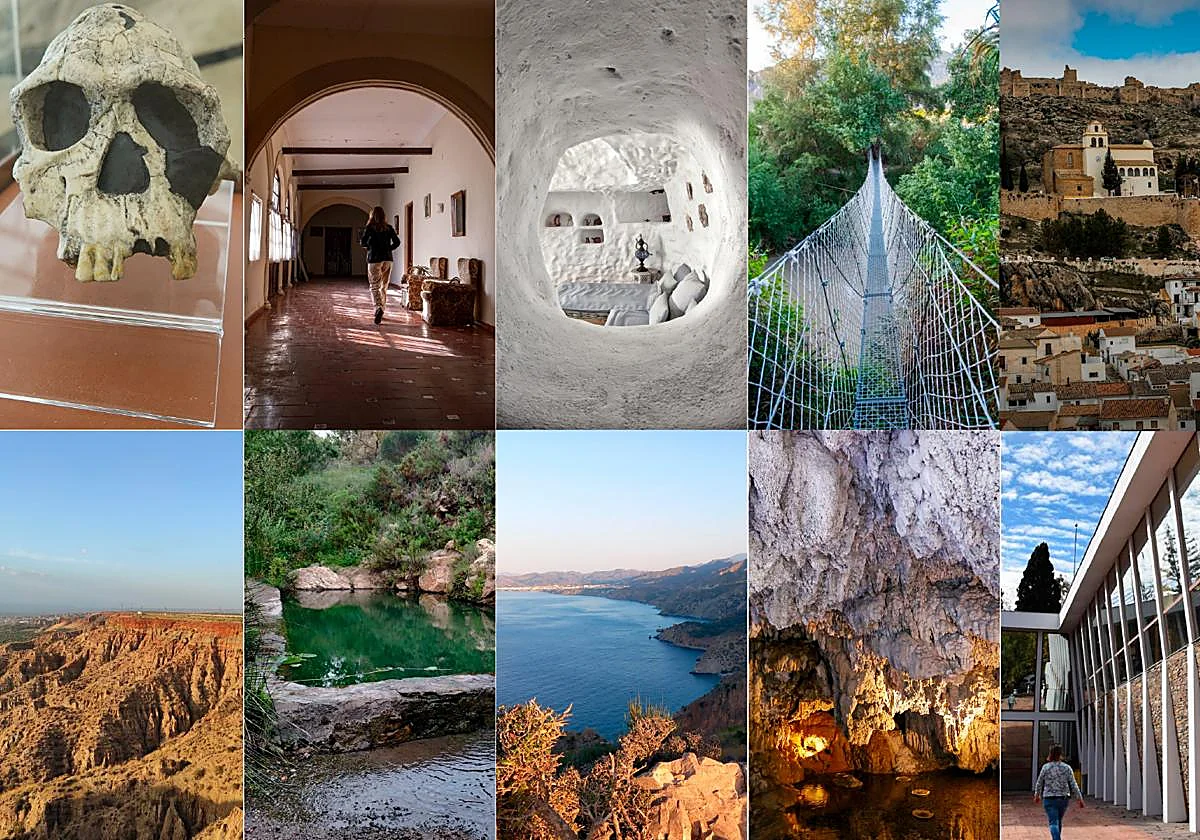
The Gorafe desert is not a desert in the strict sense of the word, but a landscape of badlands, modelled by the erosion of clay and sediment that create an almost lunar environment of ravines, gullies and steep hills. This unique site is one of the most important ecosystems in southeastern Spain for its geodiversity. Its archaeological importance is remarkable: in the immediate vicinity is the extensive Gorafe Megalithic Park, one of the largest groups of dolmens in Europe, with more than 240 funerary monuments dating from the Neolithic and Bronze Ages. These huge structures hide the secrets of burial rituals and the life of communities that settled there more than 5,000 years ago, making Gorafe a key enclave for understanding European prehistory.
4. Dúrcal
Puente de Lata
The Puente de Lata in Dúrcal is a nineteenth-century railway structure that forms part of the old Granada to Motril railway line. Its name comes from the light appearance of its metal plates, which contrast with other masonry bridges of the period. This bridge was key to the transport of goods and people between inland Granada and the coast, contributing to the agricultural development of the Dúrcal river valley. Its preservation today allows us to appreciate the historic railway engineering and offers an attractive cultural route that combines industrial heritage with walks along the river.
5. Lanjarón
Honey museum
The Lanjarón honey museum (Museo de la Miel de Lanjarón), also known as the Centro de Interpretación de la Apicultura para la Conservación de la Biodiversidad, is located in the Berta Wilhelmi estate, at the entrance to the Sierra Nevada National Park. It covers more than 18,000 square metres and is organised into different areas that explain in detail both the biology of bees and the complete process of honey-making, from pollination to the extraction and use of honey, as well as the importance of bees for biodiversity.
6. La Calahorra
La Calahorra castle
La Calahorra castle was built between 1509 and 1512 by order of Rodrigo Díaz de Vivar y Mendoza, Marquis of Zenete, on the site of an earlier Islamic fortress. It is one of the first civil buildings in the Italian Renaissance style in Spain, which makes it a key element in the architectural transition between the Middle Ages and Modernity. Its exterior structure maintains the appearance of a defensive fortress, with massive walls, circular towers and little decoration, while the interior houses a Renaissance courtyard with Carrara marble columns and capitals imported from Italy.
Situated on a hill overlooking the Marquesado del Zenete, the castle fulfilled both residential and symbolic functions of noble power. It is now privately owned, but access is by arrangement. From the surrounding area there are extensive views of the Sierra Nevada, which reinforces its strategic and scenic value.
7. Moclín
Moclín castle
Moclín castle was a key fortress during the Islamic period, especially in the thirteenth and fourteenth centuries, as it formed part of the defensive frontier of the Kingdom of Granada against the Christian territories. Its elevated location allowed it to visually control large areas of the Vega and served as a warning point against enemy incursions.
The preserved fortress includes walls, towers and the remains of the citadel, as well as secondary defensive structures scattered throughout the municipality. After the Christian conquest in 1486, the castle maintained its military functions for a time before falling into decline. Today it can be visited freely and is a popular spot for historical and hiking routes, as well as hosting historical re-enactments and cultural activities.
8. Galera
Castellón Alto site
The Castellón Alto archaeological site is one of the most important prehistoric settlements in eastern Andalucía. It dates from the Bronze Age (approximately between 1900 and 1600 BC) and belongs to the Argaric culture. The settlement was organised in terraces on a hill, with rectangular-shaped dwellings and areas for storage and burial.
The excavations have revealed the social structure of these communities, their burial practices, burials under the dwellings, and their economy based on agriculture, livestock farming and metal work. The site has a signposted itinerary and explanatory panels to facilitate the visit. The materials found are exhibited in the Galera Archaeological Museum, complementing the experience.
9. Monachil
Cahorros route
The Ruta de los Cahorros is one of the most popular trails in Granada province. It runs along the Monachil river and crosses a narrow gorge carved into the limestone rock. The route includes suspension bridges, steps squeezed between vertical walls and stretches of riverside forest.
It is a circular route, accessible to hikers with some experience and very popular all year round. In addition to its natural attraction, the route shows ethnographic elements such as old irrigation channels and the remains of traditional hydraulic infrastructures. Its proximity to Granada city makes it one of the province's most accessible nature walks.
10. Baza
Granada geopark
The Granada Geopark, which has Unesco recognition, covers a large area in the north of the province characterised by landscapes of badlands, plateaus and valleys carved out by fluvial erosion over millions of years. This area stands out for its geological value, with fossil records that document the evolution of the climate and fauna during the Quaternary.
In addition to its scientific interest, the geopark integrates a unique cultural heritage, including villages with cave dwellings, palaeontological sites and traditions linked to the use of the land. Interpretative routes, visitor centres and educational activities are offered to help understand the relationship between geology, landscape and human settlement.
11. Salobreña
Salobreña castle
Salobreña Castle is a fortress of Muslim origin located on a rock high up above the Mediterranean Sea. It was a regular residence of the Nasrid kings and played an important role in the defence of the coast and the control of the surrounding agricultural territory.
After the Christian conquest, the castle was reformed and adapted to new military needs. Today it still preserves walls, towers, cisterns and the remains of palace outbuildings. A visit allows visitors to understand the historical evolution of the site and enjoy panoramic views of the Mediterranean, the valleys and the Sierra Nevada.
12. Castell de Ferro
Rijana tower
The Torre de la Rijana is a coastal watchtower built in the sixteenth century as part of the defensive system of the coast of Granada against pirate attacks. These towers allowed for the surveillance of the sea and visual communication between different points along the coast by means of smoke or fire signals.
Situated on a promontory next to small coves, the tower is well preserved and accessible on foot. Its surroundings combine historical heritage and coastal scenery, and it is often visited on coastal routes and hiking activities.
13. La Herradura
Cerro Gordo viewpoint
The Cerro Gordo viewpoint is located within the Maro-Cerro Gordo cliffs natural park. From this point you can get an elevated view of the cliffs, coves and seabed of the coast of Granada. The area has great environmental value and is protected for its biodiversity both on land and in the sea. The viewpoint is accessible by road and has information panels explaining the geology and fauna of the area.
This viewpoint is located in the surroundings of the Granada Geopark and offers an extensive panoramic view of gullies, ravines and eroded formations. It is a popular spot for photographers and visitors interested in unique landscapes and in observing the surrounding area from an elevated perspective.
14. Beas de Guadix
Mirador del Fin del Mundo
This viewpoint is located in the Granada Geopark and offers views of gullies, ravines and eroded formations. The landscape, the result of millions of years of geological processes, allows the visitor to visually understand the magnitude of the shape of the land. It is a point popular with photographers and visitors interested in unique landscapes and the observation of the area from a raised perspective.
15. Torrenueva
Jolúcar suspension bridge
The Jolúcar suspension footbridge is a pedestrian bridge located next to the coast, designed to facilitate access and connection between stretches of steep coastline. It allows you to walk over the sea and observe the coastal environment from a different perspective.
16. Alicún de las Torres
Acequia del Toril
The Acequia del Toril is a unique example of a water channel where the deposition of minerals has created limestone formations visible along the route. The water, rich in calcium carbonate, has generated reliefs and textures that show the interaction between human use of water and natural processes.
17. Castril
Cerrada del Río Castril path
This trail runs through a narrow gorge carved out by the Castril River. The route combines footbridges, sections carved out of the rock and views over pools of clear water. It forms part of the Sierra de Castril natural park and is one of the most visited routes in the protected area.
18. Dúrcal
Baños de Urquízar
The Baños de Urquízar are the remains of ancient thermal baths linked to the traditional use of waters with mineral-medicinal properties. Although they are not currently used as a spa, the enclave retains historical and ethnographic interest. They are located in a natural setting next to the river, which makes them a common resting point on hiking routes through the valley of Dúrcal.
19. Güéjar Sierra
Vereda de la Estrella
The Vereda de la Estrella is a historic trail that was used to access old galena mines in the Sierra Nevada. Today it is one of the most popular routes in the national park, with direct views of the area's highest peaks including Mulhacén and the Alcazaba. The route crosses forests, rivers and old bridle paths and is suitable for hikers of different levels depending on the section chosen.
20. Loja
Los infiernos de Loja
Los Infiernos de Loja are a series of waterfalls, narrows and pools formed by the Genil river as it passes through the municipality. The name refers to the force and noise of the water at certain points along the route.
21. Baza
San Francisco convent
The Convent of San Francisco is an outstanding example of contemporary architecture integrated into the landscape of the Granada plateau. Its design responds to criteria of energy efficiency and adaptation to the environment, using materials and forms that dialogue with the territory. It is a reference of how modern architecture can be inserted into rural contexts without breaking with its identity.
22. Granada
Baños del Nogal
El Bañuelo is one of the best-preserved Arab baths in Spain, built in the eleventh century. It formed part of everyday life in Muslim Granada, fulfilling hygienic, social and religious functions. The building preserves vaulted rooms, star-shaped skylights and an original hydraulic system. A visit here provides an insight into the role of the hammam in the medieval city.
23. Fonelas
Fonelas Paleontological centre
This centre interprets the palaeontological findings of the Fonelas site, one of the most important in Europe for the study of the Pleistocene. The remains of large mammals such as mastodons, rhinoceroses and big cats have been found there. The museum explains the evolution of the landscape and fauna, as well as the excavation techniques and scientific analysis used in palaeontology.
24. Vélez de Benaudalla
Nasrid garden
The Nasrid Garden is a historic garden of al-Andalus origin that preserves the traditional structure of landscaped spaces linked to water. It has ditches, pools and vegetation adapted to the Mediterranean climate. It is an example of a functional historic garden, designed for cultivation, relaxation and sensory enjoyment.
15. Baza
A weekend in the caves of Tiana, Otto and Al Jatib
The cave houses of Baza represent a traditional form of housing excavated in the clay soil, with excellent natural thermal conditions. Accommodation including Cuevas Tiana, Cuevas Otto or Cuevas Al Jatib have been reformed for tourist use, while maintaining their original structure. Spending a weekend in these caves allows you to discover the ethnographic heritage of the area, as well as serving as a base for visiting the Geopark, archaeological sites and natural spaces in the north of the province.