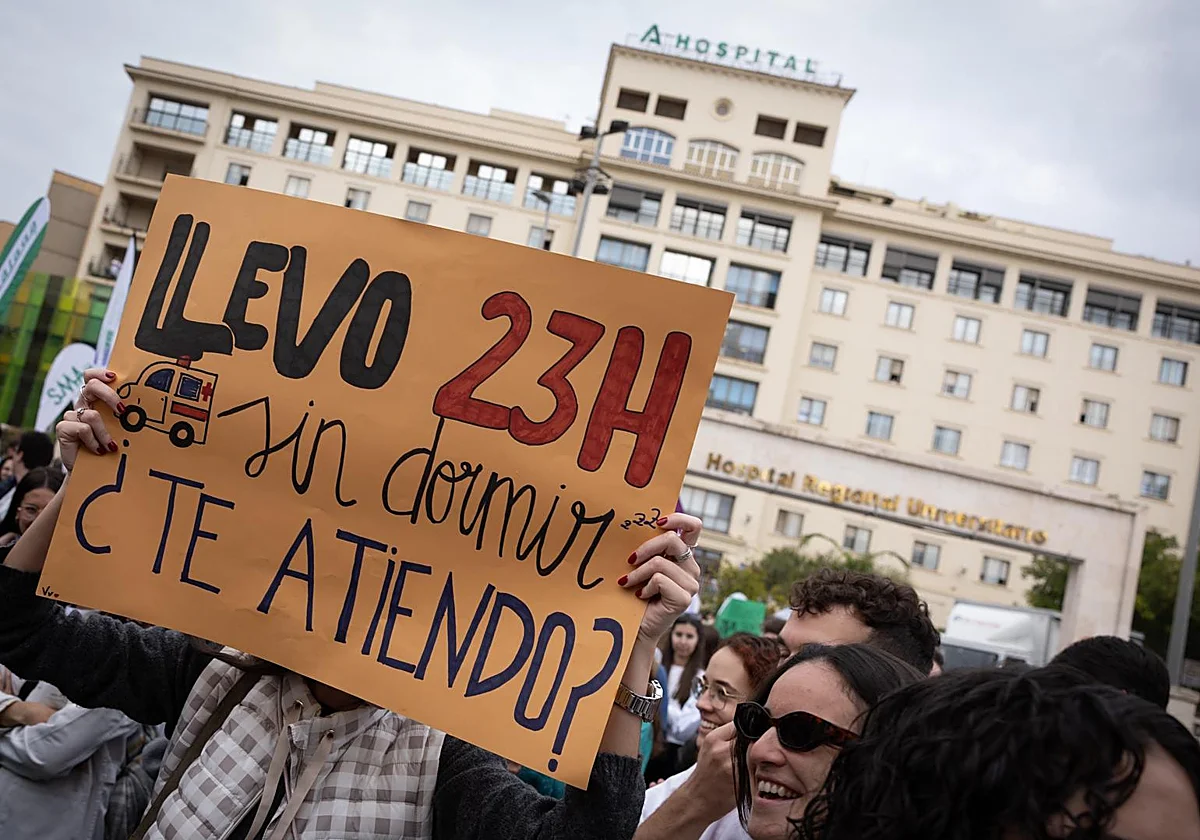
Zoom
A doctor holds up a poster denouncing long on-call shifts during the rally on Thursday. ÑITO SALAS Health A day in the life of on-call doctors in Spain: 24-hour shifts, mid-night critical decisions and frenetic paceSUR spoke to three doctors who described the challenge of treating patients on almost no sleep, the fear of making mistakes and the difficulties of reconciling work and family life on the day after these dizzying shifts
Friday, 12 December 2025, 18:55
"We finish our shifts exhausted: sometimes you are not at your best and you have to attend to critical patients and make decisions about their lives. It is a job that may bring a lot of satisfaction, but you also experience many extreme situations," an on-call doctor from Hospital Clínico Universitario Virgen de la Victoria told SUR during the rally that took place on Thursday, 11 December, the third day of a four-day strike.
Meanwhile, minister of health Mónica García has stated that this has been reduced to a maximum of 17 hours, "with a reduction in the ordinary working day before and after".
The problem lies in the small print: this maximum working day of 17 hours can be extended to 24 hours for service needs in certain circumstances. Who determines this? Health centres and hospitals, which opens the door to arbitrariness.
Marathon shifts
A veteran on-call doctor from the emergency department of El Clínico acknowledged that his generation has been used to this way of working endless hours. "When I started working, the feeling was that it was the right thing to do and it had to be done, but now people want to have quality of life," he said, alluding to younger doctors, who are seeking their rights.
His wife is also a doctor and their life has been "very different" from that of the rest of their friends. While others are making plans, they are on call. "On top of that, some people say that at least they pay us well for what we do, but it is a more derisory salary than the normal shift - it is a tremendous overexertion when you are out on call and the next day you are working."
Zoom Photo of the emergency department at Hospital Clínico. SURShifts are "hard for everyone", but "they are especially difficult" in the emergency department, where doctors "don't stop" and "try to rest in the middle of the night, splitting shifts". However, they still need to be on call every second of that shift and "surgeons and traumatologists spend all night operating". "I remember once falling asleep in a consultation with a patient, the body can't take it, it's an excess of hours, which is also not reflected in the retirement system," the doctor said.
The on-call service starts at 8am with a meeting with the incoming team. "We go through the patients one by one - those who are in consultations, those who are in armchairs and beds. It is the doctor on duty who knows them. There is a consultation area, trauma cases, "bruises, contusions, if they are serious they go to observation: in beds the most serious, in armchairs the less serious; there is a critical room, which is immediately checked: these are people with strokes, heart attacks, serious accidents. It is permanent stress, there is a bell that rings, the rhythm is frenetic, every time it rings we go to attend to the critical patient," he said.
'We split into groups to take a nap, sleep for two or three hours if possible, get up at 4am so that someone else can go to bed: you end up exhausted from the shift'
They eat "quickly", taking turns, while patients continue coming in. "At night we try to take a short break for dinner, we try to take turns so that everybody can go and eat. At that time the body does not perform as well as it should," he said. They also take turns taking naps or even, if lucky, sleeping for two or three hours. Then they "get up at 4am so that someone else can go to bed: you end up exhausted from the shift".
The Clínico veteran said that many people have left the emergency department, "even though they liked it, because their family did not understand the pace; they go to primary care because they cannot stand it". "I've seen excellent professionals fall by the wayside and leave; young people today just don't accept that rhythm. They want free time, a better quality of life and to work in a more orderly and efficient way. I wish I could have enjoyed my working life differently," he said.
"Sometimes you're assessing an ECG, aware that you're tired, exhausted and your thoughts just don't flow." Then comes the end of an on-call shift: many try not to go to bed in the morning, because that disrupts their rhythm. The pace of incoming patients is dizzying, though it's somewhat eased by the triage performed by nursing staff.
Every five days
These shifts happen every five days and they never last 24 hours - instead, they are 25 or 26 hours, some a full weekend. "New generations deserve a better quality of life for patient safety," the doctor said, adding that the amount of work doctors do in order to get to where they are, from the moment they start studying, is rewarded by a "frenetic pace". He, for example, has had to continue writing articles and doing research on his days off.
SUR also spoke to a gynaecologist at the Materno Infantil hospital. Her shifts start at 8.30am. "We have a clinical session to review handovers and see what has been done before," she said. In this case, the team is large and the shifts cover the ward, outpatient consultations and the operating theatre. They see an average of 80 to 90 patients a day and attend 12 to 14 births per shift. "The delivery room doesn't have a schedule," she stated. Different teams cover each of the designated areas.
In her field, given that they are a large team, they do try to eat together, but that doesn't always happen. "Our schedule is dictated by the patients," she said.
"The 24-hour shift is not only the atrocity that it is, but also the atrocity of the conditions in which 24-hour shifts are carried out," she stated. "If you have an obstetric emergency, for example due to an alteration in a graph, something that needs to be finished, you cannot postpone the well-being of a newborn, you have to take it out the moment that alteration occurs and that can be at lunchtime, at dinnertime, at 3am," she said.
To sleep, they also organise themselves into groups: "I work in the afternoon, you work the first part of the night, you work the second part and there are times when you can't keep that routine: you go to bed when you can. It's hard to be on call," she stated.
Zoom Another doctor carries a banner about the reconciliation of work and family life. MARILÚ BÁEZ"It's not just the shift itself, it's what it entails, the responsibility. Then the next day: life goes on. When I started and I was a resident doctor, I didn't have any obligations, I would lie down for a while in the morning. When you have children, you can't go to bed in the morning, you have to carry on with your normal life," she said, calling for longer breaks after on-call shifts and for extra pay for overtime hours.
"I earn more during the day than when I'm on call at 5am," she said. In addition, the gynaecologist believes that these hours should also be included in the pension scheme, although she acknowledges that it might be more complicated.
"Everything here is a vocation, but for me it becomes exploitation if you look at it carefully." She rejects the 17-hour on-call shift proposed by the minister. "You start that shift at 3pm, but in the morning you have already been working your ordinary day: in the end you add them up and they are 24 hours," she said.
"We made some very difficult decisions.
A paediatric specialist at the Materno, who is now doing her residency, agreed. "We want a shift that does not involve 24 hours of work and a break according to that shift: at least two days of rest when we finish the shift. While we do one, we see three shifts of other health professionals go by," she said.
In the case of this hospital, the shifts are divided between the neonatal and paediatric ICUs and the ward. "On a normal day, you work in your department from 8am to 2pm and from 2pm to 3pm you change shifts. The work is very different: the worst is the ICU, where you don't stop. There's the resident and a consultant; it's 24 hours of work with patients in very serious condition; you take new patients and monitor the children, making very complex decisions. In the ICU, you sleep very little and are constantly on call," she said, adding, as an example, that 400 children were attended to on Sunday. "There are eight paediatricians, which means 50 or 60 children per doctor," she stated.
After so many hours of work, they come to doubt the simple calculation of a dose: 'You need to have a continuous capacity to respond, even if you don't sleep for a minute. I'm worried about making a mistake'
Some doctors receive people for consultations non-stop, with the door constantly open. Although some take turns sleeping, "in the ICU it is complicated to do so".
"The neonatal ICU covers the maternity ward, the delivery room and the ICU: you have to go to see the baby, there are continuous calls at night or an emergency caesarean section. You need to have a continuous response capacity even if you don't sleep for a minute. I'm worried about making a mistake," the resident doctor said.
Zoom Other banners from Thursday's rally demonstration in front of Hospital Regional. ÑITO SALASWhen they are so tired, they come to doubt everything, even the calculation of doses. They write down basic processes in a notebook and continually resort to the judgement of their colleagues. "Tiredness leads to insecurity - you don't know if you're getting something wrong. The next day, when the new colleagues arrive on duty, there are debates because they would have made a different decision. We don't think clearly at 3am," she said, adding that many paediatricians leave hospitals to go to primary healthcare centres "to reconcile personal and work life".
"You lose the day before your on-call shift, because you'd rather not go out to dinner in case you get delayed, since you have the shift; and the next day, after finishing, you spend the whole day sleeping. I've sometimes got out of bed at 7 or 8pm," she said.