Zoom
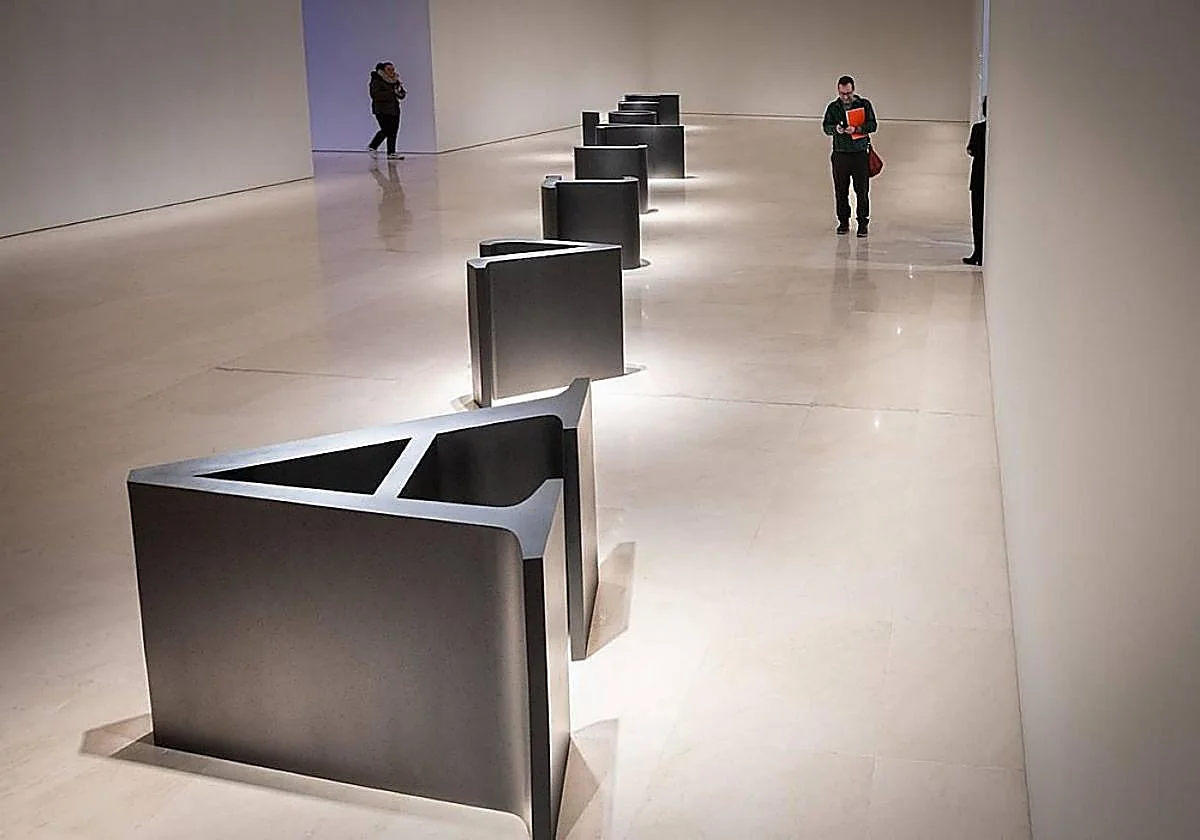
The 'A' of Antígona heads this work by Elena Asins, which updates the Greek myth through the word turned into sculpture. Ñito Salas Culture Elena Asins' radical sculpture 'returns' to Malaga Picasso Museum half a century laterThe artist, who died a decade ago, is the star of the Obra Invitada programme with the huge Antígona, a piece from her last period
Francisco Griñán
Malaga.
Friday, 6 February 2026, 15:54
There is something wrong with the headline of this article. The Museo Picasso Málaga (MPM) has just celebrated its 22nd anniversary, so, mathematically, it is impossible for Elena Asins (born in Madrid, 1940 and died in Azpíroz, Navarra, 2015) to return to the art gallery 55 years later. But there is an explanation.
Indeed, the sculptor exhibited in the same building, the Palacio de Buenavista in Calle San Agustín, just over half a century ago, except that, at that time, the art gallery that occupied the same space was the Museo de Bellas Artes.
It was there that Asins deployed her scenic and conceptual arsenal, bringing "with all her prestige the geometric and plastic solution - or solutions", as SUR reported in 1971.
The same can be said of this debut/return of the winner of the National Prize for Plastic Arts (2011) to the Picasso museum with Antigóna, one of the great works of her last creative period in which she turns to Greek tradition to show her rebellion and criticism of power.
"I am convinced that Elena would have liked to inhabit the Picasso Museum," said the director of the MPM and curator of the exhibition, Miguel López-Remiro, last week.
At the launch of the exhibition Elena Asins. Antígona, he explained how he got to know the artist and the making of this monumental sculpture, which occupies the temporary exhibition room on the ground floor, together with the audiovisual show Hemón.
Zoom
Classical inspiration
With this radical work of classical inspiration, the central feature of the Picasso museum's invited work programme, Asins returned to her origins. If she then worked with poetry as a raw and intellectual material, the artist of algorithms and calculation took up the word again to turn the letters of the Greek alphabet with the name of the classical heroine into sculpture in order to vindicate her figure and her resistance to power.
This monumental typography made of corten steel and painted black reaches its full dramatic splendour, forming a twisted line in the room of the Picasso Museum. The work is exhibited diagonally to reach its "maximum dimension", also allowing the visitor and spectator to walk around this classic myth of Antigone which, for the curator and director, is an "alter ego" of Elena Asins herself due to her rebellion against power.
"She wanted to turn that word into a sculpture that, at the end of her life, would connect with her trajectory and her beginnings by recovering the letter as a sculptural space," explained López-Ramiro about this fundamental work that "reads like a book" and has been loaned by the Reina Sofía Museum in Madrid, the universal heir to the work of the conceptual artist.
"Being able to have Elena's work here in Malaga also allows us to link it to the exhibitions she held in the 1970s at the Ateneo de Málaga, the Colegio de Arquitectos and, in particular, the Palacio de Buenavista when it was the Museo de Málaga more than half a century ago," said Miguel López-Remiro, who also highlighted Asins' links with contemporary art in Malaga at that time: "She found something in the Colectivo Palmo [art association] and in the avant-garde that inspired her."
In addition, the monumental piece joins the video Hemón - Antigone's partner in this Greek tragedy -, specifically the 89th version of this audiovisual of more than eight hours that has music synthesised by the sculptor and fundamental artist of our time.
Zoom
"When I visited her in May 2015 - a few months before her death - she gave me this version on a pendrive and it is the one shown here," revealed the curator, who did not hesitate to remember Asins, the winner of the Gold Medal for Merit in Fine Arts and the National Prize for Plastic Arts, as "a radical figure in our art" who, like Picasso, was a "great mentor in transmitting her talent to other generations".
The opening was attended by Carlos Urroz, director of the institutional office of the Madrid museum. He pointed out that his institution shares "the figure of Picasso" with the MPM as the Reina Sofía is home to the giant Guernica.
The director explained that his museum makes more than a thousand loans of its works every year and highlighted the special link with Elena Asins, who made the Reina Sofía the universal heir to her entire legacy.
"It is something very unusual for a museum, which is why ten years ago we not only found ourselves with a large collection of artwork but also with two cars, a house and a small account," revealed Urroz, who added that, after selling the vehicles, they are now trying to convert Elena Asins' country house in Aspiroz, Navarra, into "a residence for artists".
As for the sculptor's artistic legacy, he said that Antígona is a "much-loved" work because of its uniqueness and because it has been exhibited in the Nouvel building of the Reina Sofía and in the Senado.
On contemplating it, we see that "the word is as important as the form of the word," said Urroz.