6 min read
Expanding the Human Factors Toolbox: An Approach to Balancing Crew and Mission Design ParametersMeagan Chappell
Mar 10, 2026 ArticleThis article is from the 2025 Technical Update.
The human factors TDT looks for and creates opportunities to influence design to leverage human strengths and to protect people and missions. The human factors team has experts with knowledge of human performance in all aspects of NASA missions as well as from other safety-critical industries. The goal is to ensure that science-based human factors knowledge and lessons learned are applied throughout the mission lifecycle. The strategy is to 1) modify existing and create new discipline tools that meet NASA’s needs and constraints, 2) build strategies to enhance the disciplines’ chances for success, 3) enhance simulation techniques to gain maximum information even when verification and validation opportunities are limited, 4) develop new analysis methods for human performance in NASA mission contexts, and 5) reframe understanding of human performance to emphasize the key role of human resilience in mission success.
This article highlights a set of analytical models of crew workload, training, and expertise that can be used to aid decision makers in determining the size of a Mars crew adequate for crew safety and mission success. These tools are built on a Department of Defense (DoD) capability that has been used extensively to evaluate the success of specific designs. Unlike missions in low Earth orbit or even to the Moon, a crewed Mars mission will operate under extraordinary constraints, primarily a significant communication delay with Earth and prolonged communication blackout periods. This necessitates a radical rethinking of mission design, including the human elements of crew size, workload, expertise, and resilient performance.
To address this gap, the NESC developed a systematic and quantitative methodology, along with an associated suite of modeling tools, to enable the development of an evidence-based trade space for guiding crew size decisions for human Mars missions. This work provides actionable analysis to programs and projects early in development, enabling simultaneous consideration of mission architecture, operational concepts, and the roles human will play throughout the mission. This analysis supports the development of mission designs that preserve and enable human resilient performance to ensure the success and safety of future Mars exploration.
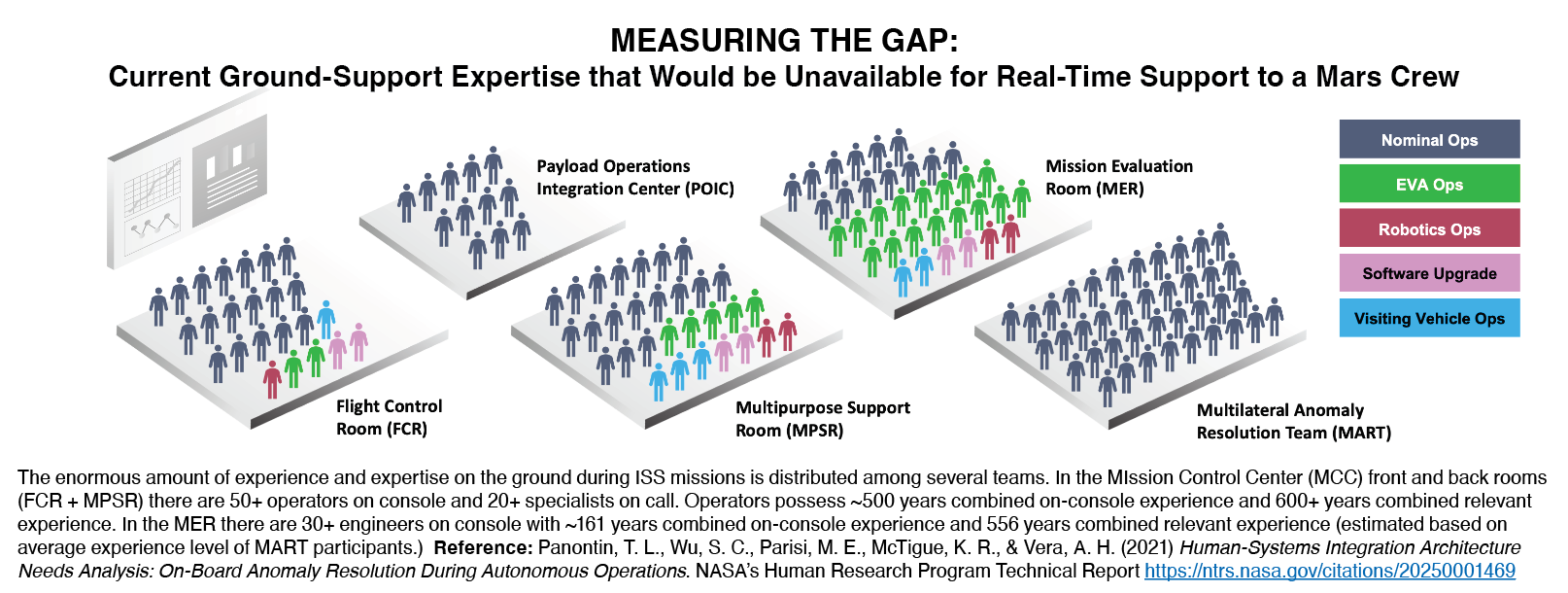
Historically, NASA’s human spaceflight programs have relied on real-time support from extensive ground control, composed of a collective intellect that acts as an extended crew to manage objectives and respond to anomalies. As depicted in Figure 1, the volume of ISS ground personnel highlights the vast support structure available for Earth-proximal missions. However, for Mars, communication delays of up to 22 minutes one-way and blackouts lasting up to three weeks during superior conjunctions will eliminate this real-time lifeline. This demands a new focus on the capabilities required of the onboard crew, who will face time-critical decisions and unforeseen failures with only their knowledge and onboard decision-support systems, often without pre-existing procedures.
Current ground-support expertise for ISS missionsThe NESC’s methodology fills a longstanding gap, as past Mars crew size determinations often lacked detailed quantitative analysis of crew tasking, workload, and expertise. Extending DoD methodologies for manpower determination, the NESC human factors trade space methodology offers a repeatable and> The NESC’s proposed methodology to aid crew-size determinations.
Trade-space parameters are input into any of four models, whose output
characterizes the risk level associated with a given crew size. Astronaut Anne McClain using the
Space Station Remote Manipulator System on ISS.