Zoom
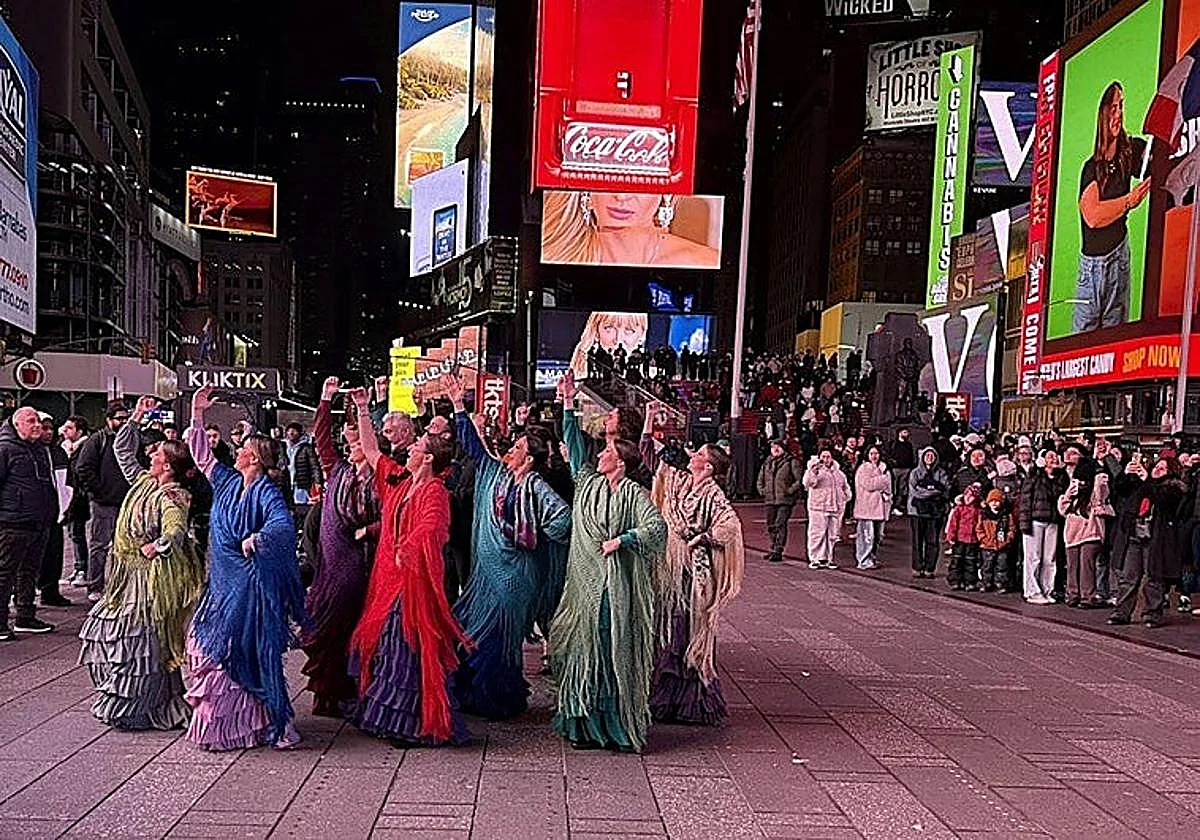
The Sara Baras flamenco dance company, in Times Square. J. B. Art and culture Flamenco: from Cadiz to an impromptu street show in New York with Sara BarasThe Cadiz-born flamenco artiste took Times Square by storm with her dance company and the legend that is Mikhail Baryshnikov joined in on a few rumbas with festival director Manuel Liñán
Julio Bravo
from New York
Tuesday, 10 March 2026, 16:54
Times Square, the heart of New York . It's eleven o'clock at night and the thermometer reads zero, but the dozens of neon signs covering the walls of the surrounding buildings create a spectacular and warm scene.
Tourists are snapping selfies, taking pictures of their surroundings and crowding around a group of street musicians who are rapping intensely. Suddenly, a group of Spanish dancers slip off their coats, revealing colourful, flamenco dresses with all the frills and trains. "One, two, three!" shouts one of them and they begin their dance routine, accompanied by musicians. Curious onlookers turn around, focus their phones on them and start wondering who they are.
Someone quickly announces that they know who it is. This is a very well-known Spanish flamenco dancer: Sara Baras. Indeed, this woman from Cadiz is in charge of this company that has headed to Times Square after performing at the City Center - without even a change of costume - just to film a short clip of the full show that will form part of the documentary with which the Flamenco Festival of New York celebrates its 25th anniversary this year. The show is dedicated to Seville. MiguelMarín, creator, director and the heart and soul of the festival since its inception, wanders around with a nervous, but excited look on his face. "What a commotion we've caused!" he says with a mischievous grin.
The Flamenco Festival has once again returned to take a bite out of the Big Apple. Twenty-five years have passed since Farruquito, María Pagés, Carmen Linares and Manolo Sanlúcar had their first encounter with New Yorkers. Yet this love affair (this year's festival theme) between New York and flamenco goes back much further, with names like Carmencita, the first flamenco dancer to appear in a film and who was painted by artists like John Singer Sargent and William Merritt Chase.
Also, Encarnación López, known as 'La Argentinita', and Carmen Amaya - legend has it that she was expelled from the Waldorf Astoria Hotel because members of her company grilled some sardines in their rooms . Others include Sabicas, the first to give a flamenco guitar recital, and he did so in New York, and Antonio and Rosario, known as 'Los chavalillos sevillanos' (the young lads from Seville).
The Flamenco Festival has ensured that the continued presence of this art form - the true 'brand of Spain' - is maintained in this city, the place that remains the world capital of entertainment. "The public has learned how and when to shout 'Olé!'", says Molly Meloy , marketing director at the City Center, the theatre that hosts the major dance shows. She adds: "And I find it significant that, every year, 60 per cent of the audience is attending a flamenco show for the first time. And the growth is constant."
"Sixty per cent of the audiences who come to our shows are attending a flamenco show for the first time."
Molly Meloy
Marketing director, City Center NY
Much of this interest in flamenco - "and in all things Spanish", adds Meloy - stems from the educational work that the theatre and the festival itself have been doing over the years. Public schools in New York have the option of choosing a show at the City Center for their pupils to attend. The Flamenco Festival's shows are the most popular. However, they don't just attend the show as, a few days beforehand, they receive an introduction to flamenco and an explanation of what they're about to see. "And it's very exciting to see their reactions."
"Pick up that apple..."
Neither is it just for schoolchildren. On Friday, a crowd gathered at the doors of City Center an hour before the show began to attend a pre-show featuring the basics of flamenco dance. XianixBarrera , a New Yorker of Latin American origin, demonstrates how to clap, how to move their arms and so on. She tells them to "Pick up the apple, eat it, throw it away." Barrera herself is a convert. "As a child, I saw the Riverdance show, which included a flamenco number danced by María Pagés. And I said: that's what I want to do. And here I am. Our job is, above all, to help them enjoy the music, their passion."
Molly Meloy herself follows the class with a beaming smile. "We have a maximum capacity of 180 people - the theatre seats 2,200 - and today we've reached it", she says, while pretending to pick up that apple, eat it and then throw it away.
Every performance ends with the audience on their feet, literally howling, and also after every number. Sara Baras, buzzing with energy and oozing quality in her dance, expresses it very vividly. "This audience is incredible!" she says, while touching up her make-up before heading to Times Square. "Their response is truly moving, as is their silence, their attention ...". This woman from Cadiz knows New Yorkers well: the first time she performed in the city was back in 2003, when she presented 'Mariana Pineda'. "Antonio Banderas came to see us," she recalls.
One extra flamenco dancer?
Another star who has occasionally graced the festival is the legendary dancer Mikhail Baryshnikov. Last year, he was captivated by the artistry of Eva Yerbabuena and he asked Miguel Marín to organise a 'Fiesta flamenca' dance party at his own place, the Baryshnikov Arts Center. Nearly 200 people - including Isabella Rossellini and Jessica Lange - were entertained by the infectious dancing, singing and guitar-playing of Manuel Liñán, Juan Tomás de la Molla, Mara Rey, Alberto Sellés, Juan de la María and José Fermín Fernández in two sittings.
Seated discreetly at the table, Baryshnikov couldn't stop tapping his feet and he finally succumbed to Liñán's encouragement, stepping up to dance, with great style, flair and grace - he even removed his jacket and handed it to Juan Tomás de la Molla - a few tangos and rumbas. In the words of the well-known song "Tú me quieres dejar y yo no quiero sufrir, contigo me voy gitana aunque me cueste morir!" (You want to leave me, but I don't want to suffer, so I'll go with you, my gypsy woman, even though it'll cost my life). As Sara Baras puts it: "This audience is incredible!"