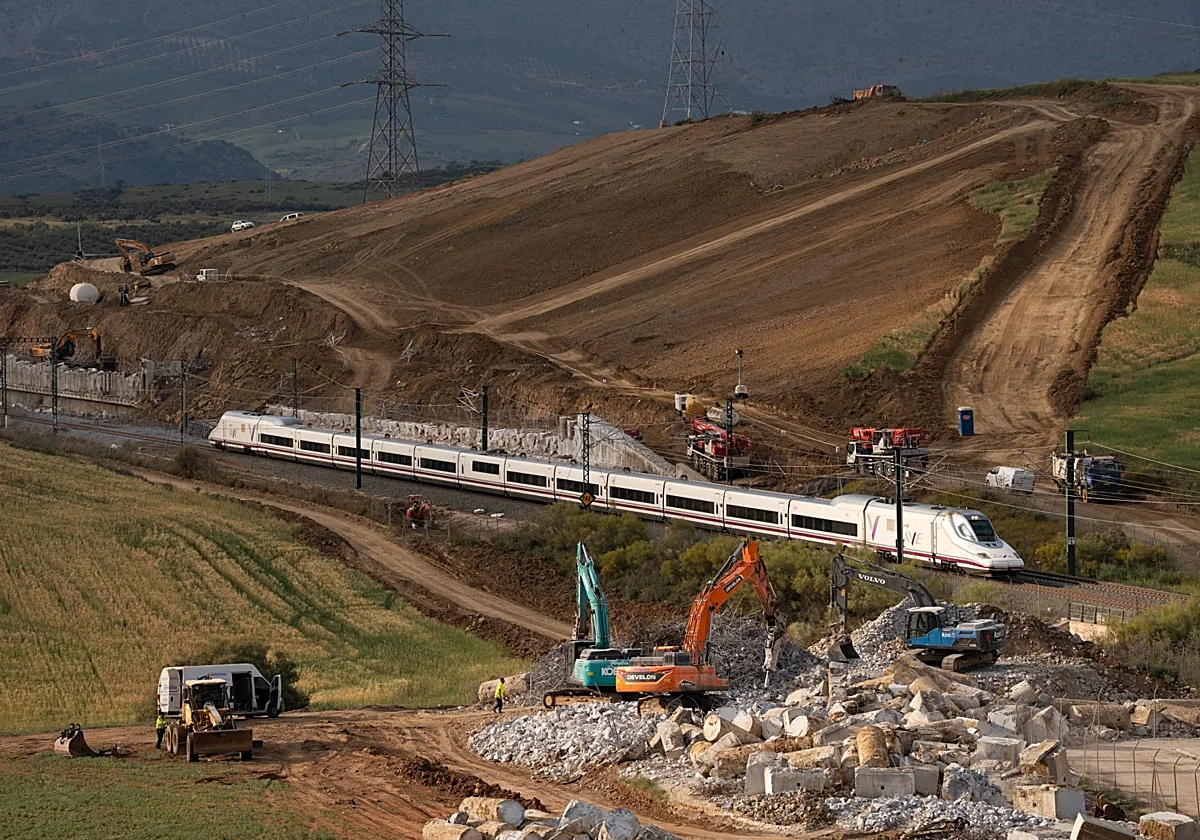
An AVE train without passengers tested the repaired track in Álora a few hours before the line reopens to check its safety
An AVE train on a test run next to the Álora embankment on Wednesday afternoon. (ÑITO SALAS)Málaga
30/04/2026 a las 09:49h.Direct high-speed trains return today to Malaga from Madrid after four months with no service and four missed reopening dates. The line was cut ... in two places: first, the railway connection between the two cities was interrupted on 18 January, when the Adamuz railway tragedy took place in Cordoba. Then, on 4 February, heavy rains caused a serious landslide, which rendered the Álora section of the line unusable.
On Wednesday afternoon, SUR was an exclusive witness to the passage of an AVE train without passengers along the closed line. This train travelled several times between Malaga city and Antequera, testing the newly repaired track.
The train made several runs from 6pm until nightfall, that is, just a few hours before the final reopening to passengers. The purpose of these exercises was to check the safety of the infrastructure for passengers and railway staff.
In the last three months, Adif has had to clear the hillside, moving 200,000 cubic metres of earth, as well as the complex stabilisation of a high-voltage pylon and the removal almost to its base of a 300-metre-long, 15-metre-high retaining wall. Subsequently, the superstructure of the line has been replaced: rail, overhead wires, signalling, etc.
During this long impasse, Renfe has been the only operator that has continued to provide the service with a handful of daily frequencies, by means of bus transfers to Antequera Santa-Ana. In the meantime, the private operators stopped running and, in fact, Iryo temporarily laid off its workers due to unforeseen circumstances and force majeure.
Half service returns
This Thursday, the railway line starts to get back to normal with direct trains run by the three operators (Renfe, Iryo and Ouigo). For the time being and for several months, the services available will not be as frequent as they were at the beginning of the year.
The first train on Thursday was due to depart at 9.50am from Atocha, Madrid, arriving at María Zambrano at 12.52pm. In the opposite direction, the first service, run by Renfe, will depart from the capital of the Costa del Sol at 12pm and will arrive at its destination at 2.58pm.
19
There will be 18 trains in the Madrid-Malaga direction and 18 in the opposite direction on Monday, 4 May, the first working day after the long weekend. Since at the end of the year there were up to 26 trainsa day, the new offer will be almost 30% lower.
The timetable has been clearly reduced, due to the fact that, for the moment, there is just a single track on the 54.5 kilometres between Los Prados, in Malaga, and Antequera-Santa Ana. This is due to the fact that the landslide destroyed equipment that allows trains to pass from one track to the other along this stretch, and which will not be replaced until the end of this year.
Although at first the decrease of available trains was going to be up to 40%, according to the offer that Renfe had on sale last week, it is finally offering a total of 13 daily departures from Madrid to Malaga, and another 12 in the other direction.
If we take as a reference the first working day after the long weekend, which will be Monday, 4 May, Iryo and Ouigo will provide another three daily trains each. Together with those of Renfe, this makes a total of 18-19 daily services. If before the cut-off there were 26 trains running in each direction, now there will be almost 30 per cent fewer than there were at the end of 2025.
Longer journeys
The second substantial change this Thursday is that passengers will face longer journeys than before the closure. The data provided by the operators show that journeys will take a minimum of three hours, whereas until the beginning of this year the journey was usually covered in two and a half to three and a quarter hours.
However, the journey will be extended by up to 24 minutes on those frequencies, such as the one in the early morning, when the train stops at all intermediate stations in smaller towns. This is due to the need to reduce speed to a minimum when passing by the Alora embankment works. Trains also slow down in the area of the Adamuz accident, among other stretches where there are speed restrictions. Long gone are the early years of the AVE, when the direct route, without stops, took barely two and a quarter hours.
Renfe also resumes Avant services to Seville and Granada
Renfe is also restoring all direct Avant services to and from Malaga this Thursday at midday. Avant Málaga-Córdoba-Sevilla services will run again without the need to change trains, with 14 trains on weekdays and eight on Saturdays and Sundays from 1 May. Avant Málaga-Granada services will also be restored from 12 noon on 30 April. These services were cancelled due to the effects of the storm and now return with a timetable of six daily services. However, the operator warns that "the current conditions of the infrastructure, which involve using a single track in some sections, have made it necessary to modify the timetables of the Avant services in Andalucía". Finally, on Monday, 4 May, long-distance connections from Malaga to Zaragoza and Barcelona will be restored.