Zoom
This route passes through two remote villages of Cuevas Bajas. J. Amellones Andalusian escape In the northernest part of Malaga province: the route from Cuevas Bajas to Cortijo de la LomaLa Moheda and El Cedrón are the two villages along this route, which uses part of the Mozarabic Way
Málaga
Monday, 13 April 2026, 13:59
This circular route starts in the municipality of Cuevas Bajas (Malaga) and runs along rural roads and farm tracks towards the villages of La Moheda and El Cedrón, also passing through the area around Cortijo de la Loma and sections of the Mozarabic Way.
Route data
Region: Sierra Norte de Málaga
Municipality: Cuevas Bajas
Difficulty level: Medium. The route is of moderate technical difficulty and has a gradient which, although not excessive, requires a certain amount of physical preparation. In addition, in one of the sections there is no signposting of the path and it will be necessary to find your way to the section that is approved and well signposted. This route is suitable for mountain bikes.
Type of route: Semi-circular
Approximate duration: Three hours and 30 minutes
Length: 10.5 kilometres.
Minimum height: 377 metres
Maximum altitude: 704 metres
Nearby places of interest: Villages of La Moheda and El Cedrón, community oven, Cortijo de la Loma, Camino Mozárabe de Málaga and El Cedrón viewpoint, among others.
Zoom
The Cedrón viewpoint has spectacular views of the surrounding area. J. AmellonesHow to get to the starting point
To begin this route, head for the municipality of Cuevas Bajas . Once there, look for the exit on Calle Archidona, where the municipal cemetery is located. Look for the signposting of the Mozarabic Way, which corresponds to the stage that links this village with Villanueva de Algaidas. You will have to look for signs as well as the characteristic shells and yellow arrows. From the latter, before leaving the town centre you will see a particularly long version , in the opposite direction (pointing towards the village). From there you can start this route.
Route description
1The route starts practically next to the big yellow arrow of the Mozarabic Way. From there you have to leave the town centre until you reach the A-7300 road, which you have to cross with caution to continue along a wide lane that forms part of the stage of the Mozarabic Way that links Villanueva de Algaidas and Cuevas Bajas. This path in the direction of Cuevas de San Marcos runs for 600 metres parallel to the road, which will be on the left. This route will be done on the outward journey in the opposite direction to the signposting. After just over half a kilometre you reach a crossroads. On the right you take a path signposted to El Cedrón and La Moheda, two villages in Cuevas Bajas. If you continue straight on, you will also reach them on the Mozarabic Way, although it is advisable to leave this route for the return journey. You leave the Pilgrims' Way to enter a beautiful olive grove, first on a slight descent and then on a gentle climb.
Zoom
Place where you leave the Mozarabic Way to follow a path through olive trees. J. Amellones2This alternative section enters a particularly attractive olive grove, with large specimens, many of them with two or even three trunks, which give the impression of an ancient and well-worked landscape. The path, which is well defined first descends gently and then begins a gradual climb between olive tree-covered hills. The sensation here is one of isolation, far from the traffic on the Mozarabic Way, in an environment where only the wind and agricultural activity set the pace.
Zoom
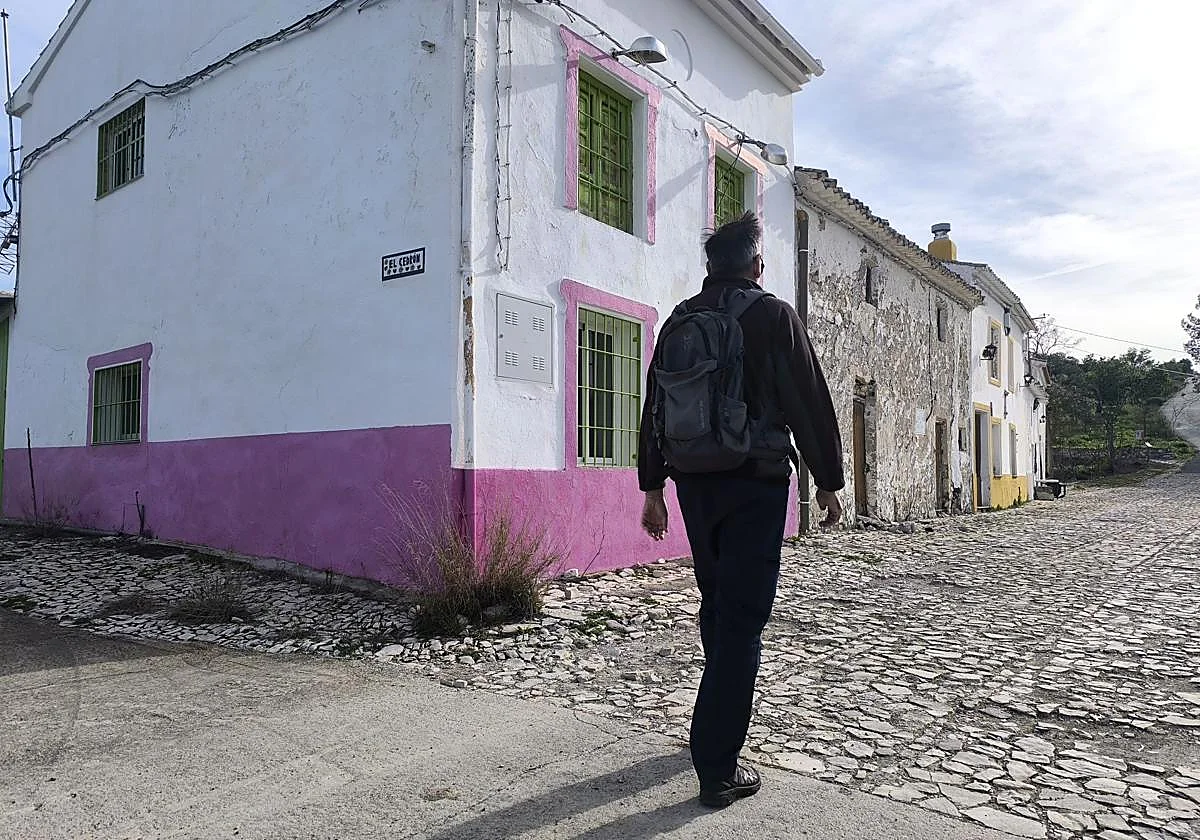
Arrival at the village crossroads J. Amellones3After this ascent, the route comes to a clearly signposted crossroads where it joins the Mozarabic Way again. At this point, La Moheda is on the left and El Cedrón on the right. The route continues in the latter direction, now on the Pilgrims' Route to Santiago de Compostela, along a wide and comfortable track that leads to the hamlet of El Cedrón. This small village conserves its traditional structure, with streets that still have cobbled sections. Very close by is the communal oven, one of the most unique elements of the route. This space, used for generations to bake bread, reflects a way of life based on community and neighbourly cooperation. From here, the path continues upwards until it reaches the Cedrón viewpoint, where one of the widest panoramic views of the route opens up, with views of the Antequera plain, the Genil valley and the Subbetic mountain ranges.
Zoom
Aldea del Cedrón, where a communal oven is preserved J. Amellones4From the viewpoint, the route continues to the area around Cortijo de la Loma, where the return journey begins. The path follows the previous section back to the crossroads where the directions to La Moheda and El Cedrón meet. This time, instead of returning along the initial path, take the detour towards La Moheda, entering this hamlet between fields and scattered buildings that reflect the agricultural character of the area.
Zoom
Arrival at the farmhouse of La Loma J. Amellones5From La Moheda, the route links up again with the Mozarabic Way, which is followed without leaving it until it returns to Cuevas Bajas. This last section runs along a wide and comfortable track, closing a semi-circular route that allows you to get to know two of the most unique villages in the municipality, as well as combining landscape, history and ethnographic elements in a little-travelled environment.
Zoom
Corner of the village of La Moheda J. AmellonesFlora and fauna
The landscape along this route is dominated by a veritable sea of olive trees, which cover the gentle hills of the north of the province. Many of these specimens are large, reflecting a centuries-old cultivation. This predominance of olive groves has largely replaced earlier plant formations, especially holm oak groves, of which there are still isolated traces such as the well-known chaparro borondo, a holm oak that acts as a reminder of those ancient forests. Alongside these elements are species typical of Mediterranean scrubland and herbaceous vegetation on borders and ditches, while the fauna is represented by birds and small animals adapted to these open, agricultural landscapes.
Zoom
Along the road, you pass by large olive trees with two or even three trunks. J. Amellones