Health
Malaga doctors' protest warns patients of risk of life-threatening mistakes during 24-hour on-call dutyThree A&E doctors spoke with SUR during the protest on Monday and all agreed that they and their colleagues are overworked, exhausted and pushed to limits harmful to everyone involved
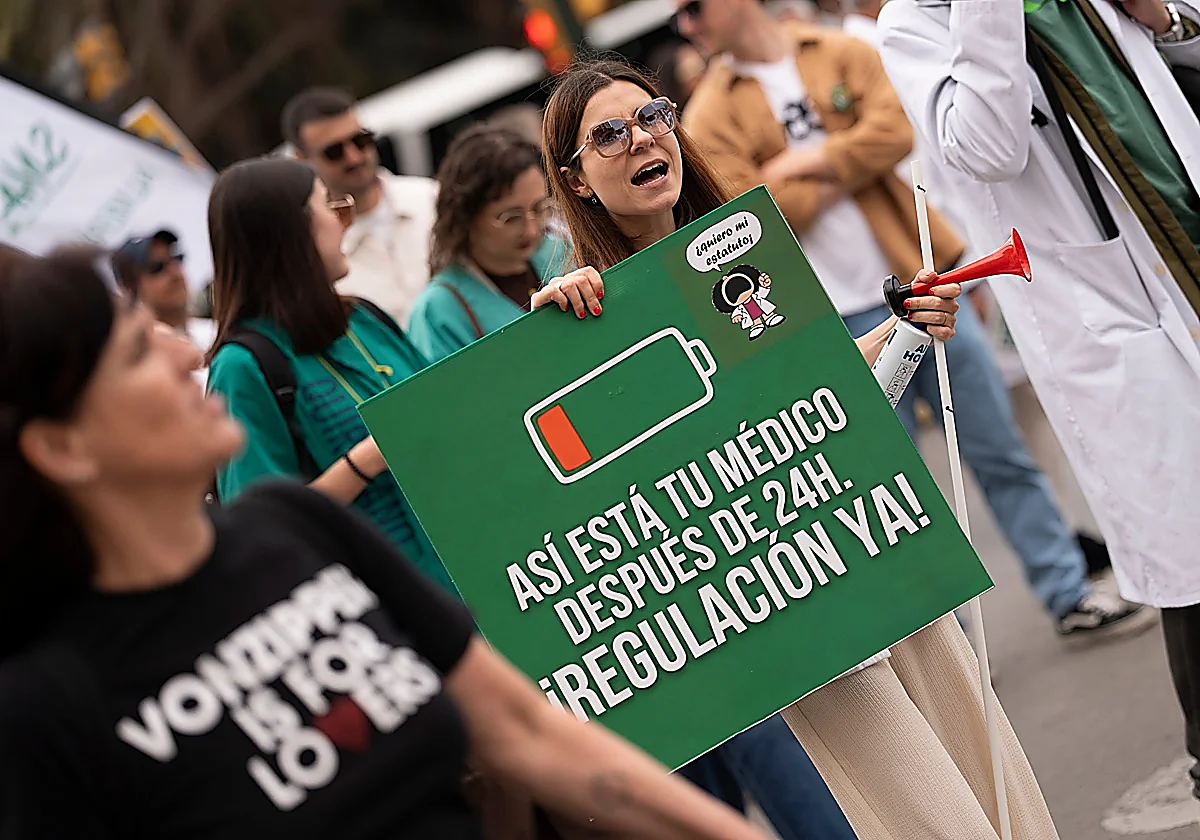
Añádenos en Google Photo from the doctors' protest in Malaga in March. (SUR)José Antonio Sau
22/05/2026 a las 14:01h.One of the key demands of doctors in their fight for their own professional framework is to end 24-hour shifts, which explains why so many young physicians are joining this week's strikes.
In contrast to the stance of previous generations, new healthcare professionals want to be able to dedicate time to their families and leisure activities.
Furthermore, they warn of the impact these marathon shifts have on their decision-making ability, mental clarity, rest and families. "You don't respond the same way after 20 hours," A&E worker Dr Gustavo Mesa told SUR at the demonstration doctors from the province of Malaga held near Hospital Regional on Monday.
The difference between a decision made after three hours of work and one after 20 hours
"A critical patient comes in, someone with acute pulmonary edema after a heart attack, both lungs filled with fluid, and you have to make decisions because otherwise they'll die. You don't do that the same way when you've been working for 20 hours as when you've been working for three or four hours. You're slower. It's true that it gives you an adrenaline rush that energises you, but you pay for that later," he said.
The subsequent drop in energy, he says, "is terrible". "It destroys you, it destroys your family. You can't plan a weekend with your wife and if you're both doctors, you have different shifts so you don't leave the children alone and you don't even see each other at the end of the month. It's absurd, no other worker is required to do that," he stated.
He said that, while Minister of Labour Yolanda Díaz talks about a 35-hour workweek, doctors "end up working 70, 90 hours a week". "It seems like the legislation applies to everyone in general except for doctors," he stated.
He explained that he can't plan his breaks because on-call shifts are scheduled "month after month and lead to utter exhaustion". After finishing a shift past 8am, "you might fall asleep at 1pm, get up at 6-7pm and then have to go back at 8am the next day".
Dr Mesa added that "working those night hours after a long period of continuous mental exertion is dangerous".
Angustias Bernal is also an A&E doctor. "We can't allow them to continue belittling the medical profession. They signed it without us, without taking into account that we have different working conditions than everyone else," she said.
"It's impossible for a doctor to work 24 hours straight and maintain their concentration and focus for that long. The minister says she's eliminated 24-hour shifts, that we'll only be doing 17, which is still much more than what other professions do. We don't do 17-hour shifts. They're going to continue being 24 because, due to service needs and weekends, they're going to keep forcing us to do them," she said.
The problem lies in the fine print, since the draft of the framework statute stipulates that this maximum 17-hour workday can be extended to 24 hours due to service needs in certain circumstances. Who decides that? The health centres and hospitals.
"It's very hard"
She says that working this many hours is "very hard".
"One or two days before, you already have a lot of anticipatory anxiety because you know you have to be on call 24 hours a day. In the emergency room, there's no rest, it doesn't matter if it's noon or midnight, you just get through your shift as best you can. By 3am, you're not yourself anymore. You don't even know what you did at 8am. You don't think the same way, you don't reason the same way, you don't diagnose the same way. The next day you try to recover, but the thing is, the next day you're back at work. At 8am, you have to be back, thinking, diagnosing, making important decisions," Dr Bernal said.
Related story
Health
José Antonio Sau
This can lead to mistakes. "A tired doctor is a guaranteed error. What you saw very clearly at 8am, you doubt at 3am and you might not even make the same decision you would have made earlier. After thinking and making decisions all day, there comes a point when you're exhausted," she said.
Cristina Guitar is the third A&E doctor who spoke with SUR. She attended the demonstration, because she is outraged by the way the government and Minister of Health Mónica García treat doctors.
"They treat us like cheap labour, with no breaks, extremely long shifts, no work-life balance and we can't even consider on-call hours as hours that count towards our pensions at a ridiculously low rate," she said.
"A total kidnapping"
For her, 24-hour shifts are "a total kidnapping". "Today I'm on call, I say goodbye to my family, I work flat out for 24 hours. I don't think you'd want to be in my hands when I've been working for 18 or 19 hours, no matter what. I lose the ability to react, to be alert," she said.
From her perspective, there are other ways to organise the workday. "Those who want to work 24 hours straight can do it, it should be voluntary, although I don't recommend it. The problem is that they don't want to listen to us," she said.
She believes that implementing 12-hour shifts is the way to go, as is the case with other healthcare professionals such as nursing staff.
Head of the Malaga medical union (SMM) Dr Antonio Martín Noblejas also addressed this issue at Monday's demonstration. He said that young doctors and residents will be the attending physicians who "will suffer these conditions that the ministry refuses to address".
For Martín, "on-call shifts are a form of slavery and exploitation" in the 21st century and they don't even count towards retirement.
"If the service needs to be provided, it should be provided, but it must be compensated properly. We need a system in place for this extraordinary work that only doctors and physicians do," Dr Martín said.