Vanessa Thomas
Feb 26, 2026 ArticleContents
- launched on Nov. 13, 2025, has turned on the science instruments that will investigate how this happened and how the Sun continues to influence the Red Planet. The science instruments, which are all operating as of Feb. 25, also will study space weather in new ways near Earth and on the way to Mars.
At Mars, ESCAPADE’s findings could also help NASA protect future explorers from the harsh Martian conditions.
“The pioneering ESCAPADE duo will not only investigate the Sun’s role in transforming Mars into an uninhabitable planet, but also will help inform the development of space weather protocols for solar events directed at Mars during future human missions to the Red Planet,” said Joe Westlake, heliophysics division director at NASA Headquarters in Washington. “By joining the heliophysics fleet of missions across the solar system, ESCAPADE will be another weather station making humans and technology in space safer and more successful.”
NASA’s ESCAPADE (Escape and Plasma Acceleration and Dynamics Explorers) mission launched on Nov. 13, 2025, atop a Blue Origin New Glenn rocket at Launch Complex 36 at Cape Canaveral Space Force Station in Florida.Blue OriginFirst of its kind
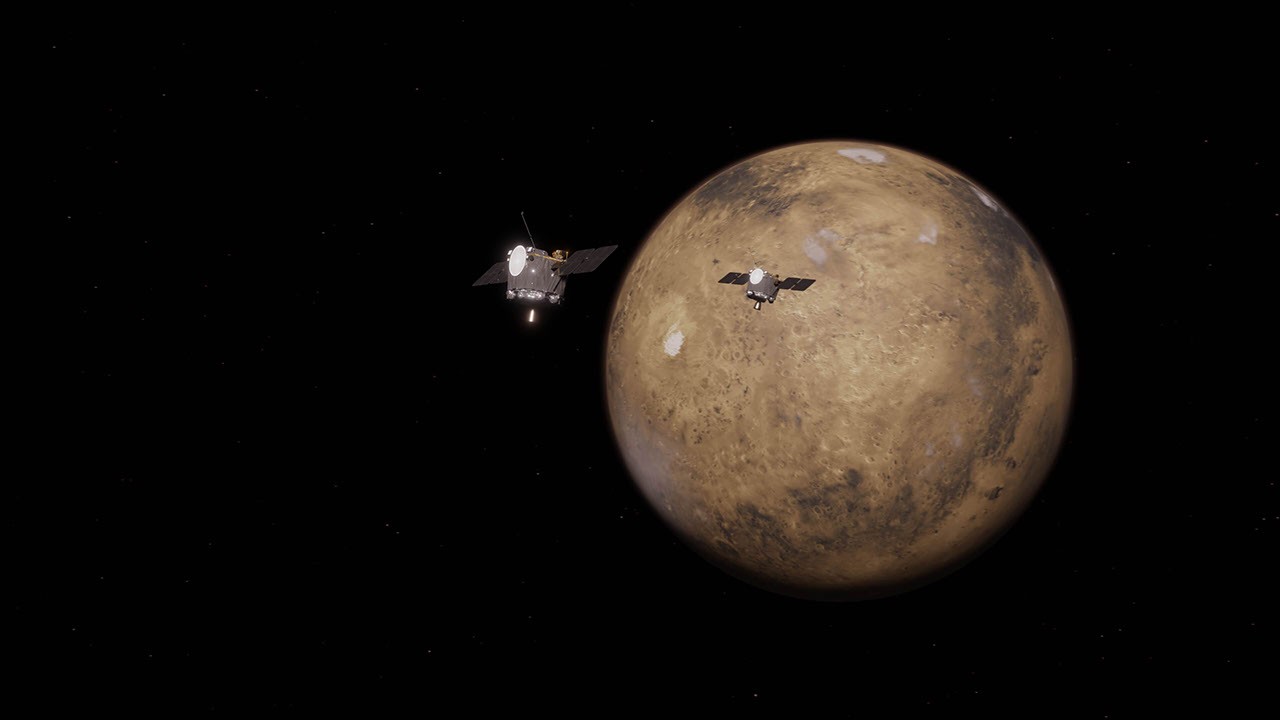
With its twin spacecraft, ESCAPADE is the first science mission to coordinate two orbiters around Mars, gaining a perspective we’ve never had before. Together, the ESCAPADE twins will measure short-term changes in the magnetized environment around Mars, called the magnetosphere, and uncover real-time processes driving the planet’s atmospheric escape.
“Having two spacecraft is going to help us understand cause and effect — how the solar wind, when it comes to Mars, interacts with the magnetic field,” said Michele Cash, ESCAPADE program scientist at NASA Headquarters.
The ESCAPADE orbiters build on earlier Mars missions that have studied Mars' atmosphere, but with just one spacecraft.
“The ESCAPADE mission is a game changer,” said Rob Lillis, the mission’s principal investigator at the University of California, Berkeley. “It gives us what you might call a stereo perspective — two different vantage points simultaneously.”
Once ESCAPADE reaches Mars, its twin spacecraft will follow each other in the same orbit, passing over the same areas at different times to uncover when and where changes are happening.
“When we have two spacecraft crossing those regions in quick succession, we can monitor how those regions vary on timescales as short as two minutes,” Lillis said. “This will allow us to make measurements we could never make before.”
After six months, the two spacecraft will shift into different orbits, with one traveling farther from Mars and the other staying closer to it. Planned to last for five months, this second formation aims to study the solar wind and Martian magnetosphere simultaneously, allowing scientists to investigate how Mars responds to the solar wind in real time.
“Prior spacecraft could either be in the upstream solar wind, or they could be close to the planet measuring its magnetosphere,” Lillis said, “but ESCAPADE allows us to be in two places at once and to simultaneously measure the cause and the effect.”
Preparing for human exploration
When people set foot on Mars, they will not be as well protected from solar radiation as their family and friends on Earth.
Earth can withstand the solar wind’s ceaseless onslaught because it has a hardy magnetic field that shields us from the Sun’s energetic particles. However, Mars’ once robust magnetic field has weakened over time. Today it’s a patchwork of localized magnetism in the planet’s crust along with an ever-changing magnetic field generated by the solar wind’s interaction with charged particles in Mars’ upper atmosphere.
Mars has a hybrid magnetosphere made up of an induced magnetic field from the solar wind and crustal magnetic fields from the planet’s surface. In this artist’s concept yellow lines represent magnetic field lines from the Sun carried by the solar wind and blue lines represent Martian surface magnetic fields. White sparks indicate reconnection activity, where field lines break and reconnect, and red lines are reconnected magnetic fields that link the Martian surface to space.
Anil Rao/Univ. of Colorado/MAVEN/NASA GSFCThis “hybrid” magnetosphere provides little protection against the atmosphere-stripping force of the solar wind. This, plus Mars’ thin atmosphere, allows the Sun’s energetic particles to easily reach the Martian surface, endangering future human explorers there.
“Before we send humans to Mars, we need to understand what type of environment these astronauts are going to encounter,” Cash said.
Additionally, ESCAPADE will provide more information about Mars’ ionosphere — part of the upper atmosphere that future astronauts will use to send radio and navigation signals around the planet, as we do on Earth.
“If we ever want GPS at Mars or long-distance communications, we need to understand the ionosphere,” Lillis said.
Unique journey to Mars
Previous Mars missions have launched when Earth and Mars are aligned in their orbits, which only happens every 26 months. But ESCAPADE launched early, pioneering a new strategy that allows Mars-bound spacecraft to launch almost anytime.
Instead of heading directly to Mars, ESCAPADE’s spacecraft are first looping around a location in space a million miles from Earth called Lagrange point 2. In November 2026, when Earth and Mars are aligned, the ESCAPADE spacecraft will return to Earth and use our planet’s gravity to slingshot themselves toward Mars for a September 2027 arrival.
NASA’s two ESCAPADE spacecraft are not traveling directly from Earth to Mars but are first making a kidney-bean-shaped loop around a location in space called Lagrange point 2 (L2). A small black triangle shows approximately where the spacecraft were on Feb. 24, 2026. In November 2026, when Earth and Mars are more closely aligned in their orbits, the spacecraft will return to Earth and use our planet’s gravity to slingshot their way to Mars.Advanced SpaceThis unique “loiter” orbit will extend approximately 2 million miles from our planet, making the ESCAPADE spacecraft the first to fly through a previously unexplored region of Earth’s distant magnetotail, part of Earth’s magnetosphere opposite the Sun.
“We’re going to be doing some discovery science,” Lillis said. “No one has ever measured Earth’s tail this far away.”
The solar wind compresses the Sunward side of Earth’s magnetosphere and stretches the opposite side into a long tail, called the magnetotail. The two ESCAPADE spacecraft (indicated here in cyan) will be the first to fly through the distant part of Earth’s magnetotail, about 1.2 million miles from Earth, before heading to Mars.NASA Scientific Visualization StudioLater, during their 10-month cruise to Mars, ESCAPADE’s two spacecraft will study solar wind and the interplanetary magnetic environment that Mars-bound astronauts will also traverse, preparing for future journeys to the Red Planet.
The ESCAPADE mission is funded by NASA’s Heliophysics Division and is part of the NASA Small Innovative Missions for Planetary Exploration program. UC Berkeley’s Space Sciences Laboratory leads the mission with key partners Rocket Lab; NASA’s Goddard Space Flight Center in Greenbelt, Maryland; Embry-Riddle Aeronautical University; Advanced Space; and Blue Origin.
by Vanessa Thomas
NASA’s Goddard Space Flight Center, Greenbelt, Md.Share
Details
Last Updated Feb 26, 2026Related Terms
- Heliophysics
- EscaPADE (Escape and Plasma Acceleration and Dynamics Explorers)
- Goddard Space Flight Center
- Heliophysics Division
- Mars
- Space Weather
- The Sun
Explore More
3 min readNASA’s Webb Examines Cranium Nebula
Article 1 day ago 5 min readNASA’s Curiosity Rover Sees Martian ‘Spiderwebs’ Up Close
For about six months, NASA’s Curiosity Mars rover has been exploring a region full of…
Article 3 days ago 4 min readNASA’s Webb Telescope Locates Former Star That Exploded as Supernova
Article 3 days ago Keep ExploringDiscover More Topics From NASA
Missions
Humans in Space
Climate Change
Solar System