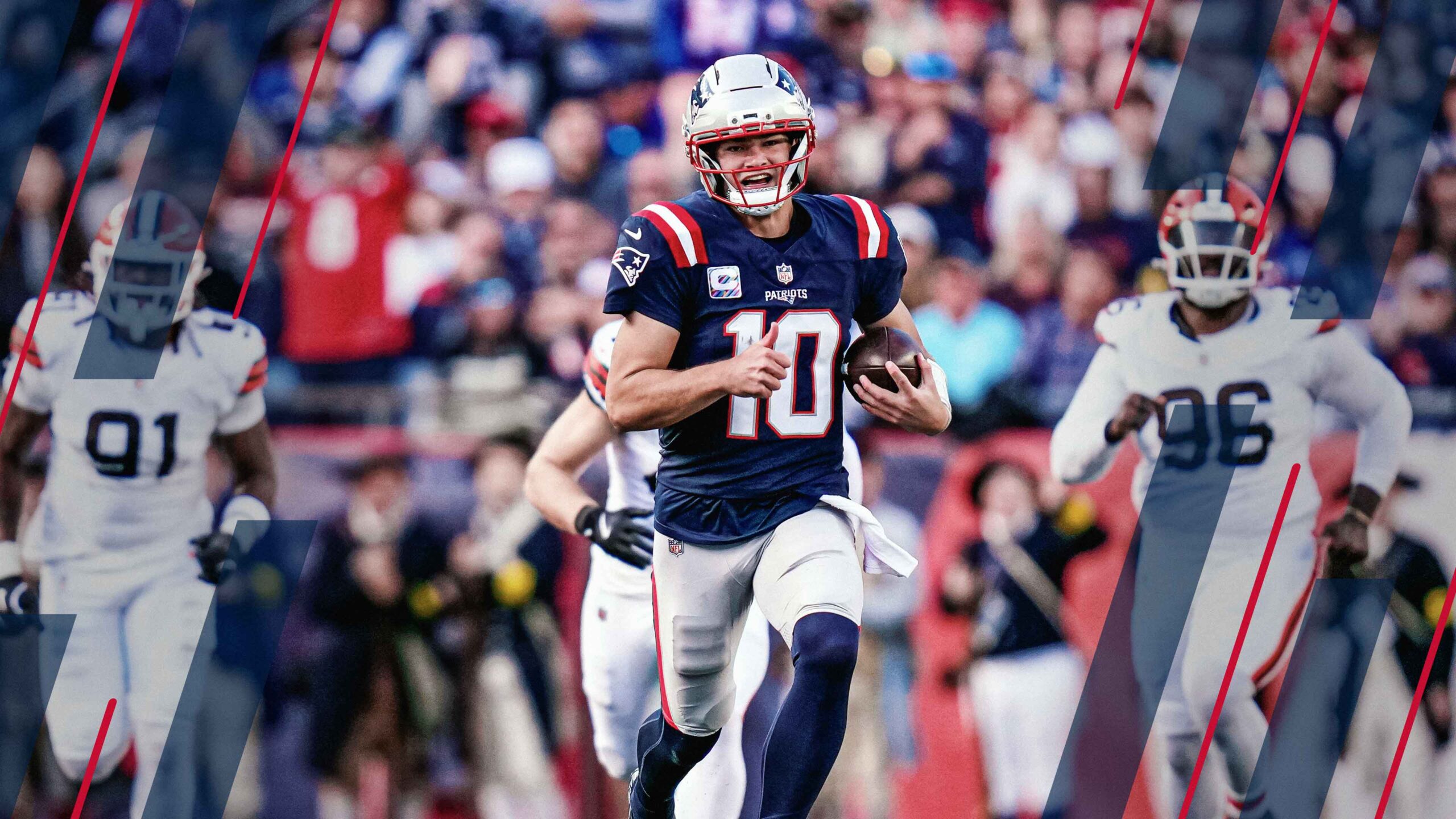
- The elite Patriots: No offense improved more from 2024 to 2025 than New England.
- 2026 NFL Draft season is here: Try the best-in-class PFF Mock Draft Simulator and learn about 2026's top prospects while trading and drafting for your favorite NFL team.
Estimated Reading Time:22 minutes
Offense wins games; defense wins championships. That’s the age-old adage across football, and one that rings true to this day. However, modern football values a high-powered offense more than ever, and NFL teams are continuously doing what they can to improve year-to-year on the offensive side of the ball.
Every year, some teams make significant jumps in EPA per play, one of the most effective ways of measuring offensive success in the NFL. Here are the most-improved offenses in EPA per play from 2024 to 2025.
1. New England Patriots
- 2024 EPA per play: -0.095
- 2025 EPA per play: 0.119
- Difference: +0.214
In most NFL seasons, there’s an offense that goes from zero to hero. Whether because of personnel improvements, a coaching change or just natural progression, there’s always one.
In the case of the New England Patriots, they checked all three boxes. The Patriots’ offense showed signs of life in 2024 with Drake Maye under center. The then-rookie quarterback’s ability to keep plays alive, as well as his natural arm talent, meant the Patriots had something to hold on to heading into 2025.
But, things weren’t as cut and dry as that. The Patriots fired first-year head coach Jerod Mayo and replaced him with former Titans head coach Mike Vrabel, who brought in former Patriots offensive coordinator Josh McDaniels. They invested heavily in the offense, too, signing veteran receiver Stefon Diggs (85.5 grade; 9th), as well as adding a heap of offensive talent in the 2025 NFL Draft, including first-round tackle Will Campbell (71.3 grade; 36th) and running back TreVeyon Henderson (68.4 grade; 42nd) with their first two picks.
That ecosystem contributed to the rise of the Patriots’ offense, but it was Maye — who completed a league-best 72.0% of his passes for 4394 passing yards, 31 touchdowns and eight interceptions in 2025, earning an 87.4 overall PFF grade in the process — who has been key to the Patriots' elevation. Maye has played like one of the league’s best quarterbacks in his second season, and the Patriots have gone from 26th in EPA per play in 2024 to second in EPA in 2025. Now, they’re one win away from the Super Bowl.
2. Dallas Cowboys
- 2024 EPA per play: -0.109
- 2025 EPA per play: 0.094
- Difference: +0.203
The Cowboys’ offensive struggles in 2024 were in large part due to losing Dak Prescott after eight games. Prescott suffered a hamstring injury and was shut down for the remainder of the season, with Cooper Rush stepping in under center. With Rush under center, the Cowboys were 30th in EPA per play and finished the season with a 7-10 record.
However, even with Prescott healthy, the Cowboys weren’t an offense to marvel at; they ranked 24th in EPA per play, and the veteran quarterback wasn’t his usual self. Prescott put the ball in harm's way more often, as his 4.7% turnover-worthy play rate was a career-high, while he was sacked 21 times in eight games — compiling a 67.9 overall PFF grade, the lowest of his career.
Though the Cowboys finished with a 7-9-1 record in 2025 and missed the playoffs for the second consecutive season, it wasn’t due to a lack of effort on the offense's part. Prescott was rejuvenated in 2025, completing 67.3% of his passes for 4,552 yards, 30 touchdowns and 10 interceptions, posting an 86.9 grade. This was the quarterback at his best, slinging the ball around the yard.
His 31 big-time throws were second in the NFL, and his connection with offseason addition receiver George Pickens (85.9 grade; 7th) was a sight to behold. Pickens had a career year with Prescott throwing the ball, catching 93 passes for 1,429 yards and nine touchdowns. On top of that, the ever-effective CeeDee Lamb (77.6 grade; 23rd) snagged 75 passes for 1,077 yards and three touchdowns in 14 games. The passing attack was on another level.
The Dallas run game with Javonte Williams (75.3 grade; 21st) in the backfield did its part, too. Williams rushed for 1,201 yards and 11 touchdowns, adding 26 rushes of 10 yards or more. Also, the work of the offensive line — a unit that registered a 71.5 PFF run-blocking grade — contributed to a career-high yardage for Williams. All of that equaled an offense that ranked fourth in EPA per play.
3. Chicago Bears
- 2024 EPA per play: -0.100
- 2025 EPA per play: 0.048
- Difference: +0.148
The Bears set themselves up for long-term success in 2024, drafting Caleb Williams with the first overall pick in the 2024 NFL Draft. Williams had an up-and-down rookie season, flashing some potential while struggling with deep ball accuracy and composure in the pocket, but the foundation for a guy who could grow into a superstar was there — even if the Bears were one of the worst offenses in the NFL in 2024, ranking 27th in EPA per play. They just needed a head coach who could piece the offense together. Enter Ben Johnson.
The former Lions offensive coordinator’s vision came to fruition early on, with the team adding Joe Thuney (77.9 grade; 7th), Jonah Jackson (72.3 grade; 18th), Drew Dalman (72.7 grade; 8th) and Ozzy Trapilo (72.5 grade; 33rd) throughout free agency and the draft to build one of the best offensive lines in football. The Bears' 72.3 PFF pass-blocking grade and 77.4 run-blocking grade were top-10 in the NFL, and the offense was first in rushing EPA per play.
Johnson helped elevate Williams in his second season, too. Williams completed 58.1% of his passes for 3,942 yards, 27 touchdowns and just seven interceptions, good for a 76.9 overall PFF grade. His 28 big-time throws were sixth among quarterbacks, too.
Importantly, Williams’ downfield accuracy improved. Williams completed just 20-of-75 deep attempts in 2024, but converted 31-of-73 tries in 2025, while his accuracy rate improved from 27.4% to 46.7%.
There’s still a lot of refinement left in Williams’ game, but the Bears are in an excellent spot with a plethora of young pass-catchers. Rookie tight end Colston Loveland (84.0 grade; 4th) looks like one of the best players in the draft, while receiver Luther Burden III (76.7 grade; 25th) came on strong in the latter half of his rookie season. His 2.69 yards per route run were the third-most among receivers.
The arrow is pointed directly upward after the Bears advanced to the divisional round in 2025.
4. New York Giants
- 2024 EPA per play: -0.128
- 2025 EPA per play: 0.010
- Difference: +0.138
Improvement wouldn’t be hard for the 2024 Giants offense. They ranked 30th in EPA per play en route to a 3-14 season, their worst since 2017, but entered the 2025 campaign with a little hope. The Giants traded back into the first round to draft Ole Miss quarterback Jaxson Dart with the 25th pick in the 2025 NFL Draft. Dart started the season behind veteran Russell Wilson (63.3 grade), but it only took four games for him to step into the limelight.
From there, Dart completed 63.7% of his passes for 2,272 yards, 15 touchdowns and five interceptions on a 68.4 overall PFF grade, and his 5.2% big-time throw rate was eighth among quarterbacks in the regular season. Dart showed real promise in Year 1, adding 487 rushing yards and nine rushing touchdowns. His athleticism and ability to extend plays with his arm talent and legs raise his ceiling, but there’ll be concerns about his swashbuckling play style that led to him being checked for concussions numerous times.
Despite that, Dart was able to carry an offense that didn’t feature a ton of talent. The Giants’ 2024 first-round pick, receiver Malik Nabers (71.9 grade), played in just four games before tearing his ACL, and rookie running back Cam Skattebo (80.5 grade; 13th) rushed for 410 yards and five touchdowns in eight games before suffering a season-ending leg injury of his own. However, receiver Wan’Dale Robinson (70.2 grade; 46th) stepped up, catching 92 passes for 1,014 yards and four touchdowns.
Altogether, the Giants finished the season 12th in EPA per play, a major improvement from a year ago. For the first time in forever, there’s a sense of hope in New York.
🏈 Draft Season 2026Prepare for the 2026 NFL Draft with PFF+
Your complete draft preparation toolkit
Mock Draft Simulator 2026 NFL Draft Big Board Big Board Builder NCAA Premium Stats Subscribe5. Los Angeles Rams
- 2024 EPA per play: 0.025
- 2025 EPA per play: 0.138
- Difference: +0.113
The Rams made one of the most difficult jumps in football from 2024 to 2025; they went from a good offense to a great offense, or more precisely, from the 15th-best offense in EPA per play in 2024 to first in 2025. The Rams have been an elite unit this year and are just one win away from a trip to the Super Bowl. They’re an all-around great team.
Los Angeles’ ascension in 2025 can be attributed to improvements across the board. The Rams have the best coach in the NFL, Sean McVay, calling the plays; they run the ball effectively; have a strong offensive line; can pass the ball; and possess great weapons at receiver.
It starts with the Matthew Stafford (93.5 grade; 1st) and Puka Nacua (96.3 grade; 1st) connection. Stafford completed 65.0% of his passes for 4,707 yards, 46 touchdowns and eight interceptions, and led the NFL with 47 big-time throws — 16 more than the next-closest quarterback. Meanwhile, Nacua caught a league-high 129 passes for 1,715 yards and 10 touchdowns. Having arguably the MVP and the Offensive Player of the Year routinely linking elevates any offense.
But, the addition of Davante Adams (85.2 grade; 12th) helped boost the passing game as well. Adams led the NFL in touchdown receptions, and his veteran savvy made him the best red-zone option in the league. As a team, the Rams recorded the second-most explosive plays (121) among offenses, and that group has played a vital role in their potential Super Bowl run.
6. Indianapolis Colts
- 2024 EPA per play: -0.052
- 2025 EPA per play: 0.056
- Difference: +0.108
The 2024 campaign was a mixed bag for Indianapolis. They finished the year with an 8-9 record and missed the playoffs for the fourth straight season, and there was little known about the future of their quarterback position. Former first-round pick Anthony Richardson struggled in his second season in the NFL, and the Colts ended the year 20th in EPA per play. They had their moments, but entered the offseason with a decision to make. And that choice ended with them starting free agent Daniel Jones (71.7 grade; 23rd).
The early returns were great; the Colts started the season with an 8-2 record and had the best offense in football. They were first in EPA per play by a wide margin, and Jonathan Taylor ripped apart every defense he faced. Even Jones, who hadn’t set the world alight in New York, looked rejuvenated. He completed 68.0% of his passes for 3,101 yards, 19 touchdowns and eight interceptions in 13 games before tearing his Achilles.
Had the Colts’ season not been derailed by injury, they’d likely be a lot higher on this list. At the same time, the wheels started to fall off the offense in Jones’ final few games of the season. Even as Indianapolis regressed to 12th in EPA per play, talks of an extension for Jones were imminent; the Colts believed he could pilot the unit. The stint with veteran Philip Rivers (51.0 grade) was fun, but as the Colts finished the year on a seven-game losing streak and missed the playoffs, they became a story of “What if?”
7. Jacksonville Jaguars
- 2024 EPA per play: -0.053
- 2025 EPA per play: 0.001
- Difference: +0.054
The Jaguars were one of the NFL’s big success stories this season. They went from a 4-13 team in 2024 to a 13-4 group and AFC South winners in 2025. That turnaround was centered around two things: The hiring of Liam Coen, the former Buccaneers offensive coordinator, and the revival of quarterback Trevor Lawrence (83.7 grade; 7th).
Lawrence had the best season of his career in 2025, completing 60.9% of his passes for 4,007 yards, a career-high 29 touchdowns and 12 interceptions, notching a career-high 84.7 overall PFF grade in the regular season. The former 2021 first overall pick kicked it up a gear in the back half of the season, compiling a 92.9 overall grade from Week 12 onward — the highest among quarterbacks.
After shouldering a large responsibility for the offense in previous regimes, Lawrence was allowed to hit the easy button more often with Coen building the offense, and the group reaped the benefits. His chemistry with receiver Parker Washington (79.9 grade; 18th) lifted the bunch, as did the acquisition of veteran Jakobi Meyers (72.1 grade; 38th) at the trade deadline. Meyers excelled in Jacksonville, catching 42 passes for 483 yards and three touchdowns in nine regular-season games. As a whole, the Jaguars had an explosive passing game with the second-most explosive passing plays in the NFL.
The Jacksonville offensive line still remains an area of improvement, but it took steps forward in 2025. Tackle Cole Van Lanen (79.3 grade; 12th) stepped in as the starter in Week 9 and played well, allowing one sack in 352 pass-blocking snaps, and zero sacks after moving to left tackle in Week 14. The run game was still a below-average unit, ranking 21st in EPA per play, but the Jaguars’ offense showed some real signs of life in 2025.
8. Pittsburgh Steelers
- 2024 EPA per play: -0.056
- 2025 EPA per play: -0.003
- Difference: +0.053
To call the Steelers’ offense a “good offense” in 2025 might be a stretch, but compared to 2024, it was a better unit.
After switching between Russell Wilson and Justin Fields in 2024 with limited success, the Steelers opted to take a chance on veteran Aaron Rodgers (68.0 grade; 29th) in 2025. Statistically, Rodgers’ numbers were solid enough. He completed 65.7% of his passes for 3,322 yards, 24 touchdowns and seven interceptions, adding 24 big-time throws while helping lead the Steelers to another winning season and their first AFC North crown since 2020. The season ended with a familiar sense of disappointment, as their loss to the Texans in the wild-card round signaled the end of the Mike Tomlin era in Pittsburgh.
However, the Steelers’ offense was still one of the most-improved units in EPA per play. Pittsburgh slotted 18th in EPA per play in 2025, even if it still fielded a below-average unit.
Rodgers provided a sense of stability for an offense that hadn’t had consistent quarterback play in several years. His play was mostly based on quick passes — his 2.56-second average time to throw was the fastest of his career — and taking advantage of isolated cornerbacks, which often benefitted trade acquisition D.K. Metcalf (71.1 grade; 41st). The former Seahawk caught 59 passes for 850 yards and six touchdowns, averaging a career-high 7.1 yards after the catch per reception.
Even the run game showed signs of growth with the one-two punch of Jaylen Warren (81.4 grade; 10th) and Kenneth Gainwell (73.7 grade; 25th) combining for 1,495 yards and 11 rushing touchdowns, adding 38 rushes of 10 yards or more.
The question now for the Steelers is what comes next. Pittsburgh could yet bring Rodgers back, but a new head coach might have designs of their own.
Explore PFF Premium Stats
Game grades, positional splits and high-level metrics for Rodgers' 2025 season.
Open Rodgers' Profile9. Seattle Seahawks
- 2024 EPA per play: -0.037
- 2025 EPA per play: 0.009
- Difference: +0.046
The Seahawks’ season to date has been nothing short of a marvel. The team won the NFC West for the first time since 2020, finishing with a 14-3 record and clinching the top seed in the NFC. Now, Seattle is just one win away from its first Super Bowl appearance in 11 years. The Seahawks’ defense, which ranked first in EPA per play allowed, led the charge, but the offense still held up its end of the bargain in 2025.
The 2024 offense wasn’t a bad unit. Quarterback Geno Smith played well while carrying an exorbitant load, but the team elected to move on from the aging Smith and take a chance on former Vikings starter Sam Darnold, who produced an excellent 82.7 overall PFF grade in 2024. The chance paid off.
Darnold thrived with Klint Kubiak as his coordinator, as the Seattle offense concluded the regular season 13th in EPA per play. Darnold completed 67.7% of his passes for 4,048 yards, 25 touchdowns and 14 interceptions in 2025, compiling a 79.3 overall grade. There were some ugly moments, but Darnold raised his big-time throw rate from 5.6% to 5.7% and dropped his turnover-worthy play rate from 3.6% to 3.4%, building chemistry with wideout Jaxon Smith-Njigba that fueled the entire image of the unit.
Smith-Njigba was electric in his third season in the NFL, leading the league with 1,793 yards on 113 receptions while snagging 10 touchdowns. His 3.62 yards per route run placed second in the NFL, behind Nacua, and was the third-best mark since 2023. Smith-Njigba won all over the field, but his connection with Darnold on deep passes helped the Seahawks to the ninth-most explosive plays in the NFL.
The rushing attack also contributed to the explosive nature of the Seattle offense. The one-two punch of Kenneth Walker (88.4 grade; 2nd) and Zach Charbonnet (86.7 grade; 3rd) was quietly excellent, and the Seahawks run game accumulated the third-most explosive rushes in the regular season. The Seahawks lost Charbonnet to a season-ending torn ACL against the 49ers in the divisional round, a devastating blow. Before that, Charbonnet had produced the fifth-most rushing touchdowns in the league.
10. Denver Broncos
- 2024 EPA per play: -0.030
- 2025 EPA per play: 0.009
- Difference: +0.039
All four of the teams featured in the NFL’s championship games rank among the most-improved offenses in EPA per play, with the Broncos picking up the final spot.
The 2024 campaign was a year of growth for the Broncos. They drafted Bo Nix with the 12th overall pick in the 2024 NFL Draft, and the former Oregon quarterback showed early promise in his rookie season, securing a 77.1 overall PFF grade in 2024 — 17th among quarterbacks. Nix was a little rough around the edges, as was the entire offense. The unit ended 17th in EPA per play as the Broncos finished with a 10-7 record and made the playoffs for the first time since 2015.
Their improvement in 2025 was slight, but still noticeable. Nix took a step forward behind the best pass-blocking offensive line in the NFL — Denver’s 78.8 PFF pass-blocking grade led the league — completing 63.4% of his passes for 3,931 yards, 25 touchdowns and 11 interceptions on a 77.1 overall grade. He was a threat on the ground, too, adding 356 rushing yards and five rushing touchdowns. Though the all-around Nix experience often felt underwhelming, the fact that the Broncos’ offense concluded the year 14th in EPA per play, and 10th from Week 11 onward, shows that there’s progress.
The Broncos’ rushing attack looked explosive early in the season until J.K. Dobbins (76.8 grade; 19th) suffered a season-ending foot injury. From then on, rookie RJ Harvey (69.8 grade; 38th) added some punch to the passing game, but didn’t always find his feet as a rusher.
Regardless, the Broncos’ offense continually found a way to do enough, as Denver went 14-3 and finished atop the AFC. Now, the team will have to find a way to do enough without Nix, who suffered a season-ending ankle injury in the final moments of the divisional round win against the Bills.