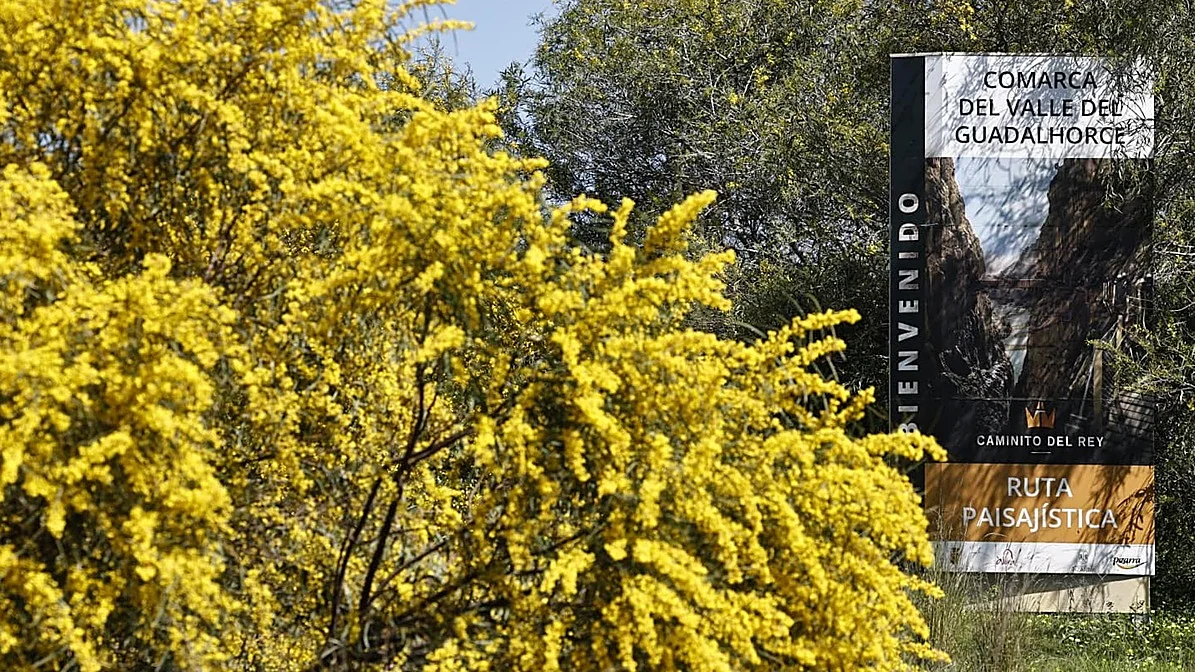
The Guadalhorce Valley has been bathed in yellow hues, synonymous of early spring
Ignacio Lillo y Salvador Salas
Málaga
Jueves, 16 de abril 2026, 14:50
Heavy rains from last winter’s series of storms, followed by this spring’s downpours, have produced striking blossoms within inland areas of Malaga.
Shades of yellow, indicative of spring, cascade across the Guadalhorce Valley - but why yellow?
“In evolution, flowers have become specialised according to their method of pollination” explained Enrique Salvo, a botanist, lecturer at the faculty of biology and director of the chair of climate at the University of Malaga (UMA). “A significant proportion of species have a pollination system in which an insect generally acts as the transmission agent.”
Glebionis coronaria
Although it is scientifically recognised as Glebionis coronaria, it is often referred to by other names such as chrysanthemum or crown daisy..
Acacia dealbata
Acacia mimosa, common mimosa or Australian acacia. These are introduced and naturalised trees. There are two groups: those originating from Africa, with large thorns, and those originating from Australia, such as this one, which are thornless. This plant is native to the Perth region, Malaga’s climate twin..
Acacia saligna
Blue-leaved acacia or blue acacia. This plant is also native to the Perth region of Australia.
Wild mustard field
Although the expanses of yellow flowers in the province are mostly ‘sheep’s sorrel’ or Bermuda buttercup (Oxalis pes-caprae), the photo shows a meadow of yellow cruciferous plants (wild mustard).
AUX STEP FOR JS
These insects have a visual system that can identify where they will consume the nectar and pollen grains, which are highly nutritious and therefore attract these species.
“The main agent for pollination is bees, but ants and butterflies are also key to this process,” adds the botanist.
Therefore, colour is essential to allow the insects most active at this time of year to identify the flowers and seek them out. At this stage, from as early as December and January, the first colours to appear are white and yellow, this can be seen in almond trees and marigolds.
1 /
Colours and seasons
And which insects see these colours? As well as bees , there are beetles “which have hard mandibles (a mouthpart used for biting), devour plants and become coated in pollen grains that will in turn be transmitted to other plants”.
This phase continues throughout the spring, as the days grow longer and the temperature rises. With the arrival of summer, the colours change too, red or even purple flowers begin to appear such as poppies, roses and violets, among others.
The flowers tend to disappear as summer progresses to become drier and hotter, this is due to the large amount of water and energy plants need to produce them. They are then replaced almost exclusively by plants such as grasses, wheat, barley and oats.
Finally, as the days begin to shorten once approaching autumn, that is when the intense blues and darker purples appear. “These flowers are characterised by their unpleasant odours, which attract flies in particular…” explained Salvo.