2 min read
Curiosity Blog, Sols 4988-4994: More New Tricks for an Old DogMars Science Laboratory Mission Team Members
Sep 03, 2026 ArticleWritten by Michelle Minitti, MAHLI Deputy Principal Investigator
Earth planning date: Friday, Aug. 21, 2026
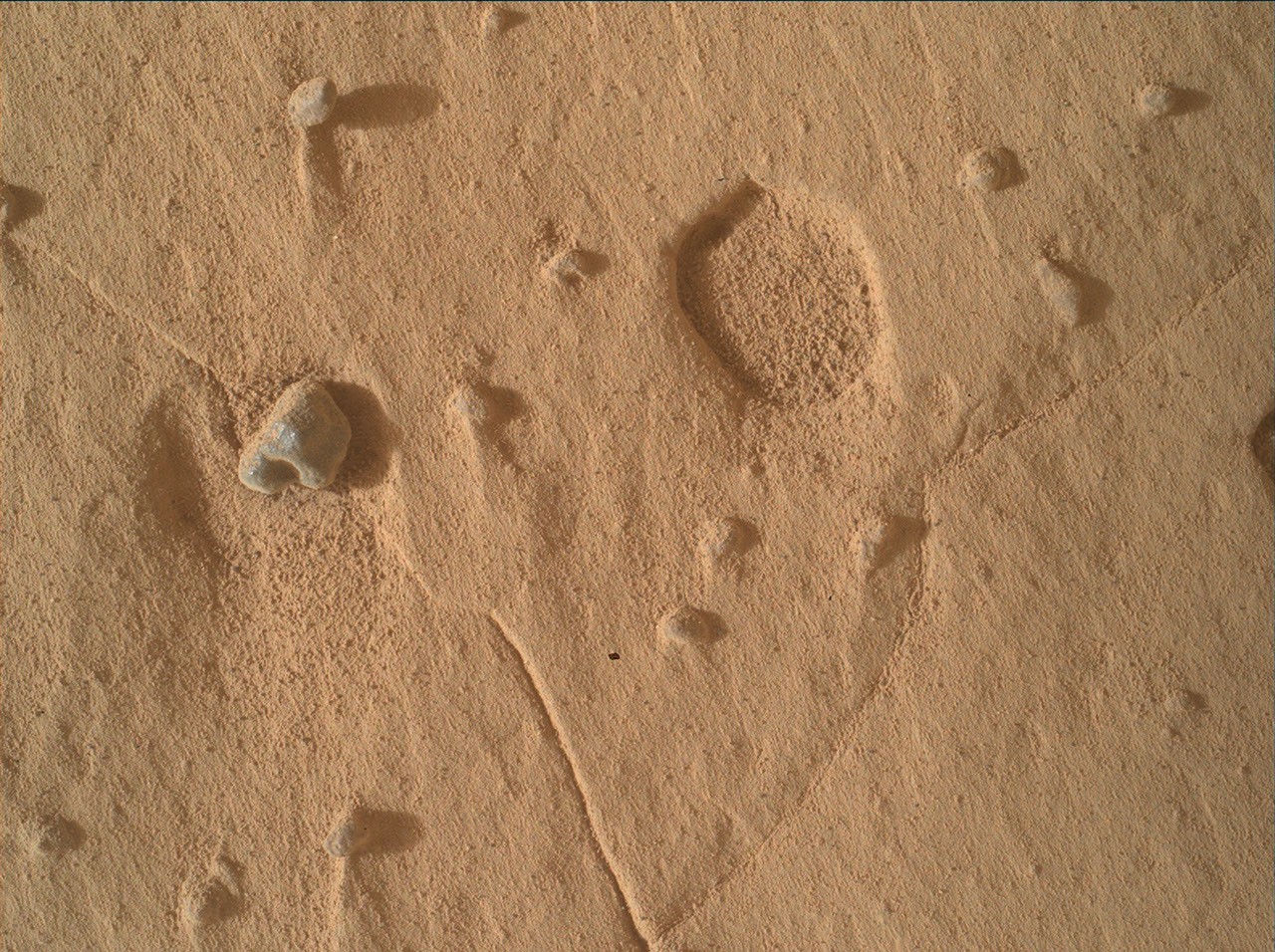
After Curiosity’s 14 years on the surface, Mars continues to surprise. Both of our workspaces this week contained features unlike quite anything we have seen in the past — broad, shallow pits (like the one in the image above) dotted across the bedrock. Pits are not uncommon — when resistant nodules or pebbles weather out of their host rock, they leave behind a void. But the pits of this week were much broader and shallower than past features and were not accompanied by obvious objects that were once in the pits. MAHLI and Mastcam were particularly interested in these features, acquiring stereo mosaics of them and tightly overlapping image sets that can be turned into a digital elevation model of their structure. They were a welcome new puzzle into the processes that have affected this particular section of rocks in the stratigraphy of Mount Sharp.
The “typical” bedrock was anything but boring. Mastcam imaged and ChemCam rastered across complex packages of layers with changes in texture and structure over short vertical differences. These might be evidence of changes in depositional conditions captured in close proximity to one another. ChemCam, MAHLI, and APXS analyzed gray, rough, resistant layers that differed from the host bedrock, likely indicative of a different chemistry. ChemCam studied one of the gray float rocks (like the small, loose pebble in the image above) that have been scattered variably across our workspaces, to try to understand the origins of these stones. Farther afield, the “Cordillera” butte continued to garner attention, with a comprehensive Mastcam mosaic covering its entire visible face, and more focused ChemCam RMI mosaics aimed at specific horizons. The “Tolhuaca” and “Potosí” buttes, which are farther south down “Valle Grande,” were also targets, with ChemCam looking for potential crossbedding and assessing the mineralogy of dark material capping Potosí.
Our environmental science team members were just as busy, planning REMS, Mastcam, and Navcam activities at a higher-than-usual cadence to monitor a potential regional dust storm. They found by the end of the week, however, that the storm appeared to be dissipating.
We managed to accomplish all of this despite having lost one of our planning days due to a lost downlink.
Want to read more posts from the Curiosity team?
Want to learn more about Curiosity’s science instruments?
Share
Details
Last Updated Sep 03, 2026Related Terms
Explore More
3 min readCuriosity Blog, Sols 4982–4987: Back to Our Regularly Scheduled Programming
Article 2 weeks ago 6 min readCuriosity Blog, Sols 4975-4981: Happy 14th Landing Anniversary
Article 2 weeks ago 3 min readCuriosity Blog, Sols 4968-4974: Rock Climbing Towards the Discontinuity
Article 3 weeks ago Keep ExploringDiscover More Topics From NASA
Mars
Mars is the fourth planet from the Sun, and the seventh largest. It’s the only planet we know of inhabited…
All Mars Resources
Explore this collection of Mars images, videos, resources, PDFs, and toolkits. Discover valuable content designed to inform, educate, and inspire,…
Rover Basics
Each robotic explorer sent to the Red Planet has its own unique capabilities driven by science. Many attributes of a…
Mars Exploration: Science Goals
The key to understanding the past, present or future potential for life on Mars can be found in NASA’s four…