Curiosity Navigation
Curiosity Home
Mission Overview
Where is Curiosity?
Mission Updates
Science
Overview
Instruments
Highlights
Exploration Goals
News and Features
Multimedia
Curiosity Raw Images
Images
Videos
Audio
Mosaics
More Resources
Mars Missions
Mars Perseverance Rover
Mars Curiosity Rover
Mars Reconnaissance Orbiter
Mars Odyssey
More Mars Missions
Mars Home
2 min read
Curiosity Blog, Sols 5002-5009: Tough Planning To Learn More About Wind-Blown Sediments
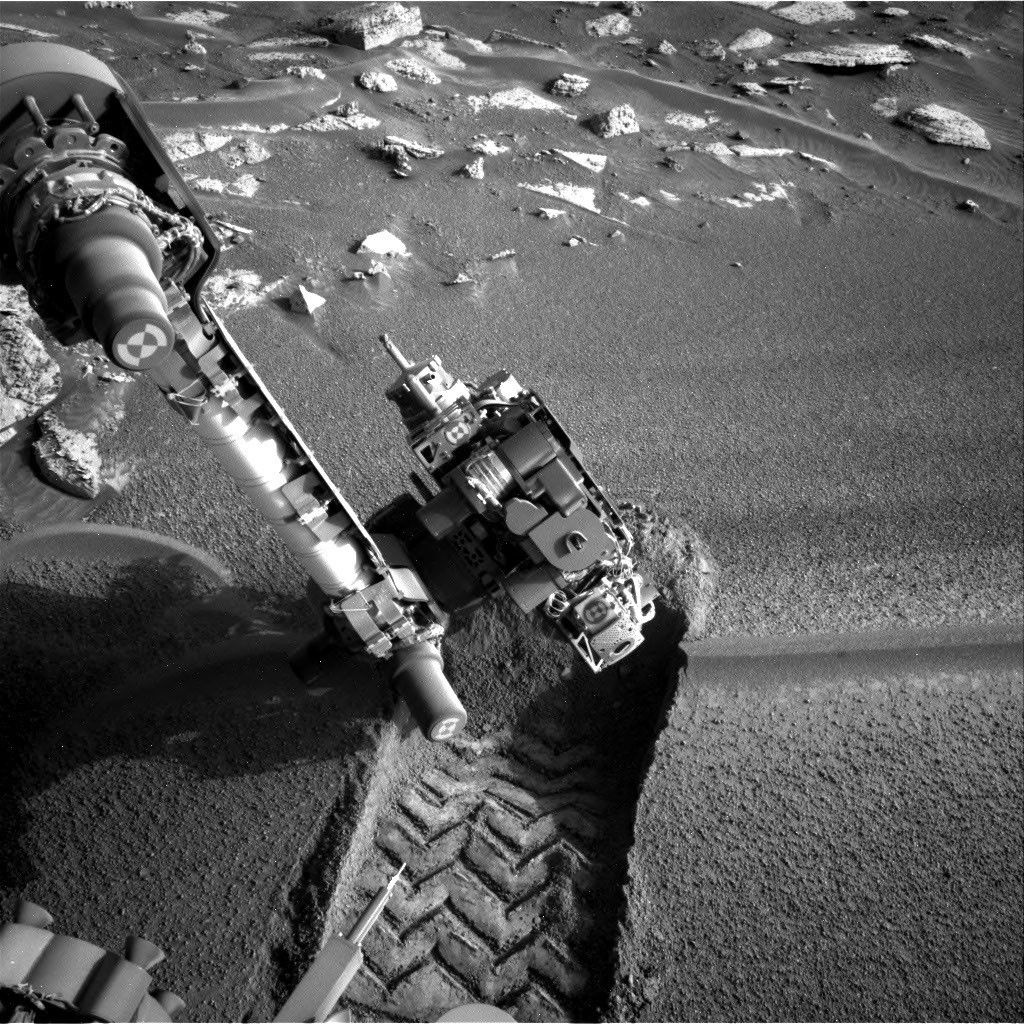
NASA’s Mars rover Curiosity acquired this image of arm operations at “Chocolatal” using its Right Navigation Camera on Sept. 2, 2026 — Sol 5003, or Martian day 5,003 of the Mars Science Laboratory mission — at 19:53:17 UTC.
NASA/JPL-Caltech
Written by Benjamin Tutolo, Professor, University of Calgary
Earth planning date: Friday, Sept. 4, 2026
Curiosity has marked several huge milestones (14 years on Mars; 5,000 sols on Mars; 1 kilometer of elevation gain since landing) over the past several weeks, and the team has duly celebrated these remarkable achievements. These celebrations punctuate the rover’s otherwise very busy and data-filled exploration of Mount Sharp, of which this week was another in a long succession of discoveries.
The team planned instrument activities that involved unstowing the arm on Sols 5003 and 5004 to continue investigations of the wind-formed long, narrow large ripple “Chocolatal” (see last week’s blog: “Curiosity Blog, Sols 4995-5001: 5,000 (Martian) Days on Mars”), followed by a short drive on sol 5004.
Planning for the arm activities on Monday was complex, with APXS chemical analyses and MAHLI imaging of targets within the wheel scuff and on top of the undisturbed ripple (seen in the image above), and a MAHLI “Dog’s Eye” image mosaic acquired on the way of the scuff. The team worked hard developing the plan for these arm activities this Monday due to the particular complexity of the MAHLI “Dog’s Eye” mosaic image. While the MAHLI instrument is frequently used to image features on the Martian surface from above, Dog’s Eye mosaics are reserved for targets we want to see edge-on, similar to how a dog close to ground may view a surface. In this instance, the team was interested in looking at potential layers visible on the sides of the sand scuff.
The end-of-week plan for activities over the Labor Day weekend in the United States and here in Canada includes APXS, MAHLI, and ChemCam analyses of the interesting gray stone that caught the team’s collective eye. Interestingly, the bedrock surrounding this stone appears to contain large nodules, which we have not seen for some time. The Mastcam instrument will be pointed back toward the Chocolatal area, and ChemCam will image and collect a couple of other LIBS observations on several interesting patches of the local geology.
Want to read more posts from the Curiosity team?
Visit Mission Updates
Want to learn more about Curiosity’s science instruments?
Visit the Science Instruments page
NASA’s Curiosity rover at the base of Mount Sharp
NASA/JPL-Caltech/MSSS
Share
Details
Last Updated
Sep 16, 2026
Related Terms
Blogs
Explore More
4 min read
Curiosity Blog, Sols 4995-5001: 5,000 (Martian) Days on Mars
Article
1 week ago
2 min read
Curiosity Blog, Sols 4988-4994: More New Tricks for an Old Dog
Article
2 weeks ago
3 min read
Curiosity Blog, Sols 4982–4987: Back to Our Regularly Scheduled Programming
Article
3 weeks ago
Keep Exploring
Discover More Topics From NASA
Mars
Mars is the fourth planet from the Sun, and the seventh largest. It’s the only planet we know of inhabited…
All Mars Resources
Explore this collection of Mars images, videos, resources, PDFs, and toolkits. Discover valuable content designed to inform, educate, and inspire,…
Rover Basics
Each robotic explorer sent to the Red Planet has its own unique capabilities driven by science. Many attributes of a…
Mars Exploration: Science Goals
The key to understanding the past, present or future potential for life on Mars can be found in NASA’s four…
Curiosity Home
Mission Overview
Where is Curiosity?
Mission Updates
Science
Overview
Instruments
Highlights
Exploration Goals
News and Features
Multimedia
Curiosity Raw Images
Images
Videos
Audio
Mosaics
More Resources
Mars Missions
Mars Perseverance Rover
Mars Curiosity Rover
Mars Reconnaissance Orbiter
Mars Odyssey
More Mars Missions
Mars Home
2 min read
Curiosity Blog, Sols 5002-5009: Tough Planning To Learn More About Wind-Blown Sediments
NASA’s Mars rover Curiosity acquired this image of arm operations at “Chocolatal” using its Right Navigation Camera on Sept. 2, 2026 — Sol 5003, or Martian day 5,003 of the Mars Science Laboratory mission — at 19:53:17 UTC.
NASA/JPL-Caltech
Written by Benjamin Tutolo, Professor, University of Calgary
Earth planning date: Friday, Sept. 4, 2026
Curiosity has marked several huge milestones (14 years on Mars; 5,000 sols on Mars; 1 kilometer of elevation gain since landing) over the past several weeks, and the team has duly celebrated these remarkable achievements. These celebrations punctuate the rover’s otherwise very busy and data-filled exploration of Mount Sharp, of which this week was another in a long succession of discoveries.
The team planned instrument activities that involved unstowing the arm on Sols 5003 and 5004 to continue investigations of the wind-formed long, narrow large ripple “Chocolatal” (see last week’s blog: “Curiosity Blog, Sols 4995-5001: 5,000 (Martian) Days on Mars”), followed by a short drive on sol 5004.
Planning for the arm activities on Monday was complex, with APXS chemical analyses and MAHLI imaging of targets within the wheel scuff and on top of the undisturbed ripple (seen in the image above), and a MAHLI “Dog’s Eye” image mosaic acquired on the way of the scuff. The team worked hard developing the plan for these arm activities this Monday due to the particular complexity of the MAHLI “Dog’s Eye” mosaic image. While the MAHLI instrument is frequently used to image features on the Martian surface from above, Dog’s Eye mosaics are reserved for targets we want to see edge-on, similar to how a dog close to ground may view a surface. In this instance, the team was interested in looking at potential layers visible on the sides of the sand scuff.
The end-of-week plan for activities over the Labor Day weekend in the United States and here in Canada includes APXS, MAHLI, and ChemCam analyses of the interesting gray stone that caught the team’s collective eye. Interestingly, the bedrock surrounding this stone appears to contain large nodules, which we have not seen for some time. The Mastcam instrument will be pointed back toward the Chocolatal area, and ChemCam will image and collect a couple of other LIBS observations on several interesting patches of the local geology.
Want to read more posts from the Curiosity team?
Visit Mission Updates
Want to learn more about Curiosity’s science instruments?
Visit the Science Instruments page
NASA’s Curiosity rover at the base of Mount Sharp
NASA/JPL-Caltech/MSSS
Share
Details
Last Updated
Sep 16, 2026
Related Terms
Blogs
Explore More
4 min read
Curiosity Blog, Sols 4995-5001: 5,000 (Martian) Days on Mars
Article
1 week ago
2 min read
Curiosity Blog, Sols 4988-4994: More New Tricks for an Old Dog
Article
2 weeks ago
3 min read
Curiosity Blog, Sols 4982–4987: Back to Our Regularly Scheduled Programming
Article
3 weeks ago
Keep Exploring
Discover More Topics From NASA
Mars
Mars is the fourth planet from the Sun, and the seventh largest. It’s the only planet we know of inhabited…
All Mars Resources
Explore this collection of Mars images, videos, resources, PDFs, and toolkits. Discover valuable content designed to inform, educate, and inspire,…
Rover Basics
Each robotic explorer sent to the Red Planet has its own unique capabilities driven by science. Many attributes of a…
Mars Exploration: Science Goals
The key to understanding the past, present or future potential for life on Mars can be found in NASA’s four…