Downloads
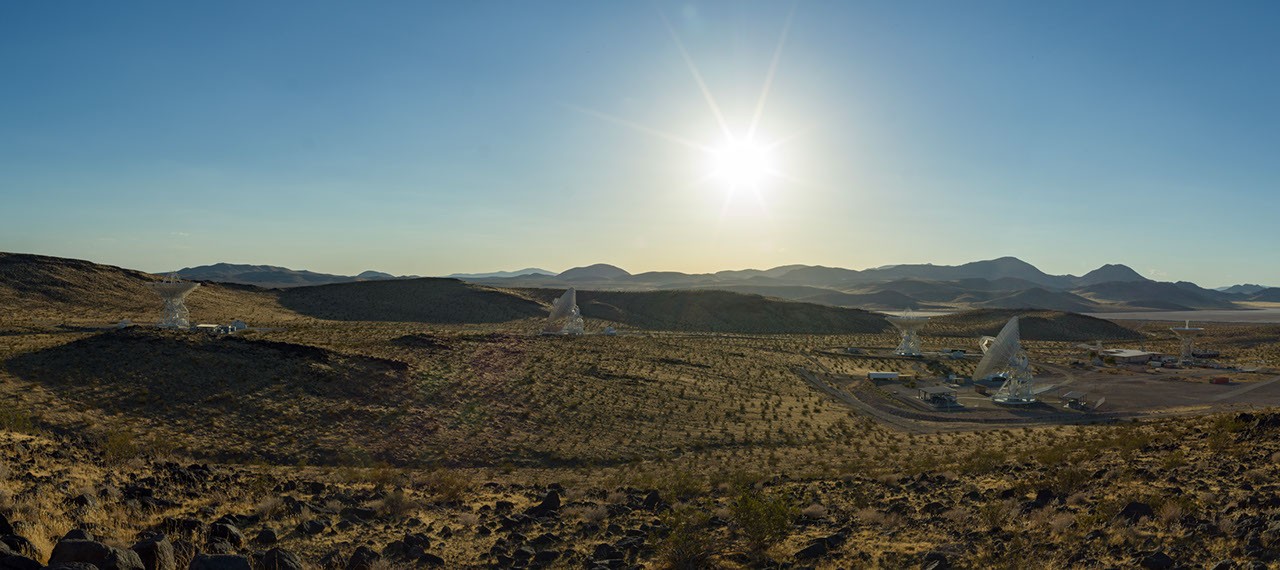
Panorama Showcasing the 34-Meter Antennas of the DSN’s Goldstone Complex
JPEG (853.58 KB)
Description
Five antennas soak in the summer sun at the Deep Space Network’s Goldstone complex near Barstow, California, in August 2026. The recently completed Deep Space Station 23, a 34-meter (114-foot) beam-waveguide antenna, can be seen to the right of the frame in the foreground. The other three 34-meter antennas are, from left, DSS-26, DSS-25, and DSS-24. At farthest right is a smaller 26-meter (85-foot) antenna, the retired “Apollo Antenna” that was built in 1967 as part of the Manned Space Flight Network and earned its nickname for providing tracking for the Apollo Program.
NASA leadership and personnel as well as dignitaries gathered at the complete DSS-23 antenna for a ceremonial ribbon-cutting on Aug. 25, 2026. It’s the latest antenna to be added as part of the Deep Space Network’s Aperture Enhancement Project, which began in 2009 to upgrade and expand the network by adding six new 34-meter multifrequency beam-waveguide antennas. These versatile Deep Space Network (DSN) dishes can enhance many missions operating over different radio frequencies.
The DSN allows missions to track, send commands to, and receive scientific data from faraway spacecraft. It is managed by NASA’s Jet Propulsion Laboratory in Southern California, a division of Caltech, for the agency’s Space Communications and Navigation (SCaN) Program, which is located at NASA Headquarters within the Research and Technology Mission Directorate.
For more information about the DSN, visit:
https://www.nasa.gov/communicating-with-missions/dsn/
Keep ExploringDiscover More Topics From Photojournal
Photojournal
Search Photojournal
Photojournal’s Latest Content
Feedback